



Container 4.0: Revolutionizing Maritime Food Transport with Smart Sensors
Globally, roughly one‑third of all food produced never reaches consumers because it spoils during transit. The Food & Agriculture Organization of the United Nations estimates this loss at 1.3 billion metric tons. In developing nations, up to 40 % of perishable goods decay while en route.
Factors such as uneven harvesting conditions, delays before cooling, and temperature fluctuations inside refrigerated containers or trucks contribute to this quality loss.
The silver lining is that enhanced monitoring not only mitigates these issues but also unlocks new possibilities for transport management and storage. A consortium of 22 industry and research partners, funded by the German Federal Ministry of Education and Research (BMBF), is working to make shipping containers truly “smart.” Central to this effort is the development and field‑testing of reliable sensor technologies. I brought Bosch IoT middleware to the project, and this article shares our insights.
Solution Approach & Implementation: Enabling Ship‑to‑Shore Communication
From the outset, we identified several technical challenges that had to be overcome to create autonomous, smart containers. Collaborating with DOLE, we conducted three pilot tests focused on monitoring and controlling the ripening of bananas. The bananas were packed in Costa Rica, with some boxes equipped with wireless sensors. Once 20 pallets were loaded into the container, remote monitoring began. The cargo was trucked to port (≈4 hours), then spent two full weeks sailing to Antwerp, during which we remotely adjusted set‑point temperatures and ventilation rates. After arrival, the container was trucked from Antwerp to Hamburg in a single day.
Historically, container‑to‑land communication relied on 3G when the unit was on a truck, or satellite when at sea—both providing limited bandwidth. To overcome this, we engineered a Freight Supervision Unit (FSU) that interfaces an internal sensor network with external communication channels. The FSU also serves as a flexible platform for deploying customized shelf‑life models or decision‑support tools via remote software updates.
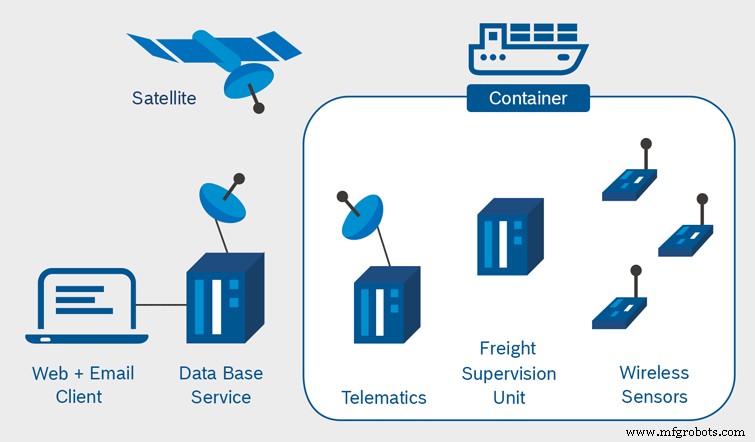
IoT Application: Temperature and Ethylene Sensing
Using Bosch.IO’s Java platform—built on an OSGi framework and the Jamaica Virtual Machine from AICAS—we adapted the system for our target environment. Multiple test runs on the Puerto Rico‑to‑Hamburg route confirmed the system’s robustness.
Accurate shelf‑life estimation for bananas requires temperature data from 10–20 sensors distributed across packing boxes and pallets. Data must traverse multiple hops through airtight, humidity‑proof sensors to ensure reliable communication. At the optimal 11 °C, conditions are deemed acceptable; deviations trigger remote interventions and alerts sent directly to the backend and customers such as DOLE.
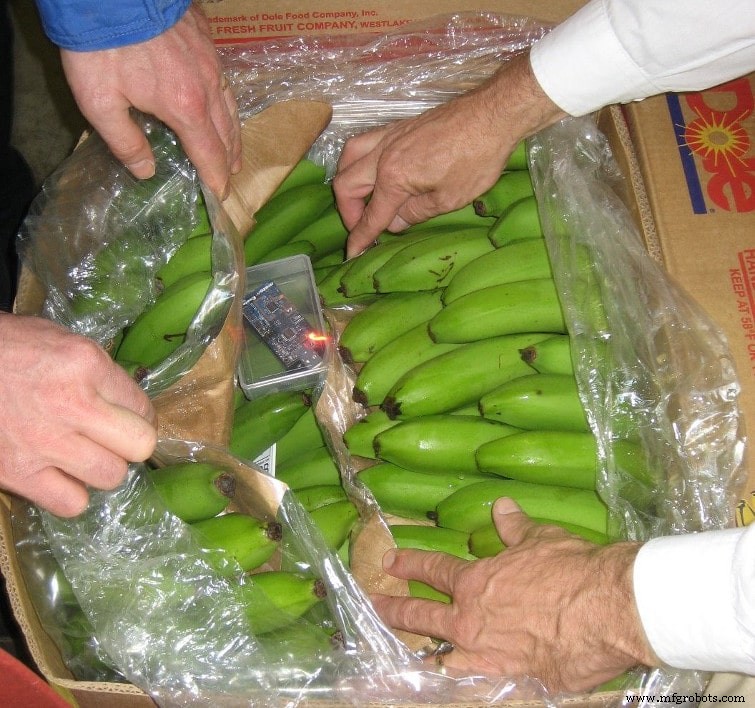
Sensor data are transmitted via satellite daily. Initial estimates of green life, respiration heat, and cooling efficiency are computed after three days. If corrections are needed, new parameters are uploaded immediately—especially when goods approach unsafe conditions. Once a mobile network is available near the port, full data can be accessed through a web interface.
Benefits of Smart Containers
Customers now react swiftly to quality issues, ordering replacements promptly. Previously, spoilage was often only discovered upon arrival at port. With sensor‑enabled logistics, losses drop from up to 30 % to roughly 20 %. Continuous monitoring enhances product quality, reduces waste, and introduces agility into supply chains.
Sensors Adding Value to IoT Applications
Ethylene—a colorless, flammable hydrocarbon—is also a key plant hormone that accelerates fruit ripening. By measuring ethylene concentration, we can gauge ripeness levels in real time, as ripening fruits emit increasing amounts of ethylene.
Integrating sensors into shipping containers offers precise location tracking and condition monitoring. Future projects aim to extend this visibility from loading to supermarket delivery, partnering with port operators and logistics providers. The vision is a fully connected supply chain where goods become active IoT nodes, relaying data across systems without manual intervention.
Industry 4.0’s digitalization is now extending to Logistics 4.0, unlocking unprecedented opportunities across the maritime value chain.
For more on food loss statistics, visit the FAO website. Learn about Bosch IoT solutions at Bosch IoT.
Industrial Technology
- How 5G is Transforming Smart Factories into High‑Performance Powerhouses
- How Smart IoT is Transforming the Oil & Gas Industry
- Why LIDAR is Transforming Smart City Traffic Management
- Vespel® Polyimide: The Aerospace Material of Choice
- Bridging the Smart Home Skills Gap: Why Britain Lags Behind Europe
- Transforming Container Shipping: A Digital Strategy for Smart, Efficient Operations
- Creating a COVID-Free Smart Building: How Technology Protects Occupants – Part 1
- How Smart Manufacturing Software Is Shaping the Future of Production
- Maximizing ROI in Smart Manufacturing: Payback & Data-Driven Success
- Choosing the Perfect Smart Meter: Expert Tips for Smart Home Owners