



Eclipse Ditto 1.0 – The Device‑as‑a‑Service Platform for Digital Twin Development
Thomas Jäckle
Thomas Jäckle is a seasoned Software Developer who joined Bosch in 2010. Since 2015 he has led the Bosch IoT Things cloud service, and from 2017 he serves as Committer and Project Lead for Eclipse Ditto. A lifelong advocate of software craftsmanship, Thomas is driven by continuous learning and holds a Bachelor’s degree in Computer Science and a Master’s in Application Architecture from Hochschule Furtwangen University, Germany.
A digital twin is the virtual representation of a real‑world entity or system, encapsulating its data model and processes. By mirroring physical objects—such as wind turbines—digital twins enable remote control, predictive maintenance, and advanced analytics. Gartner projects that two‑thirds of enterprises with IoT deployments will introduce digital twins into production.
Digital twins simplify IoT complexity by providing a consistent, interoperable view of physical assets, which accelerates the development of data analysis, simulation, augmented reality, and maintenance services.
When we launched Eclipse Ditto, our mission was to streamline twin creation. We set out to build a flexible framework that manages core data interactions between the physical and virtual worlds, allowing domain experts to focus on twin logic rather than connectivity plumbing.

Eclipse Ditto: A framework for building the bridge between devices and their digital twins.
After extensive requirements gathering, coding, testing, and community feedback, we are thrilled to announce the 1.0 release of Eclipse Ditto. We see Ditto as a device‑as‑a‑service solution that empowers digital twin builders.
Ditto – Device-as-a-Service
Ditto delivers a unified view across diverse devices. At its core lies the Thing data model, representing a physical device. The Thing is exposed through a RESTful API, giving twin experts a single entry point to interact with hardware. Ditto’s services provide:
- Persistent storage and change notifications for device state
- Advanced search across millions of Things
- Payload transformation to a lightweight JSON schema
- Fine‑grained authorization policies via OAuth 2.0 / OpenID Connect
- Live channels for real‑time device interaction
Device Persistence & Notifications
Ditto records the latest value of each device in a database, enabling twins to query the current state. Applications can subscribe to change events and trigger actions when thresholds are crossed.
Search
Ditto offers powerful search capabilities, allowing queries such as: “List all temperature sensors reporting >20°C” or “Retrieve all twins in a specific location.” These features support dashboards and analytics for large fleets.
Payload Transformations
Ditto is device‑agnostic. It normalizes data from legacy or newly designed devices into a consistent JSON model, ensuring a uniform interface regardless of underlying protocols.
Authorization
Access to Ditto APIs is governed by user‑defined policies, safeguarding device data. Clients authenticate using OAuth 2.0 and OpenID Connect, and permissions can be scoped to specific Thing attributes.
Live Channel
The live channel enables direct command and response flows to devices. Ditto routes requests through the connectivity layer (e.g., Eclipse Hono, MQTT, Azure IoT) while enforcing authorization checks.
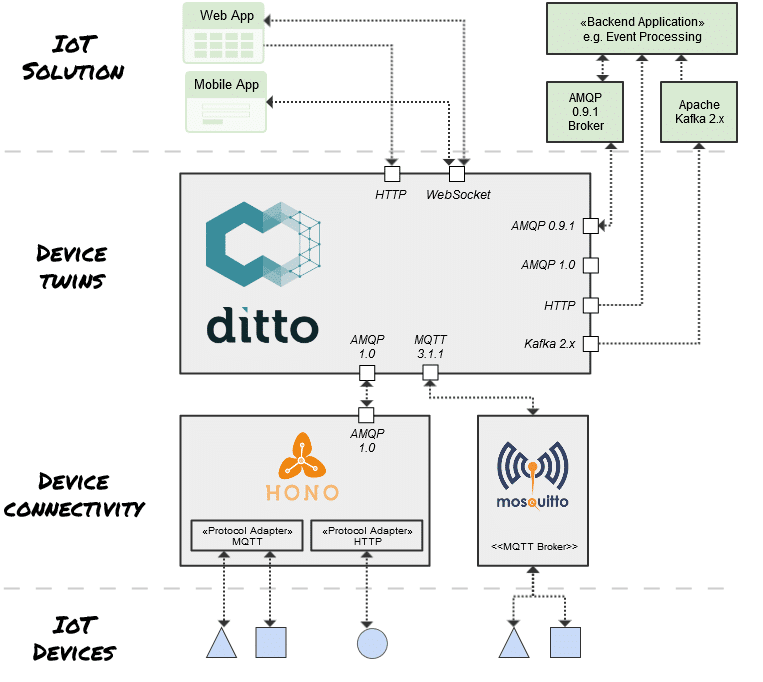
Ditto does not embed device drivers; instead, it exposes APIs for web, mobile, and backend services to interact with devices through the live channel.
Ditto 1.0 – Ready for Production
The 1.0 milestone marks a stable, mature API set, a vetted codebase, and a clear semantic‑versioning strategy. Eclipse Foundation’s approval ensures all intellectual property concerns are resolved.
Ditto now scales horizontally to support millions of Things in a clustered environment, making it production‑ready for large‑scale IoT deployments.
Community & Ecosystem
We aim for Ditto to become the industry standard for digital twins. As an open‑source project under the Eclipse IoT working group, Ditto fosters a vendor‑neutral ecosystem.
Companies such as Aloxy, Othermo, and Kiwigrid are already integrating Ditto into their IoT platforms. Aloxy, an Industrial IoT startup, leverages Ditto to offer a unified API for monitoring and interacting with industrial assets.
Join the Community
We invite developers to explore the Ditto sandbox, experiment with sample projects, and contribute via GitHub. If you adopt Ditto, share your experience—we're building a vibrant digital twin community together.
Industrial Technology
- How Digital Twins Revolutionize Manufacturing: Benefits, Applications, and ROI
- Eclipse Hono Now Supports Apache Kafka for Seamless Device Messaging
- How Machine Builders Can Boost Revenue by 20% with Digital Services
- How to Convince Your Manager to Invest in Digital Marketing for Manufacturers
- Empowering Small Manufacturers Through Digital Manufacturing
- Top 3 Digital Manufacturing Trends Shaping 2020
- Why Digital Cash Transforms Supply‑Chain Financing for SMBs
- B&R Launches Advanced Simulation Tool to Accelerate Digital Twin Development
- Harnessing Digital Twins: The Cornerstone of Electricity Sector 4.0
- Harnessing Digital Twin Technology to Boost Manufacturing Efficiency and Cost Savings