



Airbus Unveils the Factory of the Future: Smart Production and Advanced Robotics
Airbus is redefining aircraft manufacturing with its “Factory of the Future” initiative, integrating cutting‑edge robotics, intelligent power tools, and real‑time data analytics. The project leverages the Track & Trace testbed from the Industrial Internet Consortium to deliver safer, more efficient production of today’s complex aircraft.
What Does the Airbus Factory of the Future Project Entail?
With over 8,000 aircraft currently in operation and 15,276 orders logged as of January 31, 2015, Airbus must continuously evolve its manufacturing lines—each lasting more than a decade—to stay competitive. The Factory of the Future focuses on robotic exoskeletons, cobots, advanced ALM technology, virtual plateaus, and full shop‑floor digitization. These innovations are designed to streamline processes, reduce cycle times, and maintain the highest safety and quality standards.
Focusing on Smart Production and Advanced Robotics
My primary responsibility lies in developing a “smart workshop” that equips production floors with connected, intelligent tools. By embedding digital intelligence into handheld devices and wearable systems, we aim to eliminate human error, reduce downtime, and provide operators with instant feedback and guidance.
A Concrete Example: Streamlining Aircraft Assembly
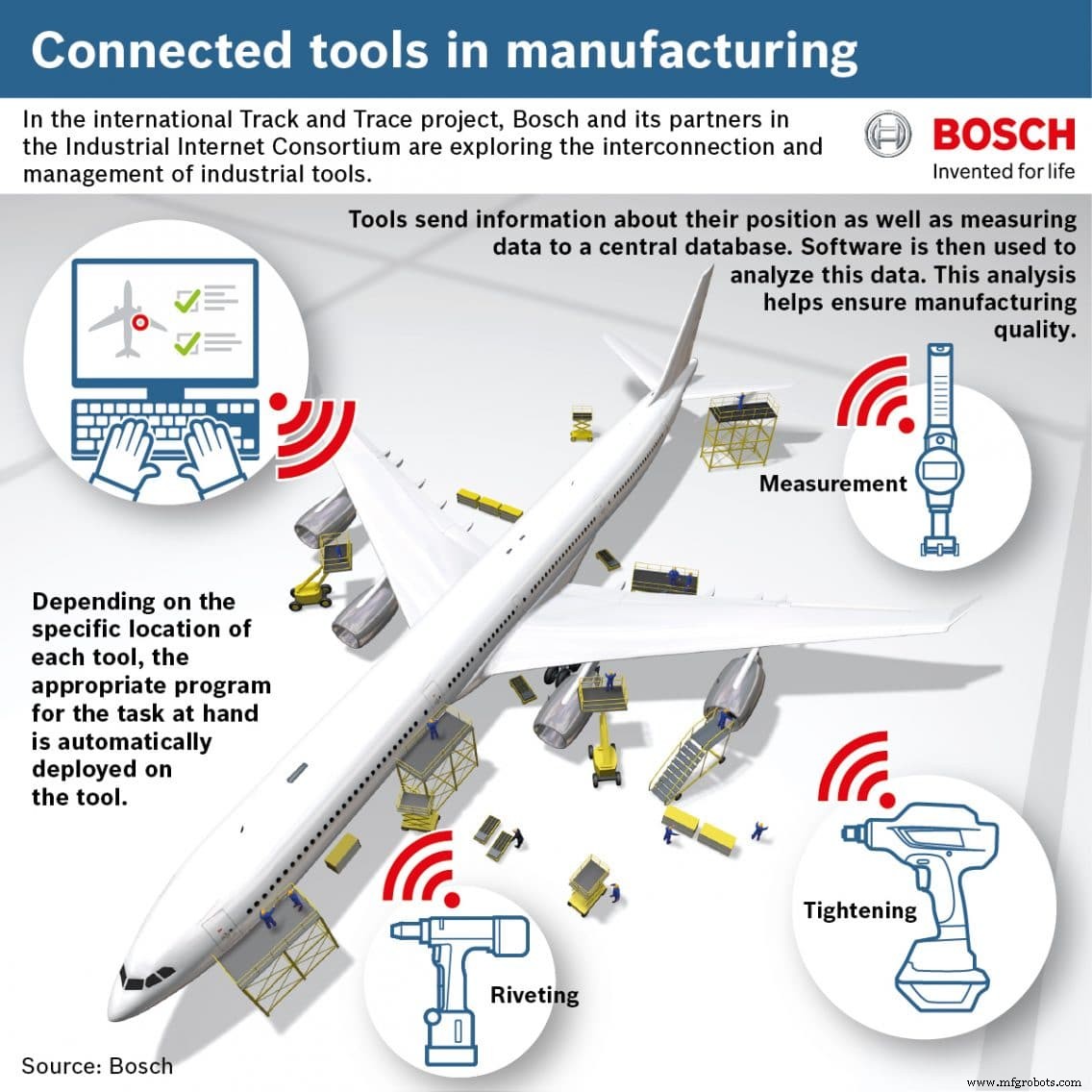
Aircraft assembly involves hundreds of thousands of point‑based process steps—drilling, measurement, tightening—that must be executed precisely. Rather than assigning a single task to each workcell, we manage these steps as coordinated sequences across multiple workcells and operators. For instance, a tightening operation may require varying torque and angle settings at the same 3D location. Errors in any step can lead to costly fixes, so our solution dynamically configures handheld tools to match the exact task parameters in real time.
Smart Handheld Tools and Wearable Intelligence
Our focus is on smarter drilling, tightening, and measurement tools. These devices either contain an onboard control unit or interface with wearable controllers—such as belt‑mounted computers—providing local processing of sensor data, actuation control, and wireless connectivity.
Integrated Architecture and Distributed Intelligence
All tools are linked to a unified platform that combines specialized hardware and software. Distributed intelligence embedded in every system ensures local data processing and sensor‑actuator integration, reducing latency and improving reliability.
Decentralized Tool Integration for Real‑Time Collaboration
Traditional centralized architectures cannot efficiently manage heterogeneous systems in real time. Instead, we employ a mashup of interconnected tools that share data only when locally required. This approach is essential for environments—such as inside an aircraft—where continuous wireless connectivity cannot be guaranteed.
Tracking, Localization, and PLM Integration
Indoor localization is crucial for aligning tool positions with Manufacturing Execution Systems (MES) and Product Lifecycle Management (PLM) data. Tracking accuracy varies: shop‑floor positioning tolerances may reach tens of centimeters, while tool‑tip tracking for precision tasks requires sub‑millimeter precision. Our system reconciles localization data with PLM records using ISO 15725 trueness values, adapting behavior based on context to prevent quality defects.
Simplifying 3D PLM Data for Shop‑Floor Workers
Direct CAD/CAM models can be overly detailed for operational use. We therefore develop an intermediate XML layer that simplifies geo‑data, enabling seamless integration between power tools and the 3D PLM environment. This layer also supports a lightweight configuration application that shop‑floor operators can use without a full 3D modeling interface.
Enterprise IoT Insights
These developments are part of the broader enterprise IoT strategy outlined in the book Enterprise IoT by Dirk Slama et al. (O’Reilly, 2015). For additional perspectives on industrial power tools, see the interview with Martin Doelfs from Rexroth.
Scaling in a Heterogeneous Supplier Environment
Deploying this technology across a diverse supplier base requires open, standards‑based interfaces. By exposing robust APIs, we enable both Airbus engineers and external partners to develop compatible tools and applications, ensuring seamless integration and future scalability.
Industrial Technology
- White Paper: Shaping Tomorrow’s Manufacturing – The Smart Factory Blueprint
- Nokia Unveils the Conscious Factory: A New Era in Industrial Innovation
- Tech Mahindra Pioneers the Factory of the Future with IoT, Blockchain, and AI
- Building the Factory of the Future: Sustainable Industries Through Digitalization and Energy Innovation
- Hyperautomation: The Key to Resilient Global Supply Chains
- The Modern Manufacturing Process: Key Techniques and Innovations
- Robotic Welding: Shaping the Future of Metal Fabrication
- Three Essential Criteria for Structuring CNC Machining Operations
- Factory of the Future: Mastering Industry 4.0 and Smart Manufacturing
- Human‑Robot Collaboration: Building the Factory of the Future