



Touchscreen vs. Button Interfaces in Aviation: Capacitive vs. Resistive Touchscreens and Haptic Feedback
Explore the fundamentals of cockpit interface evolution
In the All About Circuits/Moore’s Lobby podcast, Episode 10, NASA astronaut Matthew Dominick and engineer Dave Finch explored why the choice between touchscreen and button interfaces is critical in fighter‑jet cockpits. This article unpacks the key technologies that shape these decisions.
Mechanical Button and Keypad Interfaces
Legacy interfaces that provide a tactile response are still valuable, especially for users wearing gloves. Mechanical keypads isolate each key, reducing accidental activation of adjacent buttons. They are lightweight, inexpensive, and well‑suited for harsh environments where debris can interfere with touch input.
Touchscreen Technologies
Touchscreens emulate mechanical feedback, light up, or emit sound when pressed, yet they lack physical barriers between keys. This can lead to accidental taps, especially during rapid input sequences. However, they offer superior reliability in dirty or corrosive environments and reduce mechanical complexity.
Resistive Touchscreens
Resistive displays consist of two conductive layers separated by insulating dots. A finger’s pressure completes the circuit, allowing the controller to determine X‑Y coordinates via a voltage gradient. Advantages include low cost, low power consumption, and resistance to liquids. Drawbacks are occasional calibration needs and wear over time.
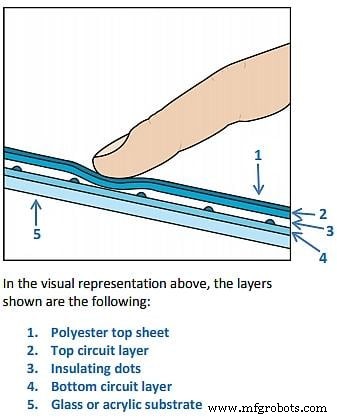
Figure 1. Resistive touchscreen construction. Courtesy of Wilson Hurd.
Capacitive Touchscreens
Capacitive panels use edge electrodes to create an electric field across a solid glass surface. A finger’s conductive surface changes the capacitance, enabling precise location tracking and multi‑touch gestures. They support bare fingers, gloves, or active styluses, and offer high optical clarity and durability, though they can be sensitive to electromagnetic interference.
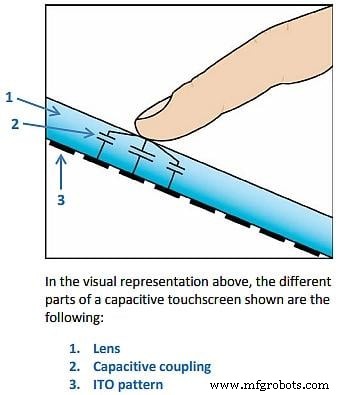
Figure 2. Capacitive touchscreen construction. Courtesy of Wilson Hurd.
For a deeper dive, see Robert Keim’s introduction to capacitive touch sensing.
Haptic Feedback
Bi‑directional communication between pilots and systems often relies on haptic cues. Vibratory haptics can overlay a conventional touchscreen, generating a tactile pulse when a touch is detected. This feedback confirms button activation without diverting the pilot’s visual focus—critical in high‑stakes environments like fighter jets or spacecraft.
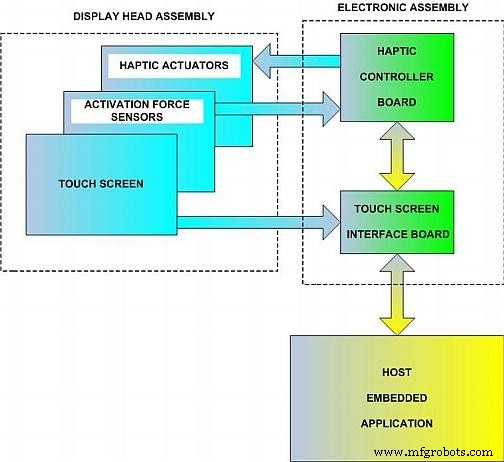
Figure 3. Architecture of a vibrating haptic system in a touchscreen. Courtesy of Catelani, Ciani, Barile, and Liberatori (IEEE Xplore).
In a future article, we will trace how these technologies evolved from the PalmPilot to the modern F‑18 Super Hornet display discussed by Matthew Dominick.
Industrial Technology
- Understanding Power in Resistive and Reactive AC Circuits
- Expert Guide to Planning & Designing Power Distribution Systems
- Master Sheet Metal Design: Proven Tips & Tricks for Faster, Cost‑Effective Production
- Essential RF & Microwave Design Principles for Reliable PCB Performance
- Crowbar Circuits: How They Protect Against Overvoltage
- Fiducial PCB Design: Purpose, Placement, and Best Practices
- Master PCB Design Quickly with Ultiboard: A Comprehensive Tutorial
- Overcoming Challenges in RF PCB Design: Proven Solutions for Reliable Performance
- Mastering High‑Speed PCB Design: Common Misconceptions and Proven Strategies
- Designing 3D Lattice Structures: Principles, Mechanics, and Applications