



Sushi Roll: Craft, History, and Modern Production
Background
Originating from Asia, a sushi roll combines vinegared rice, fresh seafood, and nori seaweed. Historically limited to restaurants, the dish is now widely available in grocery stores, often produced with mechanical sushi makers—though premium rolls are still handcrafted by expert shokunin. The scarcity of skilled chefs, rather than speed alone, drives the adoption of automation.
Sushi-making is a venerable tradition in Japan, deeply embedded in national pride. The vibrant red of fish and the pristine white of rice echo the Japanese flag, while specific tools—hangiri, shamoji, uchiwa, and makisu—ensure authenticity and precision.
History
As early as 500 B.C., Southeast Asian mountain communities wrapped fish in rice for pickling and fermentation. In Japan, carp and rice were stored in jars for up to a year, producing lactic acid that preserved the fish.
A Japanese legend tells of a couple placing rice in an osprey’s nest, discovering a fish nested within—an early example of fish-rice synergy. By the seventeenth century, Edo (modern Tokyo) introduced vinegar to rice, shortening fermentation to days and giving rise to street‑side sushi shops. The first such establishment, Sas Maki Kenukesushi, opened in 1702 and remained operational into the twentieth century.
Although nori consumption dates back to the eighth century, commercial cultivation only began in the late seventeenth century. Harvesting during December–January, when nori matures, was labor‑intensive, with spores disappearing in summer.
In the 1940s, British scientist Kathleen Drew‑Baker investigated nori spores’ survival in summer. Her 1949 paper revealed spores grow within seashell pores and detach in cooler weather. This insight spurred a ten‑fold increase in nori production from 1950 to 1980, and a bronze statue honoring Drew‑Baker was erected in 1963.
Raw Materials
Japan’s thriving nori industry deploys bamboo nets in coastal inlets to cultivate spores. At early April, the healthiest spores are transferred to Prefectorial Seeding Centers, where 1.5 tons of porphyra seeds are sprayed onto clean oyster shells—20,000 shells per batch.
The shells are suspended over bamboo supports in tanks maintained at 50–60 °F (10–15 °C). Seasonal monitoring ensures optimal growth, after which the nori is harvested, washed, and dried into sheets.
Seafood varieties vary: shrimp (ebi), crab (kani), salmon (sake), and tuna (maguro) are common, with tuna being the most prized. The Tsukiji market in Tokyo sets tuna prices and auctions daily catches. Prospective buyers sample fish to verify color, fat content, and shape—criteria defining “kata” quality.
While Japan dominates tuna fishing, the North Atlantic and Mediterranean also harvest significant quantities. Japanese expertise often guides international fisheries. Tuna may travel from New England to Japan for processing and back to Boston for restaurant use.
Vinegar—fermented rice—provides the subtle acidity in sushi rice. Wasabi (Chinese horseradish) requires two to three years to mature in shaded, cold mountain streams. Soy sauce is produced from fermented soybeans, toasted grains, salt, and water, either in-house or via suppliers. Fresh ginger and a range of vegetables—cucumber, avocado, spinach—complete the ingredient palette.
The Manufacturing Process
- Spread a half sheet of nori on the makisu. Apply 0.25 in (6 mm) of vinegared rice, creating a central groove with the shamoji.
- Lay strips of seafood or vegetables in the groove, distributing wasabi evenly on top.
- Roll the nori around the rice and fillings using the makisu, then press into a square.
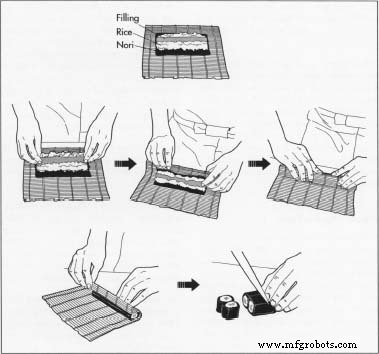 Sushi techniques vary among shokunin.
 - Remove the roll and slice into 1.5‑in (3.8 cm) pieces.
- Place finished rolls on small wooden tables with fresh ginger and wasabi. For grocery distribution, workers pack rolls in plastic cartons (six or eight per box), add soy sauce packets, seal, label, and refrigerate for immediate shipping.
Quality Control
Consumer safety is paramount, especially given raw fish parasites. The CDC and FDA recommend flash‑freezing at –4 °F (–20 °C) for three to five days to eliminate parasites—a process typically performed at sea before wholesale distribution. In Japan and the U.S., sushi bars procure fresh fish globally, adhering to the Japanese Agriculture Standard (JAS) and stringent import regulations that prohibit American rice in Japanese cuisine.
Nori undergoes rigorous testing for heavy metals, herbicides, pesticides, E. coli, yeast, and mold before processing. Fish destined for sushi is often flash‑frozen, sliced, and sealed in plastic to preserve quality during transport.
Byproducts and Waste
Fish processing waste, largely returned to the sea, also fuels a lucrative byproduct sector. In the U.S. alone, 2 million pounds of fish waste annually support fish meal, bait, stock, soups, leather, and fish‑oil supplements.
The Future
Sushi’s popularity is projected to rise throughout the twenty‑first century, intensifying demand for tuna—a species at risk of over‑fishing. Some U.S. restaurants have already ceased serving tuna to protect populations.
ICCAT in Madrid manages bluefin tuna quotas in the Atlantic and Mediterranean, yet the species’ high speed and cross‑jurisdictional migration complicate regulation. Disparate estimates by ICCAT, the U.S. National Academy of Sciences, and the National Audubon Society illustrate the challenges of sustainable management.
Salmon farming also raises environmental concerns. Farmed salmon are fed processed fish meals, treated with antibiotics, and color‑enhanced to achieve a pink hue. The resulting waste and incidents—such as the 1998 Scottish outbreak of Infectious Salmon Anemia—highlight industry risks.
Where to Learn More
Books
Davidson, Alan. “Sushi Roll.” In The Oxford Companion to Food. Oxford University Press, 1999.
Omae, Kinjiro, and Yuzui Tachibana. The Book of Sushi. Tokyo: Kodansha International, Ltd., 1981.
Trager, James. Sushi in The Food Chronology. New York: Henry Holt, 1995.
Yoshii, Ryuichi. Sushi. Boston: Periplus Editions, 1998.
Periodicals
Bestor, Theodore C. “How Sushi Went Global.” Foreign Policy (November 2000).
“Bowing Out.” Progressive Grocer (January 1998).
“Sewage with Your Salmon, Sir? Salmon Farming: More Trouble over Salmon Farms.” The Economist (23 June 2001).
“Smells Fishy.” The Economist (9 December 2000).
Thornton, Emily. “The Sushi‑Matic.” Fortune (9 September 1991).
Mary McNulty
Manufacturing process
- Roll Slitting: The Key Process for Cutting Large Material Rolls into Narrow, Efficient Production Units
- Rice Cakes: History, Production, and Future Trends
- Vision Composite Products Launches Lightweight Carbon‑Fiber Wheels Using Ultrium U660
- Optimizing Roll Pass Design for Precise Steel Profiling
- Premium Rolling Mill Rolls & Roll Shop – Expert Solutions for Performance and Durability
- Rolling Mill Roll Failures: Causes, Symptoms, and Prevention
- Metallurgy of Rolling Mill Rolls: Design, Materials, and Performance
- Mastering Plate Roll Operations for Flat Metal Fabrication
- Roll Pin Punches: Key Applications & Industrial Uses
- Mastering Rubber Roll Grinding: A Professional Guide to Superior Surface Quality