



Halogen Lamps: Technology, History, and Future – Expert Insight
Background
A halogen lamp is an advanced incandescent light source that uses a tungsten filament sealed within a glass envelope. Traditional incandescent bulbs either evacuate the glass or fill it with inert gases such as nitrogen, argon, or krypton. When electric current heats the filament to temperatures above 3,600°F (2,000 °C), it emits light. However, the tungsten evaporates and redeposits on the bulb walls, leading to blackening and a gradual drop in light output.
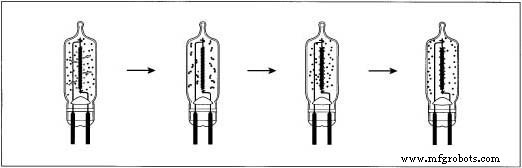
Halogen lamps overcome this issue with a few key innovations. The bulb is made from fused quartz instead of soda‑lime glass, and it contains the same inert gases plus a small fraction (typically <1%) of a halogen gas—most often bromine. The halogen reacts with the tungsten deposits to form tungsten halides. When these halides reach the hot filament, they decompose, releasing tungsten back into the filament. This “tungsten‑halogen cycle” maintains a consistent light output throughout the lamp’s life.
For the cycle to function, the bulb’s interior must reach temperatures above 482°F (250 °C). The quartz or aluminosilicate glass must be strong enough to withstand these temperatures, which is why halogen bulbs are often smaller and constructed with thicker walls. The higher internal pressure and the use of premium fill gases such as krypton or xenon further slow tungsten evaporation, extending lamp life and allowing higher filament temperatures for improved efficiency.
Compared to standard incandescent bulbs, halogen lamps are brighter, use less energy, and last between 2,000–4,000 hours (two to four years) versus 750–1,500 hours for conventional models. Their power range typically spans 20–2,000 W, with low‑voltage variants from 4–150 W. Some halogen bulbs feature an infrared‑reflective coating on the outer shell, which redirects heat back to the filament, raising its temperature and reducing the required wattage. Despite their advantages, halogen lamps are still less efficient than fluorescents or HID types and can reach temperatures of 250–900°F (121–482 °C), posing a fire risk if improperly used.
History
The evolution of electric lighting began with oil lamps and gas lamps, which were eventually supplanted by early electric lamps using platinum filaments in the 19th century. The first practical carbon‑filament lamp appeared in 1860, refined by Thomas Edison in 1878, and replaced by tungsten filaments in 1911, leading to the first vacuum tungsten lamps. By 1913, General Electric introduced tungsten lamps filled with inert gas, and the United States was producing over 200 million bulbs annually.
Halogen technology emerged in the late 1950s, with the first commercial halogen bulbs introduced in 1959. These bulbs found early applications in studio lighting, projection, and automotive headlamps, prompting the development of aluminosilicate glass in the 1970s for high‑speed production. The 1990s saw significant regulatory changes, including the U.S. National Energy Security Act of 1992, which phased out inefficient incandescent and fluorescent lamps. During this period, halogen shipments grew by nearly 15% annually, and the market for lighting equipment surpassed $10 billion in 1998.
Safety concerns led to a 1997 recall of halogen torchières due to poor fixture design and excessive heat. The recall prompted the addition of protective wire guards on new models. Today, halogen infrared‑reflecting (IR) lamps use a coating that reflects wasted infrared energy back into the bulb, increasing filament temperature without extra wattage and improving light output.
Raw Materials
Halogen bulbs are typically made from fused quartz or aluminosilicate glass. Quartz can withstand temperatures up to 1,652°F (900 °C), while aluminosilicate is suitable for lower‑wattage lamps (≤120 W). Tungsten filaments are produced from doped wire to ensure ductility and prevent distortion. Molybdenum foils seal the bulb, and bases are pre‑made from ceramic, glass, or metal. Fill gases—argon, nitrogen, krypton, xenon, bromine, hydrogen, and oxygen—are supplied in cylinders or liquid form, with natural gas piped directly from utility lines when used.
Design
Electrical performance depends on filament wire dimensions and geometry. Higher voltage or wattage requires longer or thicker filaments. Common configurations include round core, flat core, and double filament, each optimized for specific lighting applications. Filaments may be oriented axially or transversely, depending on the lamp’s intended use.
The Manufacturing Process
Making the coil
- Winding thin tungsten wire into a coil using automated bobbins creates efficient filaments. For round‑core filaments, the wire spirals around a cylindrical rod; flat‑core filaments use a rectangular rod; double filaments are built by layering a fine primary coil over a thicker secondary core.
Forming the bulb
- The glass tube is cut to length, then a softened top is shaped into a dome using a tungsten carbide wheel.
- An exhaust tube is inserted into the dome’s aperture and fused to the main tube, allowing air to be flushed out and fill gas to be introduced during sealing.
Making the mount
- Mounts are created by embedding pre‑formed tungsten wires in a quartz rod, welding the filament to support wires, and attaching molybdenum sealing foils.
- The finished mount undergoes a hydrogen furnace treatment at 1,925°F (1,050 °C) to remove oxides that could damage the filament.
Sealing
- A press‑seal machine hermetically bonds the mount to the bulb. The bulb’s base is heated to 3,272°F (1,800 °C) while stainless‑steel press pads apply 20–60 psi, sealing the quartz to the molybdenum foils. Inert gas flows through the exhaust tube to prevent oxidation.
Evacuating and filling the pressed bulb
- Vacuum pumps remove air from the bulb, then a halogen gas mixture is introduced through the exhaust tube. The bulb is pressurized above atmospheric levels and then cooled in liquid nitrogen to condense the fill gas. Gas/oxygen fires melt the exhaust tube tip, trapping the gas inside.
Attaching the base
- The base provides electrical connection and mounting. Glass, ceramic, or metal bases are bonded to the bulb with high‑temperature, moisture‑resistant cement, or mechanically fastened for special applications.
Packaging
- After testing, lamps are packaged—automatically or manually—into retail boxes or bulk cartons as required.
Quality Control
Post‑seal, lamps undergo a pressure test (40–100 atm depending on fill pressure) to ensure structural integrity. Leak tests involve lighting the lamp on a rotary machine; a yellow tint indicates a major leak, while arcing suggests mechanical defects. Random samples from each lot verify specifications such as wattage, temperature, light output, and lifespan.
Byproducts/Waste
Defective quartz is recycled or disposed of responsibly; exhaust tubes may be reused. Tungsten scrap is reclaimed and sold. Lamps failing quality checks are discarded. Manufacturers increasingly use lead‑free solder to avoid hazardous waste, complying with EPA TCLP regulations.
The Future
Halogen lamp shipments are projected to grow 7.7% annually, reaching 58 million units by 2003, outpacing incandescent sales. Market dynamics—such as imports from Asia and cost pressures—are expected to moderate unit price increases. Manufacturers aim to deliver bulbs with superior efficiency, longer life, and lower environmental impact. The U.S. lighting market is anticipated to exceed $15 billion by 2005, with incandescent lamps still dominating but experiencing slower growth due to competition and sectoral slowdowns.
Manufacturing process
- Building and Troubleshooting a Basic 6‑V Battery‑Lamp Circuit
- Exploring Nonlinear Resistance in Incandescent Lamps: A Practical Lab Guide
- Variable Inductor Lab: Exploring Magnetic Permeability and Inductive Reactance
- The Triode: A Cornerstone of Vacuum Tube Technology
- Paintbrushes: Types, Materials, and Manufacturing Process Explained
- Lava Lamp: History, Design, and Manufacturing Secrets
- Smart Traffic Light: Adaptive Street Lighting Powered by IoT
- Master 3D Printing with Wood Filament: Techniques & Benefits
- Drying PETG Filament: Simple Steps for Clear, Strong 3D Prints
- Understanding Pilot Lamps: Function, Types, and Safety Applications