



Pillow Production: Materials, Manufacturing, and Future Trends
Background
In the United States, most households keep two or three pillows on their beds. Modern pillows are primarily filled with polyester, feathers, down, or a blend of feathers and down. Polyester fillings are the most economical, durable, and hypoallergenic option. Goose down provides the highest quality and is the most expensive, while duck feathers offer a mid‑range price point. Premium pillows often combine goose feathers and down, with the proportion of down driving the price. The material of the filling is clearly marked on the pillow case to comply with consumer safety regulations.
Pillows are still mass‑produced in the U.S. and are rarely imported because of their large volume and high shipping cost. Some manufacturers have attempted to produce pillows overseas and crush them during transport to cut costs, but the pillows rarely recover their original shape and lose plushness.
History
The design and stuffing of pillows have changed little over the centuries. Wealthy Greeks used embroidered cushions and bolsters; Egyptians invested heavily in ornate pillows for the deceased. In contrast, the Chinese preferred wooden, leather, or ceramic pillows and sometimes filled them with herbal remedies for health benefits.
For many centuries, people slept upright, using a large cylindrical bolster and a pair of pillows to support the head and torso. This arrangement was thought to improve posture until the mid‑1800s. In the 19th and early 20th centuries, decorative square pillows were placed against the sleeping pillows and removed before sleep. Around 1840, cotton became readily available, prompting American women to hand‑weave linen pillowcases and personalize them with initials and case numbers. As the textile industry grew, pillow covers evolved from simple linen to durable cotton ticking.
Until recently, down and feather were the standard fillings. With advances in textile technology, synthetic polyester has largely replaced natural batts because it retains loft, is inexpensive, washable, and rarely triggers allergies.
Raw Materials
The filling is the most critical component of a pillow. Down, the fluffy undercoat of waterfowl, is the premium filling. It consists of clusters of filaments that trap warm air, providing excellent insulation. Duck down is smaller, more abundant, and less costly, but still offers superior loft. Down quality is measured by fill power, which is the volume in a calibrated cylinder that 1 oz (28 g) occupies; higher fill power indicates greater loft.
Feathers, the flat outer layer of birds, are stronger but less effective at trapping air. Duck feathers are the most common in U.S. pillows. Many manufacturers blend down and feather to create an affordable, comfortable product.
Polyester is a synthetic filling. The cheapest variant, continuous solid‑filament polyester, retains shape initially but loses loft quickly. A higher‑grade polyester called Hollofill features a hollow core that preserves loft longer.
The type of filling determines the choice of pillowcase fabric. Feather and down fillings require a dense, tightly woven cotton or cotton‑polyester fabric to prevent shafts from poking the sleeper and to keep down from escaping. Polyester batts can be used with looser weaves. Starch may be applied to stiffen the fabric. High‑quality thread is essential for sewing.
The Manufacturing Process
The following steps describe the production of a polyester‑filled pillow, the most common and cost‑effective type. A small‑to‑medium plant produces 2,000–3,500 pillows daily; the largest U.S. manufacturers produce 10,000–15,000 per day.
- Fabric preparation: Large bolts of cotton or cotton‑polyester are calendared to allow easy separation during filling. The fabric is then cut into rectangular panels on heavy tables or with cutting machines.
- Case assembly: Stacked panels are sewn together by machine or hand. A 6‑in (16 cm) opening is left for filling. The product label indicating the filling type is affixed, and the case is turned inside‑out so seams lie inside.
- Filling: The case is placed on a pillow‑filling machine. Polyester can be loaded in bulk (≈600 lb/272 kg) or baled and hand‑packed. The machine blows the polyester into the case, combing it to restore loft. High‑speed machines can fill up to 100 pillows per hour.
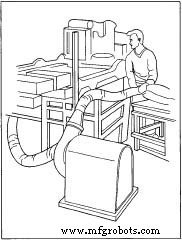
The blowing machine blows polyester filling into a pillow case.
- Sealing: Workers close the opening with an industrial sewing machine and weigh the pillow to confirm the correct fill weight.
- Bagging and packing: An automated bagger inflates thin plastic bags, inserts the pillow, and places the bagged pillows into shipping cartons.
Quality Control
Because the process is labor‑intensive, each stage is closely monitored. Operators ensure fabric layers are perfectly aligned before cutting, and supervisors oversee sewing precision. When polyester is de‑baled, it is inspected for quality. During filling, workers check equipment and verify that each pillow receives the correct amount of batting by weight.
Byproducts and Waste
Metal baling bands from polyester are recyclable and often collected free of charge by local scrap‑metal services. Cartons are also recycled. Polyester fibers rarely shed airborne micro‑fibers, making them a safer option for workers. Down dust can be hazardous, so masks are required when handling down or feathers.
Future Trends
Modern pillows increasingly use hypoallergenic blends to accommodate allergy sufferers. Some manufacturers are reintroducing herbal infusions, echoing ancient Chinese practices, to promote restorative sleep. Orthopedic pillows are advancing with foam, gel, or water cores that can be heated or cooled, offering targeted support for the neck, back, and lumbar region. Innovations such as built‑in speakers and adjustable head elevation demonstrate the ongoing evolution of sleep technology.
Manufacturing process
- Pillow Block Bearings: Components, Benefits, and Installation Guide
- From Maintenance to Reliability: Building a Culture of Predictive Excellence
- Polyethylene, Polypropylene, Polystyrene Prices Set for Decline
- Data Management: The Cornerstone of Successful AI
- Python Image Processing with Pillow: Comprehensive Guide
- IoT Love Pillow: Remote Hugs with Arduino MKR Bundle
- Comprehensive Guide to Safely Shutting Down a Blast Furnace
- Up vs Down Milling: Key Differences Explained
- Down Milling vs Up Milling: How to Choose the Right Approach
- CNC Milling Explained: When to Use Up Milling vs Down Milling