



Patent Leather: History, Production, and Environmental Impact
Background
Patent leather is a finished leather that has been coated with a chemically cured, high‑gloss lacquer, giving it a distinctive reflective sheen. Although traditionally black, patent leather can be produced in a variety of colors. It has long been a staple of formal footwear and dance shoes.
The process of making patent leather follows the same foundational steps as other premium leathers—tanning, de‑hairing, and fat removal—but the defining stage is the final lacquering. All leathers originate from animal skins or hides, most commonly cattle, but also sheep, goats, pigs, and exotic reptiles. In modern production, any hide of sufficient quality can be finished into patent leather, allowing manufacturers to use a broad range of raw materials.
Animal hides consist of three layers: an outer epidermis, a dense dermis rich in collagen, and an inner subcutaneous layer. Tanning removes hair and fat, stabilizes the collagen, and imparts durability and flexibility. The earliest tanning techniques date back to prehistoric times, evolving through plant‑based methods in ancient Egypt and the Middle East, to the chemically driven chrome tanning introduced in 1858. Modern chrome tanning, which employs chromium sulfate, has largely replaced vegetable tanning and enables large‑scale production.
Patent leather’s history traces back to 1799 when Englishman Edmund Prior patented a method for painting leather with dyes, boiled oil, and an oil varnish. Subsequent patents in 1805 and 1854 refined the finishing process, introducing linseed oil, whale oil, and a proprietary varnish blend that included dyes such as Prussian blue. Patent leather first appeared commercially in 1822 and has remained a fashionable choice for formal footwear, especially among the upper classes of the 18th and 19th centuries.
Today, patent leather is typically produced from calf or kid hide—though any high‑quality hide can be finished—using a blend of polyurethane and acrylic. Polyurethane provides a hard, shiny, and durable finish, while acrylic imparts flexibility. The finishing process is often carried out in aqueous dispersion to meet environmental regulations.
Raw Materials
Modern patent leather usually starts with a fine‑quality cow hide. The finishing coat is a mixture of polyurethane and acrylic, combined to balance hardness and flexibility. The mixture is dyed black, but color variations are possible. Additional materials common to leather manufacturing include salt for curing, lime or other caustic agents for de‑hairing, acids and salts for deliming, chromium tanning salts, and water throughout the process.
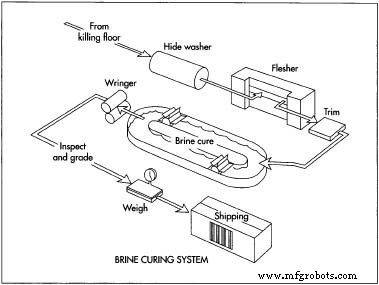
Animal hides must be cured promptly to prevent decomposition; otherwise, bacterial and fungal activity can destroy the hide’s integrity.
The Manufacturing Process
Preparing the Hide
- 1. Hides are typically sourced from cattle slaughtered for meat. Skilled workers carefully remove the hide to preserve its integrity; any mishandling can affect quality. Immediately after removal, the hide is salted to halt decomposition. In large facilities, hides are chilled, washed, and passed through a fleshing machine that separates manure, fat, and residual meat. Clean hides are then stored in brine.
At the Warehouse
- 2. Once cured, hides are shipped to the tannery. Historically, tanneries stored cured hides for up to a year, but since the late 1970s most U.S. tanneries employ a just‑in‑time system with minimal inventory.
Soaking, Liming, and Bating
- 3. In the beamhouse, hides undergo a 12–24‑hour sequence. First, they are soaked in cold water to remove brine salt. Lime or a caustic solution then de‑hair the hides, causing them to swell and become rubbery. A bating step—using warm water, calcium salts, and enzymes—removes residual hair and fat while neutralizing the hide’s pH. The hides are washed until all contaminants are removed.
Tanning
- 4. Hides are then tanned in a rotating drum filled with a chromium‑sulfate solution. They soak for 8–12 hours, during which chromium penetrates the collagen, strengthening the hide and imparting color. After tanning, the leather is dried for at least 24 hours.
Finishing
- 5. Finishing transforms the tanned leather into patent leather. In the U.S., a common method uses a flow coater: a liquid polyurethane/acrylic mixture is sprayed onto a conveyor belt carrying the leather. The first coat penetrates deeply. The leather then passes through a heated tunnel (infrared or ultraviolet) to cure the finish. A second coat, containing black dye, is applied, followed by a third clear top coat that hardens, shines, and seals the surface. Modern factories increasingly use aqueous dispersion finishes to reduce air pollution.
Final Steps
- 6. After the final coat dries, the leather retains its original shape. Shoe manufacturers then cut the material into pattern pieces, aiming to minimize waste.
Quality Control
Quality standards vary by tannery and customer specification. A reputable patent leather should exhibit no cracking, a fully cured hard finish, no tackiness, and resistance to scuffs. Many tanneries conduct visual inspections, mechanical tests, and chemical analyses to ensure compliance. Customers typically agree on testing protocols and acceptance criteria before purchase.
Byproducts and Waste
Patent leather production generates significant wastewater, especially during tanning and finishing. The 1980s EPA regulations prompted a shift from solvent‑based sprays to water‑based finishes. Treated wastewater must be processed in dedicated treatment facilities before reuse. Byproducts such as hide scraps can be sold as dog chews, while hair, fat, and other solids can be converted into fertilizer. Responsible tanneries implement recycling and waste‑minimization strategies to reduce environmental impact.
Manufacturing process
- Fruit Leather: Production, History, and Quality Control Explained
- From Ancient Hides to Modern Luxury: The Art and Science of Leather Jacket Production
- Leather Dyes: Key Components Driving Modern Leather Fashion
- Expert Guide to Leather Dyeing: Colors, Techniques, and Quality Control
- Lux Research Reveals the True Value of Sensor Patents Across Industries
- German Patent Court Decision: Discovery of Biological Correlations Lacks Novelty
- ITC: A Strategic Forum for Biologics Patent Owners
- China Moves Toward a U.S.-Style Patent‑Linkage System for Drugs
- Biologics and Biosimilars: Navigating Innovation, Competition, and Patent Strategy
- UC Extends Patent Lawsuit to New Retailers & Manufacturers Over Energy‑Efficient LED Filaments