



From Ancient Hides to Modern Luxury: The Art and Science of Leather Jacket Production
History
Leather, produced from tanned animal hides, has protected and adorned humans since prehistoric times. Early societies wrapped skins around their bodies for warmth and believed they carried protective powers. Phoenician traders exported richly embroidered leather from Babylonia, while Egyptian pharaohs’ tombs contain evidence of leather footwear.
When Roman legions advanced into northern Europe, they encountered Teutonic warriors who wore leather for protection against harsh climates. Romans quickly adopted leather for footwear, tunics, breastplates, and shields, and the first tanning guilds emerged within the Empire.
During the Middle Ages, the Moors introduced Cordovan leather—a supple goatskin—into Europe. By the Renaissance, tanners’ guilds were established across the continent. Indigenous peoples of the Americas, including the Maya, Inca, Aztec, and various Native American tribes, also harnessed leather from buckskin, doeskin, and buffalo hide for clothing.
Early techniques involved threading leather straps through holes punched with stone tools. Hides were softened with animal fat and cleaned with stone to remove cellular material. Preservation methods evolved: smoking, salting, soaking in urine or animal dung, beating, and even chewing to remove hair and flesh. Some cultures sprinkled talc and flour to replace natural oils, while women’s garments were often perfumed.
Although leather was a valuable trade commodity, tanning was notoriously dirty and odorous, relegating workers to town outskirts.
The ancient Hebrews pioneered a bark-based tanning process using oak bark. Native Americans used fish oil, while American colonists discovered plant-based tannins such as hemlock and chestnut. The 19th century brought mechanization, and a chemist’s chromium salt method reduced processing time from months to hours.
Raw Materials
Common hides used for jackets include antelope, buckskin, lambskin, sheepskin, and cowhide. Immediately after slaughter, skins are refrigerated, salted, or stored in brine barrels before heading to the tannery, where they undergo a series of preservation and softening steps that are critical to final quality.
Sewing components—thread, lining, seam tape, buttons, snaps, and zippers—are sourced from specialized vendors and stored on the factory floor.
The Preparation Process
Trimming and Cleaning
- Skins are sorted by size, weight, and thickness. Residual proteins that could promote bacterial growth are removed by soaking in rotating drums filled with water, bactericides, and detergents. Hair is stripped using chemical sprays or lime solutions, then a scudding machine with dull blades removes excess hair.
- Subsequent de‑liming removes chemicals, after which the hides are soaked in an acid solution and bathed in enzymes to dissolve excess collagen. Finally, pickling with salt and sulfuric acid preserves the skins.
Tanning
- Three main tanning methods are used: vegetable, mineral, and oil tanning. Vegetable tanning involves soaking hides in tannic acid solutions for weeks; lambskin may require only 12 hours. Mineral tanning, though faster, can alter color and uses alum salts in agitator drums. Oil tanning, the most traditional, applies fish oil to the skins.
Washing and Drying
- After tanning, hides are washed, wrung, and cut to uniform thickness with a band knife. They are then stretched on frames to prevent shrinkage during drying tunnels. To soften stiffness, skins are sprayed with water and soap and left to hang.
- Conditioned hides undergo mechanical manipulation to loosen fibers, then are vacuum‑dried. Buffing with revolving steel cylinders and abrasive paper refines the surface. Suede finishes are achieved with high‑speed emery wheels. Glazes, dyes, and lacquers are applied before shipping to the garment factory.
The Manufacturing Process
High‑speed sewing technology has transformed leather garment production, yet hand‑crafted jackets remain prized by luxury consumers. The following outline details factory‑scale production steps.
Jacket Design
- Designers create original patterns, which are then digitized. Computer grading algorithms, based on government anthropometric tables, generate size ranges that accommodate height and weight variations.
Cutting
- Tanned leather is placed on spreaders. While multiple layers can be cut simultaneously, leather is usually cut one layer at a time. Patterns are either pinned or chalked onto the hide. Cutting machines—rotary blades or band knives—execute the cut, guided manually or automatically. The latest innovation, a computerized laser cutter, vaporizes seams for precision.
- Lining material, being thinner, is cut in layers on the same spreaders.
Jacket Assembly
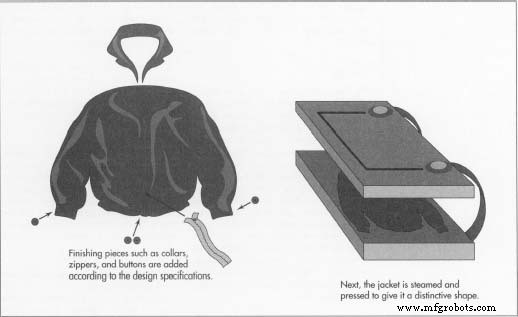
- Assembly follows a logical sequence: sides are stitched to the back, sleeve underseams are joined, and sleeves are affixed to armholes. Finishing components—collars, cuffs, buttonholes, buttons, zippers, and pockets—are added according to design. Patch pockets are sewn onto side pieces before back stitching; side pockets are integrated during side‑back assembly. Lining is attached to each piece before final sewing.
- Mass production employs an integrated production line with automatic sewing machines capable of 8,000 stitches per minute. In a sequential system, one machine performs a step, then the garment moves to the next. Tandem setups allow simultaneous attachment of buttons and collars.
- Each machine is pre‑programmed for thread and needle placement, fabric alignment, and waste management. Operators monitor stations via presser‑foot controls or touch panels, with stop‑motion devices for quick adjustments.
Molding and Pressing
- Heat, steam, and blocking shape the jacket. Buck presses regulate steam and pressure to sculpt bomber or blazer silhouettes. Curved blocks shape collars and cuffs; heat is applied and then removed to retain curvature.
Final Inspection
- Each jacket undergoes a hand inspection before packaging. Completed garments are bagged, cartoned, and shipped to retailers.
Quality Control
The tanning process is meticulously monitored to produce supple, bacteria‑free leather. Incoming hides are inspected for marks, tears, stains, and defects. Automated sewing systems feature self‑correcting lubricating loops—pumps, reservoirs, fluidic controls, and electronic monitoring—to maintain consistent quality.
The Future
Despite a brief dip during the recent recession, the leather apparel sector is projected to rebound, with many brands expanding their lines. Technologies such as laser cutting have increased production speed. While animal‑rights advocacy continues to pressure the industry, some manufacturers are boosting artificial leather production—a synthetic, animal‑free alternative that is cost‑effective yet still less popular than genuine leather for high‑end jackets.
Manufacturing process
- What is VMC Machining? An Expert Overview of Vertical Machining Centers
- Patent Leather: History, Production, and Environmental Impact
- Fruit Leather: Production, History, and Quality Control Explained
- From Ancient Hides to Modern Luxury: The Art and Science of Leather Jacket Production
- Leather Dyes: Key Components Driving Modern Leather Fashion
- How the Dye Industry Delivers Vibrant, Sustainable Colors to Everyday Life
- Expert Guide to Leather Dyeing: Colors, Techniques, and Quality Control
- Carbon Fiber Leather Cushioning Case for MacBook Pro – Discontinued, Explore the New Ion CarbonShell
- Albany Engineered Composites Secures F‑35 Wing Skin Contract with Lockheed Martin
- Water Jackets Explained: Protecting Engines from Overheating and Wear