



From Macintosh to Microfiber: The Evolution and Craft of Modern Raincoats
Background
Raincoats are crafted from fabrics that have been specifically treated to repel water. The breakthrough came in 1836 when Charles Macintosh pioneered a method of sandwiching rubber between two layers of cloth, creating the first practical waterproof jacket. In the United Kingdom, Macintosh’s invention earned the nickname “Mackintosh” or “Mac,” a term that endures in the industry today.
Modern raincoats come in a wide variety of materials and styles. All‑weather models feature removable linings for year‑round use. Fold‑up designs, typically vinyl‑finished, are lightweight and portable. Trenchcoats—popular among both men and women—are often constructed from breathable cotton‑polyester blends.
Key to a high‑performance raincoat is its waterproofing efficiency, measured by two attributes: absorption (how much water the fabric can hold) and penetration (how much water can seep through). The most reliable coats use tightly woven fabrics that are either inherently absorbent or actively repellent.
History
The quest for waterproof clothing stretches back centuries. By the 13th century, Amazonian Indians were using a milky rubber extract to seal garments. When European explorers reached the Americas in the 16th century, they noted indigenous techniques for waterproofing footwear and capes with crude rubber treatments.
In the 18th century, Europeans began experimenting with waterproofing textiles. François Fresneau proposed a concept in 1748, and John Syme advanced the field in 1815. The first commercially produced raincoat, the Fox’s Aquatic, debuted in 1821, made from Gambroon—a mohair twill—by G. Fox of London.
Early rubber‑based fabrics suffered from harsh temperature sensitivity: tacky in heat, stiff in cold. Charles Macintosh resolved this in the early 19th century by dissolving rubber in coal‑tar naphtha, a by‑product of early petroleum distillation, and applying it to fabric. In 1823, he patented the process of sandwiching molded rubber between two treated cloth layers, and factories began mass‑producing waterproof textiles in 1824, initially for the British military.
The 1839 invention of vulcanization by Charles Goodyear—heating rubber with sulfur to enhance elasticity—enabled Thomas Hancock to refine Macintosh’s waterproof fabric. By 1849, the calendering process further improved pliability and durability. Despite these advances, early 20th‑century coats remained warm, prompting designers to incorporate slits for ventilation.
Other waterproof fabrics emerged in the 19th century. Bax & Company launched Aquascutum in 1851—a chemically treated wool that gained popularity after the Crimean War. In World War I, Thomas Burberry introduced the trench coat, a fine‑twill gabardine treated to repel rain, which proved cooler and more practical than earlier rubber‑based designs.
Between the wars, oil‑treated fabrics (cotton and silk brushed with linseed oil) became fashionable, followed by car coats in the 1930s. Post‑1940s innovations saw lightweight, machine‑washable blends of wool, polyester, nylon, and synthetic fibers, along with heat‑welded seams that further sealed gaps.
The 1960s brought nylon, and the 1970s saw double‑knit fabrics, which, while less water‑repellent, offered a different aesthetic. Vinyl briefly resurfaced in the 1970s, especially among women. Today, Gore‑Tex and other high‑tech fibers dominate, while microfibers and advanced weaves continue to push the boundaries of performance.
Raw Materials
The core of a raincoat is a fabric treated to repel moisture. Common blends include cotton, polyester, nylon, rayon, and wool. Treatments vary: resin, pyridinium or melamine complexes, polyurethane, acrylic, fluorine or Teflon coatings. Natural fibers (cotton, linen) are waxed, while synthetics receive silicone or methyl siloxane finishes. Additional components—buttons, thread, lining, seam tape, belts, zippers, eyelets, and facings—are sourced from specialized suppliers.
Design
Fashion and functionality guide raincoat design. Seasonal trends influence fabric choice, cut, length, and aesthetic. Options span short commuter coats, car coats, sportswear, utility styles, and long trenchcoats. Computer‑aided design (CAD) allows designers to prototype patterns and colors virtually, accelerating the development cycle.
The Manufacturing Process
Production relies heavily on computer‑aided manufacturing (CAM) for speed and precision.
Waterproofing the Fabric
- Fabric rolls through a series of rollers into a tank containing the chosen waterproofing agent (see
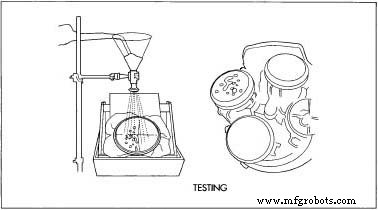 ). The solution’s absorption and repellency properties are rigorously tested.
 - The chemicals soak into the weave.
- Heat treatment ensures even distribution of the coating.
- Rollers finish the fabric, allowing it to cool and set the chemicals firmly.
- The treated bolts are re‑rolled and dispatched to manufacturers.
Manufacturing the Raincoat
- Computer‑operated cutters trim the body pieces to size‑graded patterns.
- Interlining (collars, cuffs, facings, straps, belts, pocket welts) is inserted and fused using high‑heat, high‑pressure machinery.
- Industrial sewing machines stitch small components—collars, belts, straps, pockets.
- Facings are affixed to the front edges of the shell by skilled seamstresses.
- Large shell panels are assembled—right and left backs, front panels, sleeves—on industrial sewing machines.
- A separate line attaches the lining to the shell.
- The complete coat is sewn together, with automated machines handling button‑holes and button placement.
- Trim, sleeves, and belts are finished by hand.
- Quality inspectors conduct a thorough visual and tactile check.
- Tags are affixed, and the coat is hung on a hanger.
- An automatic bagger seals the coat in a polybag.
- Packaged coats are loaded into shipping containers by trained workers.
Quality Control
Quality assurance occurs at every stage—from fabric inspection to final hand‑check of seams, button alignment, and overall finish. Defects are immediately corrected to uphold the brand’s reputation for reliability.
Byproducts/Waste
Production generates primarily fabric scraps, which are typically discarded or recycled in accordance with environmental guidelines.
The Future
Future raincoat fabrics will deliver superior water repellency, stain resistance, and wrinkle resistance, incorporating new weaves and nanotechnology. Mass customization—tailoring each coat to an individual’s exact measurements using digital scanning and advanced manufacturing—will likely become standard, offering unparalleled fit and comfort.
Manufacturing process
- Amber: From Ancient Resin to Scientific Treasure – History, Properties, and Modern Uses
- The Guillotine: History, Design, and Legacy
- Silicon: Properties, Production, and Market Outlook
- The Ukulele: From Portuguese Roots to Modern Craftsmanship
- The Complete Guide to the U.S. Chicken Industry: History, Production, and Quality Control
- Compost: The Ultimate Soil Enrichment Solution
- Gelatin: From Ancient Protein to Modern Applications – Production, Uses, and Safety
- The Evolution and Manufacturing of Modern Pin‑Tumbler Locks
- Vodka: From Ancient Distillation to Modern Production
- Milk: Production, Processing, and Nutrition in the United States