



Lyocell: A Sustainable, Strong Cellulose Fiber for Fashion and Industry
Lyocell is a man‑made fiber derived from cellulose, marketed in the United States as Tencel. Produced via a solvent‑spinning technique, the cellulose remains chemically unaltered, yielding an exceptionally strong fabric. Its versatility spans automotive filters, ropes, abrasive products, bandages, protective gear, and, most prominently, women’s apparel.
Background
Cellulose‑based textiles trace back to the mid‑19th century, but commercial production began in 1889. Swiss chemist George Audemars received an English patent in 1855 for artificial silk made from mulberry bark. He emulated the silkworm’s method by dissolving the bark’s inner fibers, then forming threads with a needle‑dipped technique. English chemist Joseph W. Swan refined Audemars’ process, forcing the solution through fine holes to create filaments for electric lamps. Though Swan showcased cellulose fabric in 1885, it failed to capture interest.
French chemist Count Hilaire de Chardonnet broke new ground in 1889 by presenting “artificial silk”—later known as rayon—at the Paris Exposition. A plant in Besançon, France, opened in 1891, catapulting rayon into mainstream fashion. In the United States, the American Viscose Company, an affiliate of Samuel Courtaulds & Co., began rayon production in 1910, laying the groundwork for what would become Courtaulds PLC (now Accordis Fibers).
The 20th century saw rapid advances in man‑made fibers. Acetate debuted in 1924, nylon in 1939, and acrylic and polyester in the 1950s. Unlike synthetic polymers derived from petrochemicals, rayon, acetate, and lyocell are cellulose‑based—often labeled “natural” fibers, though they require industrial processing.
In the late 1970s and early 1980s, Courtaulds Fibres and American Enka pioneered a solvent‑spinning method that simplified and green‑ed the process. Conventional rayon, a regenerated cellulose fiber, demands multiple steps—converting cellulose to xanthate, dissolving in caustic soda, then regenerating. Solvent spinning, by contrast, uses a non‑toxic amine oxide that is fully recycled, dramatically reducing environmental impact. Lyocell first entered the U.S. market in 1992 under the brand Tencel, and the generic name lyocell was adopted in 1996. Lenzing AG, an Austrian company, joined the market after acquiring American Enka’s rayon operation in 1992.
Raw Materials
The core ingredient is cellulose, a natural polymer present in all plant cells, and the primary source for cotton, hemp, and linen. For lyocell, cellulose is extracted from hardwood pulp—commonly oak and birch—grown on managed farms unsuitable for other agriculture. The process uses an amine oxide solvent and water, with finishing agents such as soap or silicone lubricants. Lyocell fabrics are dyed with dyes compatible with cotton and rayon.
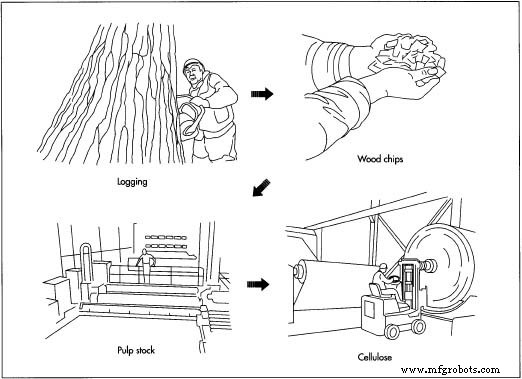
The Manufacturing Process
Preparing the Wood Pulp
- 1. Hardwood trees destined for lyocell are harvested, transported to the mill, cut into 20‑ft (6.1‑m) lengths, and debarked using high‑pressure water jets. The logs are chipped into squares slightly larger than postage stamps, then fed into chemical digesters that soften them into wet pulp. The pulp undergoes washing, optional bleaching, drying into a thick sheet, and winding onto massive spools weighing up to 500 lb (227 kg).
Dissolving the Cellulose
- 2. At the lyocell mill, cellulose squares are unrolled, cut into one‑inch pieces, and loaded into a heated, pressurized vessel containing amine oxide.
Filtering
- 3. The cellulose dissolves into a clear solution after a brief soak. The solution is filtered to ensure all particles are fully dissolved.
Spinning
- 4. The filtered solution is pumped through spinnerets—devices with numerous tiny holes resembling a showerhead—creating long fiber strands. These strands are submerged in a diluted amine oxide bath to set them, then washed with de‑mineralized water.
Drying and Finishing
- 5. Fibers enter a drying chamber where water evaporates. They are then treated with a lubricant (soap, silicone, or other) to act as a detangler, facilitating subsequent carding and spinning.
Final Steps
- 6. Dried fibers form tow—a long, untwisted bundle of filaments. Tow is crimped to add texture, carded to align strands, cut, and baled for shipment to fabric mills. The entire process, from raw cellulose to baled fiber, typically takes about two hours.
Recovery of the Solvent
- 7. Amine oxide is recovered and reused. The dilute solution is evaporated to remove water, then the solvent is routed back into the pressurized vessel. Typically, 99 % of the solvent is reclaimed.
Quality Control
Lyocell production occurs in a handful of state‑of‑the‑art plants worldwide. Sophisticated computer monitoring systems constantly assess fiber tenacity, color, denier (fiber diameter), elongation, moisture content, and finish application levels. The systems also detect spinneret blockages that produce “trash” filaments, ensuring only high‑quality fibers reach the market.
Byproducts and Waste
Lyocell manufacturing generates no harmful byproducts and is markedly less toxic and wasteful than other cellulosic fibers. The cellulose source is sustainably harvested from managed tree farms, and the amine oxide solvent is non‑toxic and almost fully recycled, preventing environmental release. The resulting fabrics are naturally biodegradable. Compared to other man‑made fibers, lyocell production consumes less water and energy, reinforcing its environmental credentials.
Manufacturing process
- Amber: From Ancient Resin to Scientific Treasure – History, Properties, and Modern Uses
- The Guillotine: History, Design, and Legacy
- Silicon: Properties, Production, and Market Outlook
- The Ukulele: From Portuguese Roots to Modern Craftsmanship
- The Complete Guide to the U.S. Chicken Industry: History, Production, and Quality Control
- Compost: The Ultimate Soil Enrichment Solution
- Gelatin: From Ancient Protein to Modern Applications – Production, Uses, and Safety
- The Evolution and Manufacturing of Modern Pin‑Tumbler Locks
- Vodka: From Ancient Distillation to Modern Production
- Milk: Production, Processing, and Nutrition in the United States