



Carbon Fiber: Composition, Manufacturing, and Future Applications
Background
Carbon fiber is a thin, elongated strand of material, typically 0.0002–0.0004 in (0.005–0.010 mm) in diameter, composed almost entirely of carbon atoms arranged in microscopic crystals aligned along the fiber axis. This alignment yields exceptional tensile strength relative to its size. Thousands of fibers are twisted into a yarn, which can be woven into fabrics or combined with epoxy to create high‑performance composites used in aerospace, automotive, sporting goods, and marine applications.
The first carbon fibers emerged in the 1950s as high‑temperature reinforcement for missile components. Early attempts using heated rayon produced fibers with only ~20 % carbon and limited strength. By the 1960s, a polyacrylonitrile (PAN) precursor process yielded fibers containing ~55 % carbon and superior mechanical properties, becoming the industry standard.
In the 1970s, petroleum‑pitch derived fibers were developed, reaching ~85 % carbon and excellent flexural strength, though their lower compression performance limited widespread adoption.
Today, carbon fiber is integral to countless products, with continuous innovation expanding its use. Production remains concentrated in the United States, Japan, and Western Europe.
Classification of Carbon Fibers
Carbon fibers are categorized by tensile modulus, the measure of resistance to stretching. The English unit is pounds of force per square inch (psi). Low‑modulus fibers have a modulus below 34.8 Mpsi (240 MPa). Higher categories—standard, intermediate, high, and ultrahigh modulus—reach up to 72.5–145.0 Mpsi (500–1,000 MPa). For context, steel typically has a modulus of ~29 Mpsi (200 MPa), so the strongest carbon fibers can be five times stiffer than steel.
Ultrahigh‑modulus fibers derived from petroleum pitch are sometimes called graphite fibers due to their crystal structure that closely resembles pure graphite.
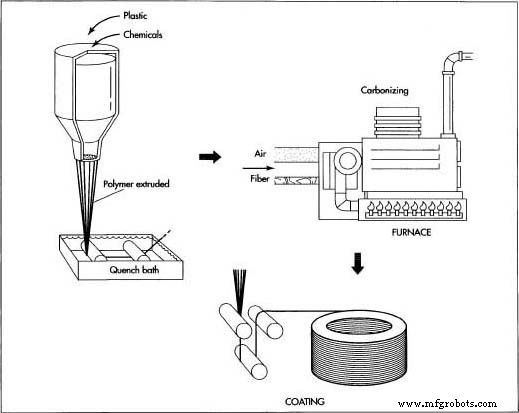
During production, polymer strands are heated to very high temperatures in an oxygen‑free environment. The absence of oxygen prevents combustion; instead, non‑carbon atoms are expelled as gases, leaving behind a tightly bonded carbon lattice.
Raw Materials
The precursor—usually polyacrylonitrile—constitutes ~90 % of commercial carbon fiber production, with the remaining 10 % derived from rayon or petroleum pitch. These organic polymers consist of long carbon‑based chains, and each manufacturer’s exact formulation is proprietary.
Various gases and liquids are introduced during processing to control reactions, temperature, and surface properties. Their specific compositions are also typically trade secrets.
The Manufacturing Process
The production of carbon fiber blends chemical and mechanical steps. The precursor is drawn into strands, heated to high temperatures without oxygen exposure, and then undergoes a series of controlled transformations to produce the final fiber.
Spinning
- 1. Acrylonitrile polymer powder is blended with a co‑polymer such as methyl acrylate and polymerized with a catalyst to form PAN.
- 2. The polymer is extruded into fibers via jet or melt‑spinning techniques, where it coagulates or evaporates solvents to solidify. This step determines the internal microstructure.
- 3. The fibers are washed and stretched to achieve the target diameter and to align the molecular chains.
Stabilizing
- 4. The fibers are thermally treated in air at 390–590 °F (200–300 °C) for 30–120 minutes. This process converts linear bonding to a thermally stable ladder structure, incorporating oxygen into the lattice and generating heat that must be carefully managed.
Carbonizing
- 5. Stabilized fibers are heated to 1,830–5,500 °F (1,000–3,000 °C) in an inert atmosphere. Oxygen is excluded by pressurizing the furnace and sealing entry/exit points. As heating proceeds, non‑carbon atoms evolve as gases (water vapor, ammonia, CO, CO₂, H₂, N₂, etc.), leaving behind a highly ordered carbon crystal.
Treating the Surface
- 6. Post‑carbonization, the fiber surface is lightly oxidized to improve adhesion with resins. Oxidation can be achieved via exposure to gases (air, CO₂, ozone) or liquids (NaOCl, HNO₃). Electrolytic coating is another option. The process is tightly controlled to avoid surface defects that could compromise strength.
Sizing
- 7. Fibers are coated (sized) to protect them during winding or weaving and to enhance compatibility with composite matrices. Common sizing agents include epoxy, polyester, nylon, and urethane.
- 8. Sized fibers are wound onto bobbins and then twisted into yarns of various diameters.
Quality Control
Visual inspection is impractical due to the fiber’s microscopic size. Quality hinges on precise control of precursor properties and manufacturing parameters—time, temperature, gas flow, and chemistry—throughout the process. Finished fibers and composites undergo rigorous testing for density, strength, sizing content, and other critical metrics, following standards established by the Suppliers of Advanced Composite Materials Association in 1990.
Health and Safety Concerns
Key concerns during production and handling include dust inhalation, skin irritation, and electrical interference.
Carbon fiber dust is generally too large to penetrate lung tissue, unlike asbestos. Nevertheless, it can irritate the respiratory tract, so workers should wear appropriate respiratory protection.
Fibers can irritate skin, particularly on the hands and wrists. Protective clothing or barrier creams is advisable, and care should be taken with sizing chemicals that may cause allergic reactions.
Because carbon fibers conduct electricity, dust can create arcing or short circuits in nearby equipment. In such environments, sensitive devices should be isolated or shielded.
The Future
Carbon nanotubes—hollow tubes with diameters as small as 0.00004 in (0.001 mm)—represent the frontier of carbon fiber technology. Their extraordinary mechanical strength and electrical conductivity open possibilities for next‑generation fibers, micro‑tubes, and semiconductor components.
Manufacturing process
- Carbon Fiber: A Journey from History to Tomorrow
- Top 3 Benefits of Carbon Fiber Watches for Luxury Timepieces
- Unidirectional Carbon Fiber: The Strength, Lightness, and Cost‑Savings Advantage for Modern Manufacturing
- Carbon Fiber: 3 Key Properties That Drive Innovation
- 5 Unexpected Carbon Fiber Innovations Reshaping Modern Life
- Carbon Fiber Weaves: Types, Properties & Industrial Applications
- Carbon Fiber Explained: Strength, Production, and Industry Applications
- Carbon Fiber Manufacturing: From Precursors to Premium Composites
- Is Carbon Fiber Conductive? Understanding Its Electrical and Thermal Properties
- Fiberglass vs. Carbon Fiber: Choosing the Right Reinforcement for 3D Printing