



Braille Publishing: From Louis Braille’s Invention to Modern Innovation
Background
Braille, the tactile writing system that empowers blind readers worldwide, was invented by Louis Braille in 1824. Since its creation, the system has evolved and spread far beyond France, becoming the standard for blind literacy across continents.
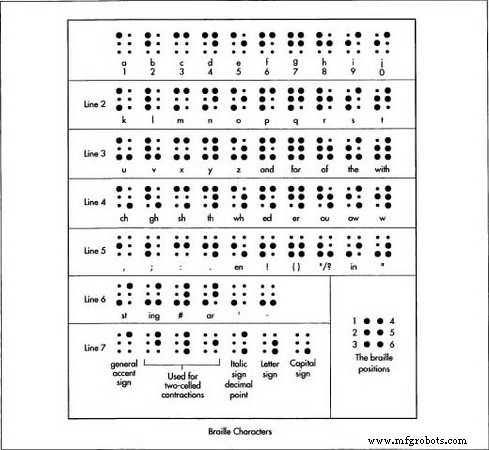
The system relies on a 6‑dot cell—two vertical columns of three raised dots—where each combination represents a letter, number, punctuation mark, or common word. Standard English Braille also incorporates 189 abbreviations for frequently used digraphs and syllables, allowing for compact text. Numbers are indicated by the first ten letters of the alphabet, while the Nemeth Code extends Braille for mathematical and scientific notation.
Before Braille, blind individuals were largely denied formal reading instruction. Valentin Hauy’s embossed type system, introduced in the 1770s, offered large, tactile letters but was impractical due to its size. Louis Braille, blinded at age three, observed this limitation and sought a more efficient method. After encountering a military night‑writing system that used raised dots and dashes, Braille refined it into the six‑dot cell that could be quickly read and written with a stylus. He unveiled his system at 15, and it was officially adopted in France in 1854 and in the English‑speaking world in 1932.
In addition to the writing system, Braille invented the raphigrapher, an early embossed typewriter that produced large Roman letters for both blind and sighted readers. Early Braille writers, such as Frank Hall’s 1892 Hall Braille writer, use six keys—one for each dot position—to emboss text onto paper. Certified Braille typists undergo a two‑year National Library Service training program and must pass a rigorous exam to ensure quality and consistency.
Raw Materials
Producing a Braille book requires materials similar to conventional printing but with some specific adjustments. Standard Braille paper measures 11 × 11.5 in (28 × 29.21 cm) and is heavier to support the embossed dots. Specialized papers—like swell paper that rises when heated—are used for certain applications. Zinc plates serve as the master for embossing; each page is cast onto its own plate. Due to the large format, Braille books are frequently bound in plastic ring binders rather than traditional hard or soft covers.
The Manufacturing Process
Translation
- 1. If the manuscript is not already in Braille, it must be translated. Options include manual transcription by a certified Braille typist, which, though labor‑intensive, guarantees high quality through human insight; or computer‑based conversion using specialized software. The latter can digitize printed text via scanning or directly process digital files, enabling near‑instant conversion of entire books.
Proofreading
- 2. Once transcribed or converted, the manuscript undergoes rigorous proofreading. A blind reader and a sighted proofreader collaborate, comparing the source text to the Braille version to catch errors or formatting issues before publication.
Making the Master
- 3. After final proofing, a master copy is created on a zinc plate. A dedicated stamping machine impresses the Braille dots into the metal; each page receives its own master, which is then mounted on a rotating barrel for the press.
Printing
- 4. With the zinc masters installed, the press operates similarly to a conventional printing press but without ink. Paper is fed through, the rotating barrel embosses the raised dots onto the sheet, and the completed page is ejected. An illustration of the embossing process is shown below:
Collating and Assembling
- 5. Braille pages must be collated manually to prevent damage to the raised dots. After careful hand‑ordering, the pages are bound—either in a three‑ring binder, which requires punching the pages, or via saddle‑stitching into a hard‑back format. The finished book is then boxed for distribution.
Quality Control
Quality in Braille publishing hinges on skilled typists and strict adherence to formatting standards. While some typists volunteer for family or community projects, professional transcribers complete a comprehensive training and certification process. Braille text follows standardized layout conventions: blank lines separate distinct blocks of text, and indentations and text size are controlled to avoid confusion. Modern software is being developed to automatically convert diverse print manuscripts into these standardized Braille formats, further ensuring consistency.
The Future
Ongoing advancements promise to make Braille more accessible. Conversion software continues to improve, allowing individual users to produce Braille materials with a personal computer and a Braille printer. Low‑cost printers, such as those designed for narrow paper, are becoming available, and “paperless” Braille—handheld devices that emboss a line at a time on a board—gains traction in Europe and the United States.
In Korea, a new printer applies a clear, glue‑like substance to glossy paper, offering an alternative embossing technique. Researchers like physicist John Gardner are developing “Dots Plus,” a hybrid system that blends conventional Braille for letters and numbers with raised, magnified mathematical symbols, and exploring an eight‑dot matrix for advanced math notation.
While voice‑output technology continues to evolve, Braille remains indispensable, especially for complex content such as equations where auditory representation is limited. The tactile nature of Braille ensures its continued relevance as a foundational tool for blind literacy.
Manufacturing process
- SIGHT: Smart Glasses Empowering the Blind
- Facilitating Deaf-Blind Communication Using 1Sheeld and Arduino
- Arduino Blind Stick: Smart Proximity Sensor for the Visually Impaired
- Blind Stick Navigator – An Arduino-Based Assistive Device for Visually Impaired
- Talking Smart Glass: Voice-Enabled Guidance System for the Visually Impaired
- Ultrasonic Smart Glasses: Enhancing Mobility for the Visually Impaired
- Arduino-Powered Third Eye: An Assistive Vision Device for the Blind
- Optimizing Blind Microvias with Copper Filling for Superior PCB Performance
- Understanding Portable Braille Displays: Key Insights & Innovations
- Blind vs Buried Vias: Expert Guide for PCB Prototyping