



Chopsticks: History, Craftsmanship, and Environmental Impact
Chopsticks are a pair of slender sticks—traditionally wooden—that facilitate the enjoyment of Asian cuisine. Their origins trace back to China during the Shang dynasty (1766‑1122 B.C.) and have since become a ubiquitous utensil across Asia.
Background
In Japan, chopsticks carry cultural significance beyond mere utensils. They are believed to nurture a child’s intellectual growth, and families often own personalized pairs that fit individual hand sizes. Etiquette governs their use: the sticks must not be held together in one fist, laid across a bowl, or used to stab food. Licking the tips or striking a plate to attract attention is also taboo. The form, size, and material of chopsticks reflect their intended purpose. Ornate, hand‑carved examples are prized for home use, while blunt‑tipped, long wooden sticks serve in kitchens. Restaurants typically provide lightweight, disposable pairs, and some Japanese homes even use extended chopsticks for cleaning cat litter boxes.
Raw Materials
Aspen wood dominates the production of disposable chopsticks, accounting for roughly 20 billion pairs annually—most of which are consumed in Japan. For premium, multi‑use sticks, artisans turn to metals or exotic woods such as ivory or jade. Common wood varieties include pine, cedar, cherry, sandalwood, paulownia, and shuboku (a composite of maple, pine, and cedar). The chosen wood must be hard, water‑resistant, and exhibit a pleasing grain pattern. Traditional beliefs attribute superstitions to certain woods: chestnut is thought to attract wealth, while black persimmon is linked to longevity.
The Manufacturing Process
Below is a step‑by‑step guide to crafting high‑quality, hand‑made chopsticks.
Milling the Wood
- 1. The maker selects a block of wood—often pre‑dried or aged—to ensure optimal hardness and moisture content. After inspecting the grain for the most attractive pattern, the block is cut on a bandsaw into a long, narrow rectangle slightly longer than the finished sticks.
Inlaying
- 2. For decorative pairs, a shallow trench is cut into the block, and a thin sheet of contrasting wood is glued and clamped until dry, creating a striking pattern.
Cutting the Blanks
- 3. Once the inlay is secured, the block is sliced on a table saw into individual blanks—each roughly 0.25 in (0.64 cm) wide and the full length of a finished chopstick.
Shaping the Sticks
- 4. The blanks are refined to the desired shape—either square at the end tapering to a cylindrical point, or fully cylindrical—using hand scrapers or a sanding belt.
Sanding
- 5. The sticks are meticulously sanded through a series of grits to eliminate splinters and achieve a smooth finish, preparing them for the final coating.
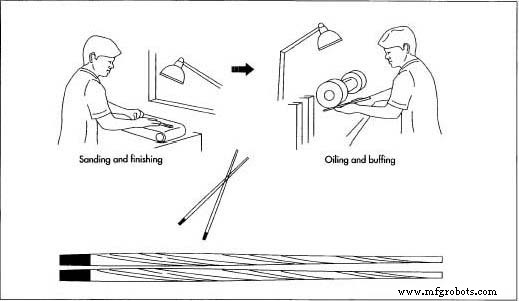
Finishing
- 6. Traditional lacquer, derived from sumac sap, is applied by dipping the sticks and letting them dry to a hard, clear surface. Some artisans use non‑toxic paint or oil to enhance the grain and provide a soft polish. The final buffing may be hand‑done or performed on a mechanical buffer.
Mass‑Produced Chopsticks
Disposable chopsticks are manufactured at scale through an automated workflow. Aspen logs are harvested and sorted for quality before being processed into blocks at the forest site. These blocks are shipped to factories where blanks are cut, sanded, and finished en masse—often producing millions of pairs per year. “Half‑split” construction—two halves held together until the moment of use—reduces handling and simplifies production.
Quality Control
Craftsmen evaluate each piece of wood for color, grain, and integrity before and during production. This vigilant inspection ensures that the final product maintains durability and aesthetic appeal.
Byproducts and Waste
The disposable chopstick industry faces criticism for its environmental footprint. Because only fine‑grained wood is suitable, many trees are harvested exclusively for chopsticks, leaving the remaining lumber to rot or be burned. Japan consumes the majority of disposable sticks, but rising ecological awareness has spurred alternatives such as reusable plastic sticks and chopsticks made from forest‑thinning wood—materials that would otherwise be wasted. Public pressure and corporate initiatives are driving the industry toward more sustainable practices.
Manufacturing process
- Professional Wood Stain: History, Types, and Production
- Charcoal Briquettes: From Ancient Fuel to Modern BBQ Staple
- Fiberboard (MDF) Production: Process, Quality, and Future Trends
- Understanding Lumber: Production, Types, and Industry Insights
- Advanced CNC Wood Machining Centers for Precision 3D Work
- Plastic vs. Wood Pallets: Selecting the Optimal Choice for Your Supply Chain
- Understanding Pressed Wood: Composition, Uses, and Benefits
- Pear Wood: Properties, Uses, and Benefits
- Understanding Fiberboard: Composition, Uses, and Advantages
- Wood: Key Properties for Construction & Design