



Fiberboard (MDF) Production: Process, Quality, and Future Trends
Background
Engineered wood, also known as composite forest products, is produced by bonding wood fibers, chips, and shavings with resins under heat and pressure. In the United States, the industry annually generates about 21 million metric tons (21 million tons) of composite wood. The most common forms are plywood, blockboard, fiberboard, particleboard, and laminated veneer lumber. These products capitalize on previously under‑utilized wood residues and low‑grade species, ensuring minimal waste of raw material.
Medium Density Fiberboard (MDF) is a panel composed primarily of lignocellulosic fibers bonded with a synthetic resin. Panels are compressed to a specific gravity of 0.50–0.80 (31–50 lb/ft³). Additives are incorporated during manufacturing to enhance strength, moisture resistance, or finishability. Because MDF can be cut into a wide variety of sizes and shapes, it finds use in industrial packaging, display stands, toys, furniture, cabinets, wall paneling, molding, and door components.
The surface of MDF is flat, smooth, and free of knots or grain patterns, which simplifies finishing operations and yields consistent results. Its homogeneous edge permits precise machining, reducing trim waste compared to other substrates. Improved dimensional stability and strength make MDF an excellent substitute for solid wood in many interior applications. Furniture makers also emboss MDF to create three‑dimensional designs, taking advantage of its uniform texture.
Over the past decade, the U.S. MDF market has expanded rapidly. Shipments rose 62 % and plant capacity grew 60 %. Today, more than 1 billion square feet (93 million m²) of MDF are consumed annually in America. Global capacity reached 12 billion square feet (1.1 billion m²) in 1996, and there are now over 100 operating plants worldwide.
History
MDF was first commercialized in the United States during the 1960s, with initial production beginning in Deposti, New York. A related product, hardboard (compressed fiberboard), emerged accidentally in 1925 when William Mason sought a use for the abundant wood chips discarded by lumber mills. While attempting to press wood fiber into insulation, he inadvertently created a durable thin sheet after forgetting to shut down his press—an early version of fiberboard produced using a blow torch, an eighteenth‑century letter press, and an old automobile boiler.
Raw Materials
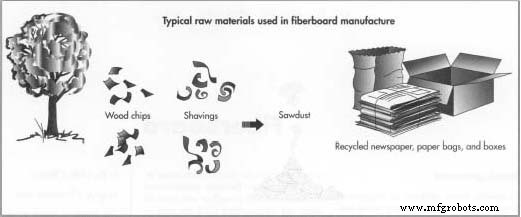
Traditional raw materials for fiberboard include wood chips, shavings, and sawdust. Increasing focus on sustainability has expanded the feedstock to include waste paper, corn silk, bagasse (sugarcane fibers), cardboard, plastic‑metal composite containers, telephone directories, and old newspapers. One company processes 100,000 tons of such waste annually, recycling the materials into high‑quality MDF. Synthetic resins bind the fibers, and additional additives improve performance.
The Manufacturing Process
Advancements in technology have markedly improved MDF quality. Innovations span wood preparation, resin formulations, press machinery, and panel sanding techniques. Modern presses reduce cycle times, while anti‑static systems extend belt life during sanding.
Wood Preparation
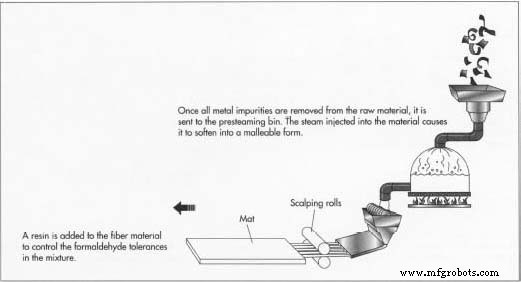
- Selection and refinement of recycled fibers begins with magnetic separation to remove metal impurities. The material is then sorted into large chunks and small flakes, with flakes further divided into sawdust and wood chips.
- After a second magnetic scan, unused material is diverted as fuel. The remaining fibers are pre‑steamed, then fed through side‑screw and plug‑screw feeders that compress and dewater the material. A refiner tears the fibers into uniform strands; a second refining step may be employed to enhance purity. Large‑motor refiners also sift out foreign objects.
Curing and Pressing
- Resin is added before refining to control formaldehyde content, and a catalyst is introduced afterward. The fibers are blown into a flash‑tube dryer heated by oil or gas. Precise weighing ensures the correct resin‑to‑fiber ratio.
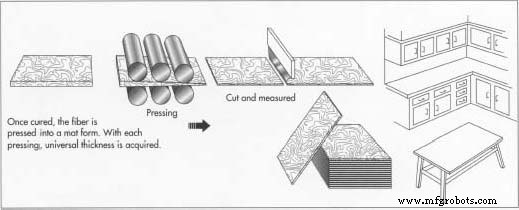
- Compressed mats pass through scalping rolls to achieve uniform thickness, then undergo multiple pressing stages. A continuous press equipped with a large drum compresses the mat at a consistent rate, monitored by electronic controls that guarantee target density and strength. The final product is trimmed to specification and cooled before cutting to length.
- Presses feature counterbalanced, hydraulically‑powered closing systems that provide four‑point position control, enabling individual panel thickness precision and reducing pre‑cure issues.
Panel Sanding
- Panels are sanded with belts coated in abrasives such as silicon carbide or ceramic alternatives (zirconia‑alumina, aluminum oxide) to achieve fine, smooth surfaces. Eight‑head sanding machines and double‑sided grading deliver consistent finish quality. Anti‑static technology eliminates static electricity, reducing dust and extending belt life.
Finishing
- Depending on the final application, panels may receive a variety of finishes. Lacquer colors and wood‑grain patterns can be applied, and surface embossing is common. Guillotine cutting produces large sheets (up to 100 inches wide), while die cutting handles smaller sizes (42 × 49 in). Narrow strips (1–24 in) are produced with specialty machines.
- Laminating machines apply vinyl, foil, or other veneers. The process involves unwinding a roll of MDF, applying adhesive between two rollers, bonding the laminate, and passing the composite through a laminator.
Quality Control
Most MDF plants employ computerized process controls to monitor every manufacturing step and maintain product consistency. Continuous weight belts, basis‑weight gauges, density‑profile monitors, and thickness gauges work together to preserve uniformity. The American National Standards Institute (ANSI) has established product specifications, including formaldehyde emission limits, for each application. These standards evolve with environmental regulations and market demands.
ANSI Standard A208.2, the current third edition, classifies MDF by density and intended use (interior or exterior) and defines four interior product grades. It specifies physical and mechanical properties, dimensional tolerances, and formaldehyde limits in both metric and inch‑pound units.
Key performance metrics—density, specific gravity, hardness, modulus of rupture, abrasion resistance, impact strength, modulus of elasticity, tensile strength, water absorption, thickness swelling, and internal bond strength—are measured per ASTM D‑1037. These tests ensure each panel meets industry benchmarks.
The Future
Although 750 new plants were added in 1996, consumption projected a 10 % decline in 1997, with certain markets and exports falling short of expectations. Nonetheless, plants that invest in high‑tech equipment and stringent environmental controls can still produce premium MDF.
Environmental regulations will continue to drive innovation. While urea‑formaldehyde resins dominate due to cost and fast curing, they raise formaldehyde‑emission concerns. Phenol‑formaldehyde resins, which do not emit formaldehyde post‑cure, offer a cleaner alternative, albeit at higher cost. Early studies suggest that smaller resin quantities can achieve comparable processing times.
Manufacturing advancements—such as press systems that eliminate pre‑cure and minimize panel‑thickness variation—will yield MDF with superior edge consistency, smoother surfaces, and enhanced physical properties. These improvements are expected to encourage broader adoption of MDF in furniture and cabinetry design.
Manufacturing process
- Professional Wood Stain: History, Types, and Production
- Charcoal Briquettes: From Ancient Fuel to Modern BBQ Staple
- Chopsticks: History, Craftsmanship, and Environmental Impact
- Understanding Lumber: Production, Types, and Industry Insights
- Advanced CNC Wood Machining Centers for Precision 3D Work
- Plastic vs. Wood Pallets: Selecting the Optimal Choice for Your Supply Chain
- Understanding Pressed Wood: Composition, Uses, and Benefits
- Pear Wood: Properties, Uses, and Benefits
- Understanding Fiberboard: Composition, Uses, and Advantages
- Wood: Key Properties for Construction & Design