



Understanding Asphalt Cement: Production, Applications, and Future Innovations
Background
Asphalt—dark, heavy, and resilient—belongs to the family of bituminous hydrocarbons. It serves as a robust, weather‑ and chemically‑resistant binder that unites crushed stone and gravel (aggregate) into durable surfaces for roads, streets, and airport runways. Asphalt, also known as mineral pitch, is sourced either from natural deposits (native asphalt or brea) or as a by‑product of petroleum refining. Its enduring utility dates back to 6,000 B.C., when Sumerians used it for ship caulking, and to 2,600 B.C., when Egyptians employed it for waterproofing and mummification.
Natural asphalt formed when crude petroleum rose to the surface, leaving behind a black residue after lighter oils were weathered away. While naturally occurring asphalt was common until the early 1900s, the advent of petroleum refining and the rise of automobiles dramatically expanded the industry. Modern petroleum asphalt matches the durability of natural variants but offers consistent purity and uniformity free of impurities.
Today, petroleum asphalt dominates highway surfacing. A typical paving mix is a dark blend of asphalt cement, sand, and crushed rock, applied hot, compacted, and cured. Asphalt also finds use in expansion joints, concrete patches, runway construction, sports surfaces, and roofing—particularly asphalt shingles and roll roofing where it provides waterproofing and preservation.
Raw Materials
The cornerstone of contemporary asphalt manufacturing is petroleum—naturally occurring liquid bitumen. Crude oils that are nearly pure asphalt are refined to extract the heavy fraction that becomes asphalt cement.
The Manufacturing Process
Crude petroleum undergoes fractional distillation in refineries, separating lighter products (gasoline, kerosene, diesel) from the heavy residue that forms asphalt. Because asphalt does not vaporize, it remains as a thick, viscous by‑product.
Distilling the Crude
- 1. Crude is pumped from storage into a heat exchanger where it is rapidly heated for initial distillation. It enters an atmospheric tower, where volatile fractions vaporize and are collected. The remaining heavy residue—often called topped crude—is further processed into asphalt. Vacuum distillation can remove high‑boiling fractions to produce a straight‑run asphalt; if low‑volatile components persist, solvent deasphalting may be employed.
Cut‑Back
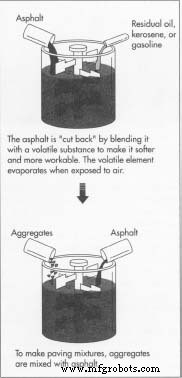
- 2. Asphalt can be blended with volatile solvents to create a cut‑back product that remains workable at lower temperatures. Upon exposure to air or heat, the solvent evaporates, leaving hard asphalt. The volatility of the additive defines slow, medium, or rapid‑curing classifications (e.g., residual asphaltic oil for slow, kerosene for medium, gasoline or naphtha for rapid).
Emulsifying
- 3. Emulsification produces a pump‑able liquid that can be mixed with aggregate or sprayed. Asphalt is ground into micron‑sized globules (5–10 µm), mixed with water, and stabilized with emulsifiers such as colloidal clay, silicates, soap, or sulphonated vegetable oils.
Pulverizing
- 4. Pulverized asphalt is crushed and sieved for uniform particle size. When mixed with road oil and aggregate, it binds under heat and pressure to form a material comparable to standard asphalt cement.
Air Blowing
- 5. For non‑paving applications such as roofing or pipe coating, asphalt is oxidized—or air‑blown—at 500 °F (260 °C) while air is bubbled for 1–4.5 h. The cooled product remains liquid but hardens at higher temperatures.
Asphalt Paving Mixtures
Asphalt cement is central to road construction. There are two primary mix types: hot‑mix (HMA) for high‑traffic roads and cold‑mix for secondary or maintenance roads. 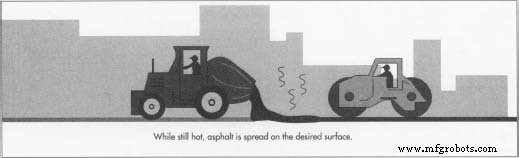
Hot‑mix is produced by heating aggregate and asphalt together to eliminate moisture and achieve proper fluidity. The mixture is then proportioned, blended, and delivered to the paving site for compaction while still hot.
- 6. In a mixing facility, asphalt and aggregate are heated, weighed, and combined in a pugmill (batch) or drum (continuous) system. The finished mix is loaded onto trucks or stored in surge bins.
- 7. Once transported to the site, the hot mix is spread and compacted by paving machines and heavy rollers, creating a smooth, durable surface.
Quality Control
Quality hinges on the source crude, refining method, and controlled processing. Key attributes include viscosity (fluidity at a given temperature), purity, and safety.
Viscosity is measured by penetration tests and varies with temperature; careful control prevents premature hardening. Purity is assessed by solvent dissolution (often with trichloroethylene) to confirm >99.5% solubility in carbon disulfide. Moisture must be excluded to avoid foaming—specifications require no foaming up to 347 °F (175 °C). The flashpoint, the temperature at which fumes ignite, is also monitored for safety.
Ductility—measured by the extension test at 77 °F (25 °C)—indicates the material’s ability to stretch under load. While high ductility can signal temperature sensitivity, it remains a critical performance metric.
Byproducts / Waste
Stringent environmental regulations limit water discharge, particulate matter, and gaseous emissions from refineries and asphalt plants. Controls include electrostatic precipitators, cyclones, baghouses, and exhaust recirculation to capture hydrocarbons and reduce odors. These measures not only protect the environment but also enhance process efficiency.
Rising material costs have driven widespread recycling. Three main recycling modes exist: hot‑mix recycling (centralized blending), cold‑mix recycling (on‑site or centralized), and surface recycling (in‑place heating, scraping, and re‑laying). Organic additives can rejuvenate aged asphalt to meet specifications.
Regulatory shifts discourage rapid‑curing cut‑back asphalts (gasoline/naphtha) due to volatility, while emulsified asphalts (water‑evaporating) are gaining preference for cost and environmental reasons.
The Future
Innovations aim to enhance sustainability and performance. Microwave recycling rapidly heats crushed rock, warming asphalt without combustion. Researchers are exploring synthetic asphalt from sewage sludge liquefaction and advanced emulsions. High‑performance gel‑permeation chromatography (HP‑GPC) offers rapid property profiling.
Polymer‑modified crack sealers and other additives—polymers, elastomers, metal complexes, fibers, lime, cement, silicones, and anti‑strip agents—control rutting, cracking, oxidation, and water damage. Emerging concepts include “smart asphalt” that adapts to moisture conditions, potentially improving safety when combined with modern vehicle technologies.
Manufacturing process
- Rubber Cement: From Ancient Glue to Modern Adhesive
- Comprehensive Guide to Asphalt Pavers: Design, History, and Future Trends
- Propane: Production, Quality Standards, and Environmental Benefits
- Understanding Roofing Shingles: Materials, History, Production, and Quality Assurance
- Concrete: Composition, Production, and Future Innovations
- Understanding Masonry Cement: Composition, Uses, and Benefits
- Mastic Asphalt Explained: Composition, Uses, and Benefits
- Understanding Soil Cement: Composition, Uses, and Benefits
- Gypsum Cement Explained: Properties, Uses, and Benefits
- Understanding Brick Cement: Types, Uses, and How to Choose the Right Formula