



Understanding Roofing Shingles: Materials, History, Production, and Quality Assurance
Background
Roofing shingles are produced from a range of materials, each chosen for its durability, fire resistance, and cost-effectiveness. Wood shingles, traditionally cut from red cedar or pine, now often come from sustainably harvested young trees and are treated with chemical preservatives to match the longevity of older, slow‑growing varieties. Chemical treatment also enhances fire resistance, a critical safety factor for modern homes. Aluminum shingles, though pricier, offer a long lifespan and excellent corrosion resistance. Asphalt shingles dominate the U.S. market, covering roughly 80% of residential roofs, thanks to their lightweight nature, low cost, straightforward installation, and minimal maintenance demands.
A standard asphalt shingle measures 12–18 in (30–46 cm) wide by 36–40 in (91–102 cm) long. Popular styles feature several cut‑outs along one edge, creating tabs that mimic individual shingles. These tabs—typically three, but ranging from two to five—allow shingles to interlock during installation, improving wind resistance.
History
Asphalt has been used as a building material for millennia. Ancient Babylonians employed it as mortar between clay bricks and as a waterproofing layer in canals. In the United States, roll roofing—long strips of asphalt‑coated felt with a stone finishing layer—has been manufactured since 1893. Henry M. Reynolds launched the first marketed asphalt shingles in 1903, cutting them from roll roofing sheets. By the 1920s, asphalt shingles were sold through mail‑order catalogs. The 1950s introduced the modern shingle with tab cut‑outs that we recognize today.
Since the late 1950s, manufacturers have shifted from organic felt to inorganic base materials to improve fire resistance and reduce weight. While asbestos‑filled mats were common until health risks were recognized, fiber‑glass mats have become the industry standard since the late 1970s, offering superior durability and lighter weight.
Raw Materials
Asphalt shingles, often called composite shingles, are built on a base of either organic felt or fiberglass. Organic felt mats derive from recycled paper or wood pulp, processed into water‑based sheets that are dried, cut, and wound onto rolls. Fiberglass bases, which provide higher fire resistance and lighter weight, are produced by blending chopped glass filaments with water, vacuum‑dewatering the pulp, and applying a binder before curing and cutting.
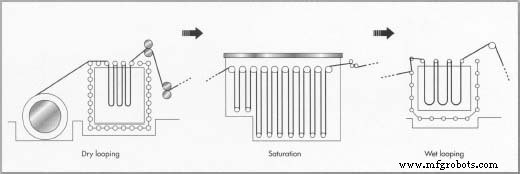
Manufacturing begins by mounting a roll of felt or fiberglass onto a dry looper. The material then traverses a presaturation chamber where hot asphalt removes moisture, followed by a saturator tank that coats the fibers. A wet looping machine may further saturate the mat by drawing asphalt into the fibers as it cools.
Asphalt is typically a by‑product of crude oil refining. Before use, it undergoes a “blowing” oxidation process—air is bubbled through heated asphalt with catalysts to achieve the optimal viscosity for shingle coating. Mineral stabilizers such as fly ash or finely ground limestone are added to enhance durability, fire resistance, and weather tolerance.
Top‑coat ceramic‑coated granules—available in various colors—protect shingles from UV radiation, increase fire resistance, and add aesthetic appeal. Granules may be natural stones or slag particles; copper‑containing granules help inhibit algae growth in humid climates. The shingle’s back surface is treated with sand, talc, or mica to prevent sticking during storage.
Thermoplastic adhesive strips are applied during manufacturing; when the shingles receive sunlight after installation, the adhesive activates, bonding overlapping pieces for enhanced wind resistance.
The Manufacturing Process
Asphalt shingles are produced by a single machine that sequentially adds each component, making the process efficient for both shingles and roll roofing.
Dry Looping
- A jumbo roll (6 ft/1.83 m) of organic felt or fiberglass mat is mounted and fed into the roofing machine. The base material first passes through a dry looper, where it is folded accordion‑style, allowing continuous operation even after a roll is exhausted.
Saturation
- The mat moves through a presaturation chamber, where hot asphalt sprays one side to expel moisture. It then enters a saturator tank, fully coating the fibers and filling voids.
Wet Looping
- After cooling, the asphalt is drawn into the mat, increasing saturation and ensuring a uniform coating.
Coating
- Stabilized coating asphalt is applied to both sides of the mat using a pair of coating rolls. A fine mineral particle coating is then applied to the back, embedded by rollers, and the material is cooled and cut to size.
Mineral Surfacing
- Ceramic‑coated mineral granules are applied to the top surface. A fine particle coating (talc or mica) is applied to the back, both embedded by rollers before final cooling.
Finishing
- The finished strip is folded accordion‑style on a cooling looper to stabilize temperature.
Cutting
- Using a back‑sided cutter, the material is sliced into individual shingles. Bundles, typically containing enough shingles to cover 25–35 sq ft (7.62–10.67 sq m), are stacked for shipping.
Packaging
- Bundles are wrapped and labeled by dedicated packaging equipment.
Quality Control
Quality assurance starts with the base material. The mats must exhibit sufficient tensile strength and tear resistance to survive manufacturing, and they are continuously monitored for moisture content and fiber distribution. During shingle production, key parameters—such as asphalt coating uniformity, mineral coating distribution, and final weight—are rigorously inspected.
Manufacturers may also invite independent third‑party labs to test samples. Compliance with Underwriters Laboratories (UL) and ASTM standards confirms that products meet stringent fire resistance, wind resistance, and structural performance criteria.
Byproducts and Waste
Manufacturing generates shingle fragments and tab cut‑off waste. In some cases, this material is repurposed for asphalt pavement. For example, North Carolina has permitted the use of shingle waste in road construction since 1995 without observed issues. However, high shipping costs often limit this application to plants located near pavement processing facilities.
Manufacturing process
- Comprehensive Guide to Asphalt Pavers: Design, History, and Future Trends
- Understanding Roofing Shingles: Materials, History, Production, and Quality Assurance
- Understanding Asphalt Cement: Production, Applications, and Future Innovations
- Dillman Equipment Drives Sustainable Asphalt Production
- Optimize Asphalt Compaction: Proven Rolling Patterns for Target Density & Production
- Optimal Placement of Asphalt Compactors During Breakdown Rolling for Maximum Density
- 3 Proven Tips for Synchronizing Asphalt Compactors with Pavers
- Mastering Asphalt Compaction: Key Techniques for Durable Pavement
- Mastic Asphalt Explained: Composition, Uses, and Benefits
- Asphalt vs. Concrete: Key Differences and Choosing the Right Material