



Rubber Cement: From Ancient Glue to Modern Adhesive
Background
Rubber cement is a solvent‑based adhesive made from unvulcanized (gum) rubber dispersed in a volatile solvent. It excels at bonding rubber to rubber, as only one surface requires coating. When attaching paper, both surfaces are treated; the solvent evaporates, leaving a resilient bond that can be gently separated without damage—an advantage over white glue.
Adhesives originate from natural animal or plant materials or synthetic polymers. Natural formulations are typically water‑soluble, whereas synthetic adhesives fall into thermoplastic, thermosetting, elastomeric, or hybrid categories. Thermoplastic adhesives like polyvinyl alcohol and acrylics can be re‑softened, while thermosetting adhesives (e.g., epoxies) cross‑link irreversibly. Elastomeric adhesives, such as isoprene‑based rubbers and silicones, provide elasticity and toughness.
The performance of a joint depends on adhesive properties, material compatibility, and surface condition. Proper wetting and spreading enable molecular contact, critical across industries such as packaging, construction, electronics, transportation, furniture, and medicine.
In 1996, U.S. adhesive consumption exceeded 12 billion lb (5.4 billion kg), with construction accounting for 40%—the largest share for rubber cement. Other significant markets include HVAC and automotive components. Manufacturers also supply rubber cement to re‑packagers who brand it independently.
Analysts estimated the global adhesive market at $19.1 billion in 1997, with packaging, construction, and furniture/woodworking driving over 65% of revenues.
History
Natural adhesives have been used for millennia. Egyptian carvings reveal the use of veneer glues; ancient fabrics were bonded with flour paste, and gold leaf was affixed to paper with egg white. Animal glues evolved through the eighteenth and nineteenth centuries, culminating in the first rubber‑based cements in the 1900s.
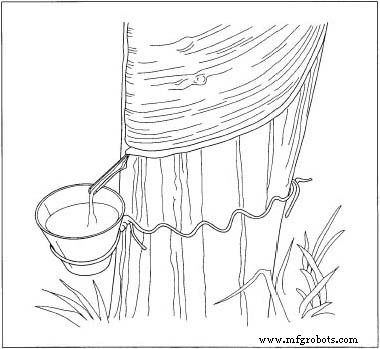
Natural rubber comes from the sap of the Hevea brasiliensis tree. The Maya and Aztec peoples first harnessed it over 2,500 years ago to waterproof footwear and garments. In 1823, Charles Macintosh, a Scottish chemist, pioneered waterproof textiles by dissolving rubber in naphtha, creating a rubber paste that bonded cloth layers into the first practical raincoat.
Raw Materials
Rubber cement is an opaque liquid comprising pulverized natural or synthetic rubber and a solvent blend of hexane or heptane. Typical formulations contain 70–90% hexane/heptane and 1–15% isopropyl alcohol or ethanol. Rubber is supplied as 100 lb (45 kg) slabs, while solvents are shipped in thousands of gallons by tank truck.
Natural rubber is harvested from the Hevea brasiliensis tree, tapped for latex that coagulates into a lump. The lump and residual material are processed at high temperatures to denature proteins and produce a solid rubber base. Synthetic variants such as neoprene and latex are produced via chemical polymerization, chosen based on the intended application.
Design
The final properties of rubber cement hinge on ingredient type and proportion. Laboratory formulations are scaled to production after rigorous testing for solids content, viscosity, tack, and heat load, ensuring consistent performance across batches.
The Manufacturing Process
The production line is streamlined and largely automated.
Mixing
- Rubber slabs are pulverized using twin‑roller mills or high‑speed mixers to a sawdust‑like consistency.
- Solvent blends (40–6,000 gal tanks) are stirred with paddles; rubber is gradually introduced until fully wetted and dispersed.
Packaging
- After thorough mixing, the solution is fed to an automated filling line that caps and secures each container.
- Products are offered in 4, 8, and 16 oz (118, 237, 473 ml) bottles, as well as quart (946 ml) and gallon (3.8 gal) containers. Explosion‑proof equipment handles the flammable material.
- Finished units are boxed in cardboard cases with full labeling; larger volumes are shipped in drums or tank trucks via gravity or pump feed.
Quality Control
Supplier specs dictate raw material quality. Each batch is tested for solids content by evaporating a sample and weighing the residue. Post‑mixing, viscosity, tackiness, heat load, and up to 20 other parameters are measured to guarantee batch uniformity. Final containers are inspected for proper labeling before shipment.
Byproducts/Waste
Automated, precisely calibrated equipment eliminates waste; excess material is recycled into the process. All shipments include an MSDS detailing safe handling of the volatile, flammable solvent. Under the 1990 Clean Air Act Amendments, adhesives are regulated as hazardous air pollutants, and EPA MACT standards protect public health.
The Future
U.S. adhesive demand was projected to surpass 15 billion lb (6.8 billion kg) by 2003—a 2.6% annual growth rate. The global market was expected to reach $26.2 billion in 2003, growing at 5.3% CAGR. The industry is shifting from solvent‑based to water‑based adhesives for improved environmental performance.
Manufacturing process
- What Is Vulcanized Rubber? A Professional Guide
- The Evolution and Craftsmanship of Rubber Stamps: From Invention to Modern Use
- Understanding Latex: Types, Production, and Future Trends
- Understanding Asphalt Cement: Production, Applications, and Future Innovations
- The History, Production, and Future of Toy Balloons
- Concrete: Composition, Production, and Future Innovations
- The Evolution and Production of Rubber Bands
- Tire: From Raw Materials to Advanced Design – A Comprehensive Guide
- Understanding Masonry Cement: Composition, Uses, and Benefits
- Understanding Soil Cement: Composition, Uses, and Benefits