



Tire: From Raw Materials to Advanced Design – A Comprehensive Guide
Background
A tire is a robust, flexible rubber shell that attaches to a wheel rim, providing traction and cushioning for moving vehicles. Modern tires are found on automobiles, trucks, buses, aircraft landing gear, agricultural machinery, forklifts, baby carriages, shopping carts, wheelchairs, bicycles, and motorcycles.
Most tires are pneumatic—air is pressurized inside the rubber. Historically, pneumatic tires used an inner tube, but contemporary designs form a direct pressure seal with the rim, eliminating the tube for greater reliability.
Scottish inventor Robert Thomson first created a pneumatic tire with an inner tube in 1845, but it was John Boyd Dunlop’s 1880s redesign that captured cyclists’ attention and sparked widespread adoption.
Natural rubber, harvested from the Hevea brasiliensis tree, remains the primary raw material, though synthetic rubber derived from petroleum polymers also plays a key role. To achieve the necessary strength, resilience, and wear resistance, rubber is chemically treated and heated—a process known as vulcanization or curing. Charles Goodyear accidentally discovered this technique in 1839, turning rubber into a durable material.
Today, global production exceeds 250 million tires annually. While automation drives many steps, skilled workers still assemble the final product, ensuring quality and precision.
Raw Materials
Natural rubber is extracted as a milky latex from the rubber tree, then solidified with acids, pressed into sheets, dried in smokehouses, baled, and shipped worldwide. Synthetic rubber comes from crude‑oil polymers. Carbon black, a fine soot produced by limited‑oxygen combustion of oil or natural gas, is added in massive quantities—so much that rail cars transport it and large silos store it at factories.
Other chemicals, such as sulfur, and various additives, are blended to tailor tire properties. For example, high‑friction compounds are used for racing tires, while low‑friction, high‑mileage compounds suit passenger cars. Flexibilizers keep rubber pliable during shaping, and UV stabilizers protect it from sunlight.
Design
A passenger‑car tire’s core components are the tread (the road‑contact pattern), the body (the layered rubber structure), and the beads (metal‑wire bundles that secure the tire to the rim). Modern design relies heavily on computer simulations that model stresses, wear, and traction. Engineers test up to twenty different rubber compounds within a single tire, selecting the optimal blend for each zone—tread, sidewalls, and body.
Once simulation results are satisfactory, manufacturing and assembly teams prototype the tire. Successful prototypes lead to full‑scale production.
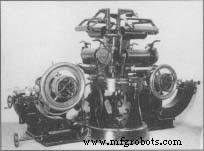 The tire‑building machine invented by W. C. State of Goodyear in 1909 dramatically increased workers’ productivity.
The Manufacturing Process
A passenger‑car tire is constructed by layering specially formulated rubber on a metal drum in a tire‑forming machine. Below is a step‑by‑step overview:
- 1. Mixing. Raw materials—natural or synthetic rubber, carbon black, sulfur, and other additives—are blended in large mixers that can handle up to 1,100 lb batches. Computer‑controlled recipes ensure consistency.
- 2. Remilling. The mix is reheated and remixed to soften the rubber and distribute chemicals evenly. Different formulations are produced for the body, beads, and tread.
- 3. Rolling. The softened rubber is passed through rolling mills to form thick sheets. These sheets are then cut into strips for the body, sidewalls, and tread.
- 4. Bead Formation. Wire bundles are wrapped, formed into rings, and covered with rubber to create the beads that anchor the tire to the rim.
- 5. Extrusion. Tread and sidewall rubber is extruded through dies to produce the required shapes and then sliced or rolled into the final forms.
- 6. Tire Building. At the tire‑building machine, a skilled assembler layers body plies around a collapsible drum, integrates the beads, and attaches sidewall and tread sections. The result is a “green tire.”
- 7. Curing. The green tire is placed in a clam‑shaped mold around a flexible bladder. Steam heats the tire to 280 °F, forcing it to mold against the steel walls and curing the rubber.
- 8. Inspection and Testing. After curing, the tire cools and undergoes rigorous checks for defects (bubbles, voids, imbalance). Test wheels with sensors measure balance and straightness before the tire is shipped to warehouses.
Body, Beads, and Tread
- The body comprises up to four plies—layers of rubberized fabric—providing structural integrity.
- Beads consist of tightly wound wire bundles that secure the tire to the rim.
- Tread rubber is sliced into strips and stored in large flat metal cases called “books.” Sidewall rubber is protected with a plastic sheet and rolled.
Tire‑Building Machine
- All components—sidewall strips, tread books, and beads—are delivered to a tire‑building machine. The machine’s central rotating drum holds the parts as the assembler wraps plies, locks beads, and attaches extruded rubber layers. The finished green tire is then removed for curing.
Curing
- During curing, the green tire is placed over a bladder inside the mold. Steam expands the bladder, shaping the tire against the mold walls and bonding all layers.
- Post‑cure, the tire is inspected for structural integrity, balanced on test wheels, and then stored for distribution.
Quality Control
Quality control starts with raw‑material suppliers. Manufacturers partner with vetted suppliers who provide detailed certifications. On arrival, chemists perform random tests to confirm properties such as tensile strength and density.
Throughout the mixing process, samples are taken and analyzed. Each component is tracked via code numbers and a comprehensive computer record system.
New designs undergo destructive testing: selected tires are sliced to check for internal voids, puncture resistance, and mileage under simulated conditions. Non‑destructive techniques, such as X‑ray videography, quickly reveal internal defects. Findings inform process adjustments to eliminate recurring flaws.
Consumer and dealer feedback is continuously correlated with production data to drive continuous improvement.
The Future
Ongoing advances in rubber chemistry and computational design are producing tires that last up to 80,000 miles and perform exceptionally in extreme weather. Modern tread patterns feature asymmetrical bands for superior traction on wet or snowy roads.
Engineers are also exploring non‑pneumatic tires that cannot deflate. One design uses a thick plastic slab attached to the rim, with a rubber tread secured to the slab. This construction offers lower rolling resistance, better fuel economy, and improved handling due to increased contact area.
Manufacturing process
- What Is Vulcanized Rubber? A Professional Guide
- How Rubber Bumpers Protect Industrial Machinery and Floors
- Rubber Cement: From Ancient Glue to Modern Adhesive
- The Evolution and Craftsmanship of Rubber Stamps: From Invention to Modern Use
- Understanding Latex: Types, Production, and Future Trends
- The History, Production, and Future of Toy Balloons
- The Evolution and Production of Rubber Bands
- Premium Liquid Silicone Rubber (LSR) Molding for Durable, Flexible Components
- Polyurethane vs. Rubber: Choosing the Best Material for Performance
- Expert Guide to Heavy Equipment Tire Selection and Longevity