



The History, Production, and Future of Toy Balloons
Background
A balloon is an airtight envelope made from a lightweight material that can be inflated with air or gas. Toy balloons come in a wide array of shapes, sizes, and colors, delighting both children and adults at celebrations and festive events.
Balloon technology traces its origins to France in the late 18th century. Two papermakers, Jacques and Joseph Montgolfier, discovered that paper bags filled with hot air rose, sparking the first public demonstration of a lighter‑than‑air balloon in June 1783. A 35‑foot (11 m) cloth balloon lined with paper marked the debut, followed by Jacques Charles’s 1783 hydrogen‑filled silk balloon coated with rubber varnish. These early achievements generated excitement and laid the groundwork for future scientific, sporting, and military applications.
The rubber toy balloon that we know today differs from those early designs by being made entirely of rubber. The ability to produce such items emerged gradually, beginning with the establishment of the world’s first rubber factory near Paris in 1803.
Natural latex—a suspension of rubber globules in water—coagulates when exposed to air, heat, or certain chemicals, forming an elastic, solid material. Vulcanization, through chemical additives or heat treatment, enhances strength, resilience, and temperature resistance.
Rubber’s use dates back to pre‑European South American cultures, who coated earth molds with latex. In 1830, English inventor Thomas Hancock patented a process of pouring or dipping latex into molds, foreshadowing modern dipped products such as gloves and condoms.
In 1921, a technique to retard latex coagulation was developed, enabling global transport of raw latex in liquid form and sparking new manufacturing methods. By the early 1920s, several British patents authorized liquid‑latex dipping. The first modern latex balloon appeared in 1931 when Neil Tillotson created “Tilly Cat” balloons—cat‑head shapes with printed whiskers—sold at a Massachusetts parade, and he founded a company that continues to produce balloons today.
While synthetic rubber exists, natural latex remains preferred for its superior elasticity—stretching seven to eight times its original length before returning to shape—unmatched by synthetic alternatives.
Raw Materials
Natural latex is a white or yellowish opaque liquid, resembling milk, sourced from the Hevea tree, primarily cultivated in Malaysia and Africa. Harvesting involves scoring the tree bark, collecting the sap into buckets, filtering to remove debris, and mixing with alkali to prevent coagulation before shipping to processing centers.
Before use, latex is blended with additives to achieve desired viscosity, drying rate, and durability. Antidegradants slow oxidation, while pigments—metal oxides or organic dyes—impart color.
The Manufacturing Process
Balloon production fundamentally revolves around dipping a mold—shaped like a deflated balloon—into liquid latex.
Early forms were disposable cardboard and dowel assemblies; contemporary forms are reusable, typically stainless steel, aluminum, or porcelain, polished for a smooth finish. Multiple forms are mounted upside‑down on racks that move mechanically through the factory line.
Efficiency is achieved through a highly automated, continuous loop, producing batches of identical color and size to minimize manual intervention, which is reserved for setup, packaging, and occasional maintenance.
Preparing the Latex
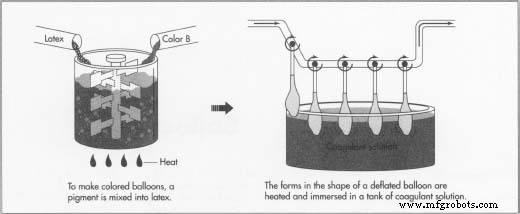
- 1. Color may be added by mixing pigment into the latex on site or by purchasing pre‑pigmented latex.
- 2. Latex is poured into temperature‑controlled tanks equipped with stirrers to maintain uniformity.
Dipping the Forms
- 3. Forms are heated and briefly immersed in a coagulant solution (water, calcium‑based salt, soap, talc). The salt initiates gelation; soap promotes even film formation; talc eases later removal.
- 4. Heated forms are then dipped in colored latex. Timing is critical: a brief immersion yields a thin coating; prolonged immersion thickens the film. Controlled speeds prevent air bubbles and ensure evenness.
Making the Ring
- 5. A lip at the balloon’s neck is created by rolling edges with brushes or rollers, forming the characteristic ring.
Removing Excess Coagulant
- 6. Forms are rinsed in a leaching solution—typically plain water—to dissolve residual coagulant.
Curing the Rubber
- 7. The latex layer is dried and cured. Some manufacturers use latex pre‑laden with vulcanizing agents, drying at moderate temperatures. Others perform vulcanization in ovens for up to an hour.
Removing the Balloons
- 8. Balloons are detached mechanically, often by spraying water or air and collecting them in baskets or nets.
- 9. Water‑sprayed balloons are spun in a centrifuge to expel excess moisture.
- 10. Final drying occurs in large tumble dryers.
Printing and Packaging
- 11. Balloons may be printed before packaging or packaged directly. When packaged directly, a conveyor passes balloons past a counter before bagging and sealing.
- 12. Printing involves inflating each balloon on a device, applying a pattern—logos, faces, or other designs—manually, then routing them to packaging.
Quality Control
Manufacturing environments are tightly regulated. Computer‑based instrumentation continuously records and controls humidity, ambient temperature, latex and oven temperatures, and dryer conditions to maintain consistency.
Precise formulation of latex and chemicals ensures specific viscosity and drying characteristics. Tanks incorporate circulation systems to prevent skin formation and settling.
Byproducts/Waste
Minimizing rubber waste is economically vital, given the high cost of latex relative to individual balloon prices. Coagulant is largely reclaimed; unreclaimed waste is regulated by environmental laws. While latex eventually biodegrades, post‑manufacturing waste from discarded balloons still contributes to litter.
Safety Concerns
Though toy balloons bring joy, they can pose hazards. Children may suffocate on balloons, and latex balloons that enter aquatic environments can be mistaken for jellyfish, posing threats to marine life such as whales and turtles.
The Future
Competition drives continual automation, especially in printing and packaging. Emerging technologies aim to reduce manual steps. Metal‑film balloons—constructed from Mylar polyester sandwiches—have gained popularity. Their flat origin facilitates printing, and the reflective foil yields bright designs. They offer greater strength and durability than rubber but are less versatile—unable to twist or hold liquids—and decompose more slowly.
Manufacturing process
- What Is Vulcanized Rubber? A Professional Guide
- How Rubber Bumpers Protect Industrial Machinery and Floors
- Angioplasty Balloons: How They Work, History, and Future Advances
- Rubber Cement: From Ancient Glue to Modern Adhesive
- The Evolution and Craftsmanship of Rubber Stamps: From Invention to Modern Use
- Hot Air Balloons: From Montgolfier to Modern Flight
- Understanding Latex: Types, Production, and Future Trends
- The Evolution and Production of Rubber Bands
- Tire: From Raw Materials to Advanced Design – A Comprehensive Guide
- Premium Liquid Silicone Rubber (LSR) Molding for Durable, Flexible Components