



Tofu: History, Production, and Health Benefits
History
Tofu, derived from soybean curds, traces its roots to ancient China, where it was first documented as doufu in the second century B.C. The legend attributes its accidental creation to Liu An of Huai‑nan, who treated soybeans like grains—drying, mashing, and boiling them—and used sea salt to coagulate the resulting mash into curds. Other accounts suggest the curd‑making technique migrated from neighboring regions. Regardless of its precise origins, the process of forming tofu with a sea‑water precipitate was established by the 2nd century B.C., a method still used by many producers today.
Historical texts note that soybeans were cultivated in northern China as early as the 15th century B.C. during the Shang period. A 6th‑century Chinese agricultural encyclopedia cites that the explorer Chōken introduced soybeans from Greece, Rome, and India. Even earlier, Emperor Shēng‑nǔn’s 2838 B.C. treatise on plants includes a detailed description of the soy plant, while Chinese agronomists in 2207 B.C. documented its cultivation. The plant’s nitrogen‑fixing roots earned it a place among China’s Five Sacred Grains.
In the 8th century, Buddhist missionaries carried soybeans to Japan and Korea. Monks promoted tofu as a wholesome, protein‑rich alternative to meat, believing a vegetarian diet benefited the spirit. Initially favored by the Japanese elite, tofu spread across all social strata by the Muromachi period (c. 1400 A.D.).
Prior to World War II, tofu production in Japan and China was largely artisanal, with families using identical ingredients, methods, and tools. The 1960s Japanese Food Research Institute modernized the industry by recommending calcium sulfate as a coagulant, replacing the traditional sea‑water precipitate (nigari), and introducing pressure cookers, hydraulic presses, and centrifuges. While these innovations increased efficiency, some purists argue they altered tofu’s flavor. Traditional manufacturers continue to uphold classic techniques.
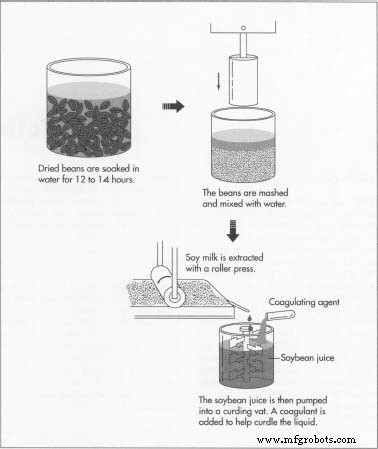
Tofu’s core ingredients are minimal: soy milk, water, and a coagulating agent. Modern production largely automates the traditional hand method.
In the U.S., soybeans entered the market in the mid‑1700s, gaining popularity during the California Gold Rush when Chinese immigrants introduced tofu. Post‑World War II, demand for Asian foods grew as returning soldiers brought back culinary influences. By the 1950s, U.S. soybean production matched Asia’s output, and today the U.S. supplies roughly two‑thirds of the world’s soybeans.
The 1970s saw tofu’s mainstream adoption as health‑conscious consumers sought protein sources with low saturated fat. By the 1990s, the industry had expanded to a 4‑million‑pound market, with tofu used as a meat substitute, in entrees, desserts, sauces, dips, and smoothies.
The Soybean
Soybeans (Glycine max) offer a balanced profile of protein, fat, carbohydrates, vitamins, and minerals. Their amino acid composition is complete, supporting human nutrition.
The plant grows 30–36 in (76–91 cm) tall, with a woody stem and greenish hairs. Leaves cluster in threes and drop as beans mature. Its papilionaceous flowers come in white, red, or purple. Pods measure 1–2 in (2.5–5 cm), each containing two or three round or oval seeds. Soybeans typically appear yellow but can also be green, purple, or brown.
As a legume, soybeans fix atmospheric nitrogen through root nodules hosting rhizobia, enriching soil fertility. Though tropical, they can thrive up to 52° N latitude. Farmers plant in mid‑May; after ~15 weeks, the beans are harvested mechanically.
The Manufacturing Process
Ingredients: soy milk, water, coagulating agent. Modern facilities process up to 3.5 tons of tofu daily from 5.7 tons of soybeans.
Soaking the Beans
- 60‑lb (27 kg) sacks of dried beans soak for 12–14 hours, doubling in size.
Processing the Soybeans
- Soaked beans are mashed with a Japanese stone grinder or similar appliance, blended with water into a slurry, and boiled to deactivate anti‑digestive enzymes.
- The soy milk is extracted via roller press, separating it from the hull and fiber pulp. The pulp, rich in fiber, can be used as livestock feed.
Solidifying the Soy Milk
- Extracted milk is poured into curding vats; a coagulant—calcium sulfate, magnesium chloride, or nigari—is added, altering pH and forming curds in ~20 minutes.
Pressing the Tofu
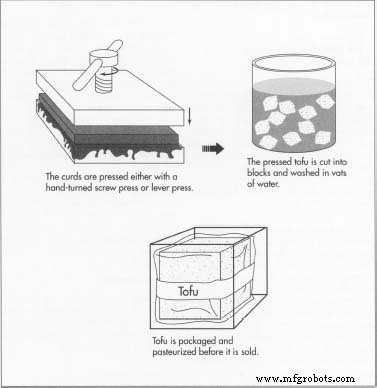
- Curds are pressed with hydraulic or centrifugal equipment (traditionally with hand‑turned screw or lever presses) to remove whey. The resulting blocks vary from dense, cheese‑like to soft or liquid textures.
Cutting the Tofu
- Automated cutters slice the tofu into 1‑lb (0.45 kg) blocks, wash them in water to firm, and store for further processing.
Packaging the Tofu
- Blocks are shrink‑wrapped or placed in continuous thermo‑formed packages; water may be added. They are sealed, weighed, dated, and sometimes processed directly in the package.
Pasteurizing the Tofu
- Packaged tofu is pasteurized at ~180°F (82°C), extending shelf life to ~30 days. It is then chilled to below 45°F (7°C) before distribution.
Quality Control
In the 1970s, U.S. tofu producers adopted meat and dairy industry standards due to a lack of specific guidelines. Early critiques highlighted blandness, a beany taste, and astringency. Advances in genetics have reduced lipoxygenase—a key enzyme causing off‑flavors—by breeding low‑lipoxygenase soybeans. Flavor additives also help neutralize residual taste.
The Future
Innovation continues to refine tofu’s flavor and texture. New products enter the market annually, propelling the segment beyond $100 million in the 1990s. Ongoing research into soy’s health benefits—particularly heart disease and cancer prevention—suggests demand for soy‑based foods will rise.
Manufacturing process
- What is VMC Machining? An Expert Overview of Vertical Machining Centers
- Expert Guide to Aluminum Laser Marking: Precision, Durability, and Industry Applications
- MIG vs. TIG Welding: Selecting the Right Arc Welding Technique for Your Project
- Comprehensive Guide to Laser Marking: Types, Benefits, and Applications
- Key Considerations for High‑Volume Swiss Machining
- The History and Making of Authentic Soy Sauce
- Tofu: History, Production, and Health Benefits
- Hydrothermal Synthesis of Blue‑ and Green‑Emitting Carbon Quantum Dots from Tofu Wastewater
- Diversifying U.S. Soybean Sales: The Role of Container Shipping
- Understanding Tofu Buildings: Causes, Risks, and Safety Measures