



Screwdrivers: From Archimedes to Modern Manufacturing
Historical Background
Almost every American household contains at least one screwdriver—one of the most ubiquitous hand tools in the world. Its lineage stretches back to antiquity, reflecting a long history of innovation and evolving manufacturing techniques.
Archimedes is credited with inventing the screw in the 3rd century B.C. — not for fastening but to transfer motion, as in the continuous worm‑gear assembly. By the 1st century B.C. wooden screws were already employed in wine‑and‑olive‑oil presses, with a corkscrew‑like handle to turn them.
Metal fasteners appeared in the 15th century, but early screw heads were square or hexagonal and turned with a wrench. The first documented screw with a slot—compatible with a screwdriver—emerged in the 16th century, though the exact tool remained unknown.
The modern screwdriver evolved from a flat‑bladed bit used in a carpenter’s brace circa 1750. Woodworkers began using hand screwdrivers in the early 1800s, and the tool became commonplace after 1850 when machine production of screws and drivers became possible.
Early screwdrivers featured a uniformly flat shaft. Modern designs employ a rounded shank that is flattened only at the tip, enhancing strength and exploiting the round wire used in manufacturing. The oldest and most common type remains the slotted screwdriver, designed for screws with a single slot. Today, there are roughly thirty distinct screwdriver types, each tailored to specific screw heads.
Design Milestones
The Phillips screwdriver, introduced in the late 1920s by Henry Phillips, revolutionized assembly by allowing greater torque from power tools. Its “cam‑out” feature—where the driver slides out when fully seated—ensures screws are fully driven. Modern Phillips drivers incorporate design tweaks to minimize cam‑out, such as angled edges or advanced grip coatings.
To address cam‑out while maintaining torque, the Torx driver was created for automotive and other high‑torque applications. Its six‑edge star pattern fits square‑shaped screw heads, offering both strength and precision. Torx drivers are frequently sold in sets that include slotted and Phillips options.
Other specialized drivers—such as Robertson (square), Pozidriv, and unique dual‑slot types—serve niche applications. Despite innovation, consumer adoption of new driver types remains limited, often due to the inertia of existing screw inventories.
Raw Materials
The core components of a screwdriver are steel wire for the shank and cellulose‑acetate plastic for the handle. Steel tips are commonly plated with nickel or chromium to resist corrosion.
Manufacturing Process
Steel Bar Production
- Large coils of green wire—often 3,000 lb (1,362 kg)—are drawn to the required diameter (≈0.375 in, 0.95 cm) using adjustable drawing machines.
- The wire is annealed at ~1,350 °F (732 °C) for 12 hrs to achieve optimal tensile strength.
- After straightening, a cold‑forming press cuts the wire to length, shapes the tip and wings, and the bar undergoes a high‑temperature quench (~1,555 °F, 846 °C) followed by a draw‑back bake (450–500 °F, 232–259 °C) to set hardness.
- Consumer models receive nickel plating before assembly. Professional models are hand‑ground, chemically milled, polished, and then nickel‑chrome plated.
Phillips Drivers
- After cold forming, a swage‑and‑grind operation shapes the tip and wings. Professional models then undergo an automatic tipping machine to create a bullet point and a profilator to carve the four Phillips slots.
- Bars are heat‑treated identically to flat‑tip drivers. Consumer Phillips drivers are nickel‑plated; professional versions receive polishing and nickel/chrome plating.
Handle Fabrication
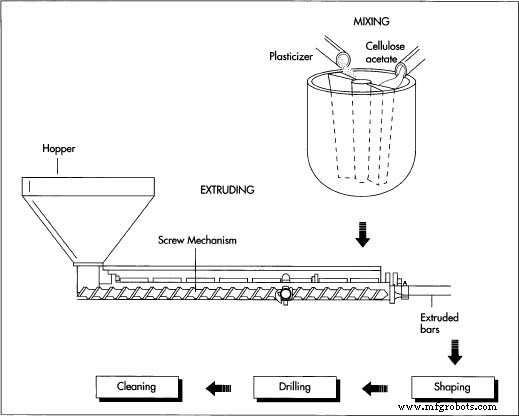
- Cellulose‑acetate powder is blended with a liquid plasticizer and optional pigments in a large mixer. The resulting paste is extruded into bars (8–10 ft, 2.4–3 m) and cut into pellets.
- Pellets are extruded again to form the final handle shape, then cut to length. A hole is drilled for the shank insertion.
- Handles are washed, dried, and subjected to an acetone vapor bath—performed in an explosion‑proof chamber—to smooth the surface.
Assembly
- Professional models are assembled individually on a hydraulic press that forces the bar into the plastic handle, with hot‑stamped branding applied just before assembly.
- Mass‑market models are assembled on hydraulic presses in batches (three or six units), then robot‑packaged into skin cards.
- Optional accessories—such as rubber grips or large‑handle covers—can be added for ergonomic enhancement, especially for professional users.
Quality Control
Consumer Reports (1983) found that finish type had minimal impact on overall screwdriver quality; however, poor plating and grinding can compromise durability. Rounded edges from inadequate grinding or burned tips from excessive heat reduce torque efficiency and longevity.
Manufacturing process
- Structural Screws: The Heavy‑Duty Fasteners Every Builder Trusts
- Prevent Screw Stripping: Expert Tips for Long‑Lasting Fasteners
- Screws: History, Materials, Design, Manufacturing, and Quality Standards
- Cap Screws Explained: Types, Applications, and How to Choose the Right One
- Offset Screwdriver Explained: Purpose, Benefits, and Applications
- Understanding Screw Jacks: Types, Uses, and How They Lift Vehicles
- Understanding Screw Joints: Definition, Uses, and Advantages
- Comprehensive Guide to Ball Screw Support Units
- Micrometer Screw Gauge: Definition, History, and Practical Use
- Screw vs. Bolt: Key Differences, Types, and Applications