



The Evolution and Future of Satellite Dish Technology
Background
A satellite dish is a parabolic television antenna that captures signals from communication satellites orbiting Earth, delivering a broader range of channels to the viewer. While the first communication satellite, Echo I, launched in 1960 transmitted telephone signals, Relay followed in 1961 with TV broadcasts, and Syncom became the first geostationary satellite to provide continuous coverage to a specific region.
Satellite television only reached mainstream audiences in the 1970s, when cable operators began installing dishes to receive feeds that were then distributed via coaxial cable. By 1976 cable companies owned 130 dishes, and by 1980 every cable station had at least one. Personal satellite dishes, originally costing about $35,000, were pioneered by Stanford researcher Taylor Howard, whose 16‑foot aluminum mesh dish first operated on 14 September 1976. Five years later, 5,000 home dishes were sold, and in 1984 a staggering 500,000 were installed worldwide. Today, the global market exceeds 3.7 million units and continues to grow.
Raw Materials
Modern consumer dishes are built from a few key components:
- Parabolic reflector made of fiberglass or aluminum, featuring a central feed horn and amplifier.
- Steel actuator for satellite selection.
- Aluminum shroud (6–18 inches tall) to reduce side interference, illustrated below.
- Cables—typically vinyl‑tubed copper wiring.
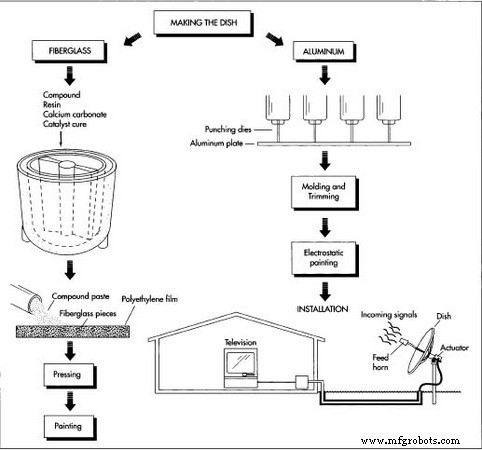
Fiberglass dishes are produced by mixing resin, calcium carbonate, and a curing catalyst with a reflective metallic compound, then pouring onto a polyethylene film with embedded fiberglass. The composite is pressed into shape under high pressure (1,400–2,200 metric tons) and finished with a protective paint coat.
Aluminum dishes are perforated with a punching die; hole size is critical—smaller holes reduce signal loss, especially for powerful satellites in the K band (12 GHz). After perforation, the plate is heated, stretched over a mold, cooled, and powder‑coated with electrostatic application before being sealed at the factory.
Mesh petals, often extruded aluminum, are assembled on site by sliding them into ribbed brackets and securing them with metal pins.
Manufacturing Process
- Mix the sheet‑molding compound (resin, calcium carbonate, metallic reflector, UV scatter) with a catalyst to create a paste. Pour onto a fiberglass‑reinforced polyethylene film.
- Press the sheet at 89 °F (30 °C) to mature, then shape into a parabola under high pressure. Trim, cool, and paint. Once the paint dries, the dish is boxed for shipment.
- For aluminum dishes, perforate the plate, heat, stretch over a mold, cool, trim, and apply a powder coating. Petals may be pre‑assembled with ribs or installed separately.
- Extruded mesh petals are slid into ribs and pinned into place during on‑site assembly.
Installation
- Factory‑installed feed horns and amplifiers are shipped to the dealer. Dishes can be installed by professionals or the owner with retailer assistance, depending on size and skill.
- Select a site within 246 ft (75 m) of the home, free of obstructions and compliant with local codes. Build a concrete foundation below the frost line; for unstable sites, a slab mount (1.6 ft × 3.2 ft) may be required. A triangular steel mount is embedded in the concrete.
- Attach the pedestal to the base or mount, then attach the elevation arm.
Alignment
- Precisely point the dish at the chosen satellite. Elevation and azimuth angles depend on satellite position and latitude. Coaxial cables run from the dish to the home receiver; bury them in a trench lined with pipe.
Quality Control
Consumer dishes are not subject to the same stringent standards as commercial units, but key criteria are maintained: a smooth, exact parabolic surface; metal composition for microwave reflection; minimal hole size for mesh dishes; and robust mounting to withstand extreme weather. Manufacturers test components against ASTM standards (ASTM A490 for steel, ASTM A683 for aluminum). After installation, owners should clean twice yearly, lubricate bolts annually, and trim surrounding vegetation. Rarely, realignment may be necessary for optimal reception.
The Future
Satellite dish ownership will expand as more satellites launch, particularly in the K band (12 GHz). Current C‑band dishes will need conversion to K‑band receivers. Engineers are developing ultra‑compact dishes (as small as 18 inches) suitable for windowsills or porch railings, and flat‑plate designs that simplify installation. Beyond TV, satellite connectivity promises two‑way communication for remote banking, e‑commerce, interactive gaming, and community outreach—potentially redefining one‑on‑one interaction in a globally connected world.
Manufacturers worldwide are racing to deliver smaller, cheaper, and more user‑friendly dishes, ensuring that satellite television—and the broader satellite Internet ecosystem—continues to proliferate in the years ahead.
Manufacturing process
- Russian Astronauts Successfully Deploy First Fully 3D‑Printed Satellite from the ISS
- Satellite LoRaWAN Bridges Connectivity Gap for Underserved IoT Markets
- Connecting the Remote World: How Satellite IoT Expands Global Coverage
- Comparing Auto‑Addressing Schemes for Bluetooth Car Access Systems
- Satellite Navigation & Software‑Defined Radio: Enhancing GNSS Performance
- Monitoring Satellite Health with Current‑Sense Amplifiers
- Award‑Winning 3D‑Printed Miniature Satellite Triumphs at India’s First CanSat Challenge
- Advanced Satellite Tracker: 3D-Printed Dish Powered by Arduino MKR1000
- Satellite Tech: A Game-Changer for Global IoT Connectivity
- Understanding Parabolic Dishes: Design, Function, and Applications