



Offset Screwdriver Explained: Purpose, Benefits, and Applications
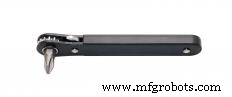
There are many variations on the standard screwdriver. The main reasons to use a non-standard screwdriver are for jobs that a straight screwdriver cannot reach or jobs that require more torque or power. An offset screwdriver is a variety of screwdriver that is used at a perpendicular angle from a traditional screwdriver. This offers a better angle for some jobs that could be awkward or even impossible with a normal screwdriver. This type of screwdriver can also offer increased leverage, making it easier to turn and remove screws that would otherwise be very difficult.
A typical screwdriver consists of a handle and a shaft, at the end of which is a blade that makes contact with the screw that needs to be turned. The main difference of an offset screwdriver is that the end of the shaft has a ninety degree turn. Instead of twisting the handle of a screwdriver to drive a screw in or out, an offset screwdriver turns more like the hands of a clock, and can be rotated both clockwise and counterclockwise.
A simple offset screwdriver consists of a metal shaft with a flathead or Phillips-type blade in an “L” shape, with the blade oriented on the short side. Some offset screwdrivers can contain blades on both ends of the shank that typically protrude in opposite directions from one another. In this variation, one of the two blades can be a flathead screwdriver while the other is a Phillips head. They can also be different sizes of the same style head.
There are more complicated types of screwdrivers, and for every one there will typically be a corresponding offset screwdriver. For example, some screwdrivers have removable blades that can be replaced with different sizes and types for various screws. The same type of offset screwdriver can be found, with a fixed handle but interchangeable blades. These are often sold as complete sets that contain the screwdriver along with a number of removable blade bits.
Another popular variation is a ratchet offset screwdriver. When tightening a screw with this, the user does not need to break contact between the blade and the screw since the tool keeps the blade stationary when twisting it in the opposite direction. This is also a handy feature when working with screws that in cramped spaces where the turn radius of the screwdriver is very small. These popularly contain interchangeable blades for increased utility, and are built with a switch that reverses the direction of the ratcheting mechanism to switch between clockwise and counterclockwise motions.
Industrial equipment
- Demagnetizers Explained: How They Add or Remove Magnetism from Tools
- Offset Lever Arms: Design, Benefits, and Industrial Applications
- Diamond Turning: Precision Machining for Advanced Optics and Beyond
- Screwdrivers: From Archimedes to Modern Manufacturing
- Understanding the Oxygen (O2) Sensor: Role, Placement, and Failure Signs
- Understanding AS9100: The Aerospace Quality Management Standard
- What Is A2 Steel? A Versatile, Cost‑Effective Tool‑Steel Grade for Industrial and Woodworking Applications
- Understanding Metal Casting: Process, Benefits, and Applications
- Demystifying 3D Printing: A Clear Guide for Innovators
- Decoding 'N' in Pump Calculations: Its Role and Significance