



Is Tungsten Magnetic? Expert Analysis of Its Properties, Behavior, and Engineering Uses
W. is known for its unrivaled strength, high melting point, and exceptional wear resistance. It is integral to aerospace, tooling, electronics, and high‑performance industrial systems. A frequent question among engineers and manufacturers is:
Is tungsten magnetic?
From a materials‑science standpoint, understanding tungsten’s magnetic response is essential when selecting materials for environments where magnetic interference could compromise performance or safety.
Pure tungsten is not magnetic in the conventional sense. Unlike ferromagnetic metals such as iron, nickel, or cobalt, it does not attract a permanent magnet and cannot be magnetized.
It is, however, a paramagnetic material: it shows only a very weak attraction to a magnetic field, a response that is generally undetectable without specialized instrumentation.
In practice, this translates to:
- A standard magnet will not attract a sample of pure tungsten.
- W. will not retain magnetism after the field is removed.
- Any magnetic response is negligible in most engineering contexts.
Why Tungsten Is Not Strongly Magnetic
Magnetic behavior depends on a material’s atomic structure and electron configuration. Tungsten’s outer‑shell electrons are unpaired, giving it weak paramagnetism, but they do not align to produce lasting magnetism. The effect vanishes immediately once the external field is removed, which is why tungsten is treated as a non‑magnetic engineering material in practice.
Why Some Tungsten Products Appear Magnetic
In industrial settings, certain tungsten components seem to react to magnets. The cause is usually the alloying or binding elements, not tungsten itself. Commercial tungsten products are often:
- W. alloys containing nickel, iron, or copper.
- W. carbide bonded with cobalt or other metals.
Elements such as cobalt, iron, and nickel are strongly magnetic, so the observed attraction originates from these constituents rather than the tungsten matrix.
Key Physical Properties of Tungsten
- Melting point >3,400 °C.
- Density ≈19.3 g / cm³.
- Exceptional wear resistance, especially in tungsten carbide.
- High strength retained at elevated temperatures.
These attributes make tungsten indispensable for high‑performance engineering.
Why Tungsten’s “Non‑Magnetic” Nature Matters
Although technically paramagnetic, tungsten is conventionally considered non‑magnetic in engineering practice. This quality is valuable in several domains:
- Precision Measurement – Minimizes magnetic interference in coordinate‑measuring machines and sensitive instruments.
- Medical & Imaging – Low magnetic interaction improves safety and performance near MRI systems.
- Aerospace & Defense – Reduces magnetic signatures that could interfere with navigation and detection.
- Electronics & High‑Frequency Systems – Helps preserve signal integrity by avoiding electromagnetic disturbances.
Machining Considerations for Tungsten
From a CNC perspective, tungsten’s high hardness and brittleness present significant machining challenges:
- Hardness accelerates tool wear.
- Brittleness increases crack risk.
- High density adds cutting resistance.
W. carbide, being even harder, requires:
- Specialized cutting tools (carbide or diamond).
- Optimized cutting parameters.
- Advanced cooling strategies.
- Precision grinding or EDM.
Understanding tungsten’s magnetic behavior aids engineers in selecting appropriate machining and inspection methods.
Tungsten vs Magnetic Metals
For context, compare tungsten with common magnetic metals:
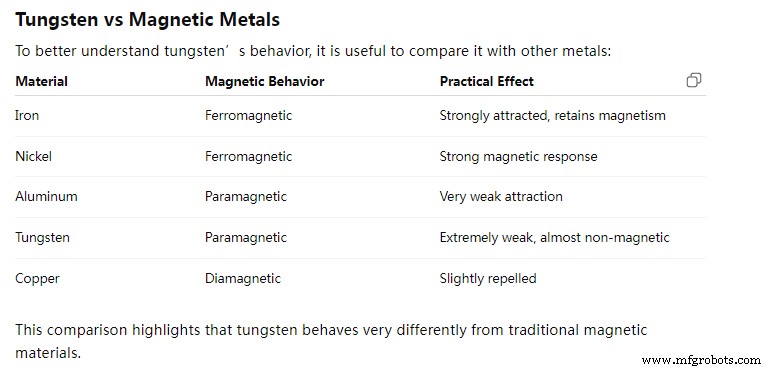
Conclusion
Pure tungsten is effectively non‑magnetic. While it exhibits weak paramagnetism, the material is treated as non‑magnetic in most engineering and manufacturing settings. Any noticeable magnetic response in tungsten products typically stems from alloying elements such as cobalt, nickel, or iron. For engineers and manufacturers, awareness of tungsten’s magnetic properties is critical when selecting materials for precision, medical, aerospace, or electronic applications.
Manufacturing process
- Chromium, Nickel, and Zinc Plating: Key Differences and Applications
- Expert Guide to Creating Sand Casting Molds for Foundries and DIY Projects
- The History, Ingredients, and Production of Graham Crackers
- Powertrain vs. Drivetrain: What They Are and Why It Matters
- Arduino Joystick‑Controlled Mouse: Precise Cursor Navigation
- Consumer Product Design: A Practical Guide for Success
- Build a Wall‑Avoiding Robot with Raspberry Pi – Step‑by‑Step Guide
- Premium Plastic Dolls: From Playtime to Collectible Art
- Expert Guide to Flea Collars: Design, Manufacturing, and Future Innovations
- Build a Functional Arduino-Powered 3D‑Printed Robotic Arm – Step‑by‑Step Guide