



The History, Ingredients, and Production of Graham Crackers
Background
Graham crackers are whole‑wheat biscuits flavored lightly with sugar or honey, available in a variety of sizes and shapes. First created in 1829, they have remained a beloved snack, with millions sold each year.
The invention is credited to Sylvester Graham, an American clergyman who championed unrefined foods. In 1829 he devised a cracker made from unsifted, coarsely ground whole‑wheat flour, marketing it as a health food. The product quickly gained popularity and was copied by other bakeries, eventually leading to mass production. Graham crackers are now a staple in many kitchens and a key ingredient in pie crusts.
Animal crackers share the same basic recipe but differ mainly in shape. Originating in late‑19th‑century England, they were later produced in the United States. The National Biscuit Company famously boxed them in circus‑wagon‑style packaging, a strategy that spurred numerous variations. Advances in the 1950s allowed for finer detail in the animal shapes.
Raw Materials
The core formula has stayed largely unchanged since 1829, featuring whole‑wheat flour, fat, and sugar as the main components.
Flour
Whole‑wheat flour contains the bran, germ, and endosperm of the wheat kernel. The bran and germ add flavor, fiber, and color, while the endosperm provides starch and protein that form gluten when mixed with water. This gluten network gives dough the elasticity needed for shaping. The flavor profile of graham crackers is largely determined by the particle size distribution of the flour; an improper mix can result in crumbly or lumpy crackers.
Fats and Oils
Typical recipes use hydrogenated vegetable shortening derived from soybean and cottonseed oils, which have been refined to remove strong flavors. Butter may also be employed, retaining its natural taste. Because fats are insoluble in water, they create a barrier that limits gluten formation, yielding a soft, crumbly texture while enhancing appearance and flavor.
Sweeteners
Sugar (sucrose) from cane or beet accounts for 5–15% of the dough, providing the slight sweetness. Other sweeteners such as dextrose, corn syrup, molasses, or honey are sometimes added to improve texture, color, aroma, and shelf life.
Other Ingredients
Seasonings like cinnamon and salt refine the taste. Whey is sometimes added to balance flavor without adding much. Leavening agents (sodium bicarbonate or sodium acid pyrophosphate) release CO₂, creating air pockets. Lecithin from soybean oil reduces stickiness, easing processing.
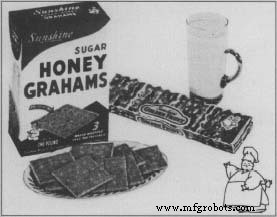 A 1959 graham cracker magazine ad. (Henry Ford Museum & Greenfield Village)
Modern graham crackers differ significantly from Sylvester Graham’s original recipe, which contained no fat or refined sugar. Graham, a health reformer born in Connecticut in 1794, advocated whole‑meal wheat flour as the basis for digestive foods. He publicly criticized commercial bakeries and urged home bakers to use whole‑meal flour instead of refined white flour. His ideas were later incorporated into large‑scale production, a practice he would have disapproved of.
Today, graham crackers contain whole‑wheat flour, sugar, and shortening.
Nancy EV Bryk
The Manufacturing Process
Producing graham crackers involves a sequence of steps that transform raw ingredients into finished products. Key stages include ingredient handling, compounding, shaping, baking, post‑conditioning, and packaging.
Ingredient Handling
- Major ingredients—flour, shortening, sugar—arrive in bulk and are stored in temperature‑controlled tanks. Liquid ingredients like shortening require precise temperature management to remain pumpable.
- During production, ingredients are transferred to mixing tanks via metered pumps (liquids) or pneumatic transfer (powders). Small‑scale items are weighed and poured manually.
Compounding
- The dough is mixed in vertical or horizontal mixers according to a strict recipe. Sugar, water, and shortening are blended first to create a cream‑like mixture. Subsequent additions produce a “short” dough that is allowed to rest for 2–3 hours for leavening agents to activate.
Machining
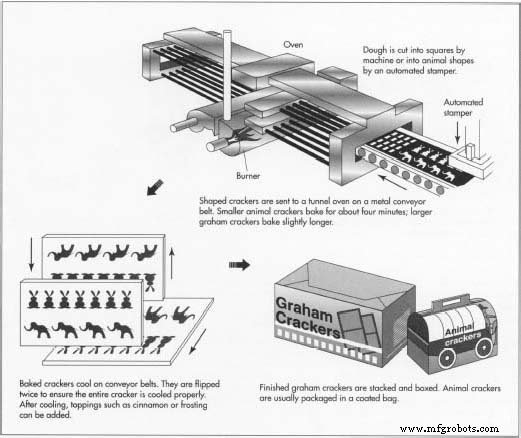
- Graham crackers are typically sold as squares or animal shapes. Dough is rolled thin on a conveyor, sometimes laminated with multiple layers. The sheet is then relaxed and fed to cutting machines.
- Rotary cutters trim smooth edges, while stampers shape animal crackers. After cutting, optional toppings such as sugar, cinnamon, or honey are applied.
Baking
- Crackers are baked in tunnel ovens 100–300 ft long. Three stages—development, drying, and coloring—control dough set, moisture loss, and browning. Conveyor speed determines bake time; animal crackers bake in about four minutes, while squares may require slightly longer.
Post‑conditioning
- After the oven, crackers cool on conveyors, being flipped to ensure even temperature reduction. Cooling typically takes twice as long as baking.
- Optional coatings (icing, chocolate, sugar) are applied via stenciling, extrusion, or deposition. Excess coating is removed by air or vibration.
Packaging
- Packaging must protect fragile products. Square crackers are stacked and wrapped in flexible film; animal crackers, being sturdier, are placed in coated bags. Both are boxed in decorative cartons, then shipped in larger case boxes on pallets.
Quality Control
Quality control starts with incoming raw‑material testing. In the lab, ingredients are evaluated for appearance, color, odor, flavor, particle size, oil viscosity, and pH to ensure consistency.
Each batch is monitored for physical attributes—appearance, flavor, texture, odor—against established standards. Sensory panels trained to detect subtle differences provide qualitative feedback. Instrumental analyses complement sensory data to guarantee product uniformity.
The Future
Trends in graham crackers focus on premium, healthier options. Marketers emphasize organic ingredients, low‑fat formulations, and new flavor profiles. Continued innovation aims to sustain consumer interest and long‑term sales.
Manufacturing process
- What is VMC Machining? An Expert Overview of Vertical Machining Centers
- Expert Guide to Aluminum Laser Marking: Precision, Durability, and Industry Applications
- MIG vs. TIG Welding: Selecting the Right Arc Welding Technique for Your Project
- Comprehensive Guide to Laser Marking: Types, Benefits, and Applications
- Key Considerations for High‑Volume Swiss Machining
- CNC Prototyping Guide: Precision, Speed, and Cost‑Effective Production
- Expert Shaft Manufacturing: Precision Processes & Custom Solutions
- Fiber Laser Marking: Precision, Speed, and Versatility for Modern Industries
- The History, Ingredients, and Production of Graham Crackers
- Meet Markforged’s Experts—Nick, Graham, Jeff—at Booth G39, TCT Show Birmingham