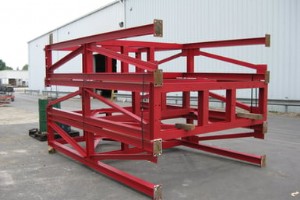
Industrial manufacturing
Manufacturing process


Manufacturing industries that are involved in making different types of cutting tools, hand tools, machine dies, and others typically maximise the properties of tool steels. Tool steels are carbon alloy steels that are known for their hardness, abrasion resistance, and ability to retain shape at hig
Punches or punch tools are small and narrow hard metal rods that feature a narrow sharp point or flat face on one end and a broad flat surface at the other. The narrow part of these tools is normally pointed against a target surface, effectively cutting, drawing circles, or punching some holes on a
Precision machining is a type of technical manufacturing that helps create and design parts, tools, machines, and other hardware intended for modern manufacturing. Products of precision machining are intended to maintain process controls and tolerances even under tight environments and specification
One metal fabrication process that is frequently used by numerous manufacturers is punching. Punching basically removes any scrap slug from sheets of metal or metal workpieces whenever the punch material enters the punching die. Holes and openings are typically left whenever the punching process is
Machining processes like drilling, turning, or mining are all available to effectively create and produce hard materials, especially the metal ones. However, most of them cannot produce intricate and sophisticated parts and components that are needed for certain applications. Fortunately, one known
Most manufacturing industries use tooling products as part of their daily processes. These tools are intended to cut, remove, or any other actions that will be applied to certain areas in a workpiece before proceeding to the next steps of their whole fabricating process. One factor that affects thei
Steel is commonly used in a wide variety of applications that require framework strengthening and structural support. Roads, buildings, bridges, airports, and other infrastructures are often built with steel because of its reliable strength and fracture resistance. Aside from the construction indust
When talking about the dies themselves, they are known to be a unique precision tool that can cut and form sheet metal into a desired shape or profile. They have cutting and forming sections that are made from durable materials. Given their importance, the overall design of your die must employ cost
Tool steels are carbon and alloys steels that have distinct characteristics such as hardness, wear resistance, toughness, and resistance to softening at high temperatures. These steels are comprised of carbide-forming elements such as chromium, vanadium, molybdenum, tungsten, cobalt, and nickel in d
Once upon a time, professional engineers would research every detail of a piece so that they can craft it perfectly. After all, these engineers have the main task of optimising complex processes or systems by developing, improving, and implementing integrated systems of people, knowledge, and many m
Different industries have been utilising various types of punches for their works for a long time now. Punches are usually made from a hard metal rod with a pointy tip at one end and a dulled end at the other. They are often used in conjunction with other tools like hammer and chisel to cut and shap
A lot of industries are now utilising CNC machining since it only reduces manual labour works and overall costs. This process also produces precise, high-quality products under a short time, which makes it more efficient than its manual counterparts. This efficiency even extends to the fact that CNC
Just about any kind of material can be formed by CNC machines. Following on from this thought, Computer Numerical Machines (CNC) have the capacity to transform these materials into all sorts of intricately fashioned components. Really, there’s no limit to the detailed shapes that can be create
Considering industry pressures, punch and die facilities can’t afford significant periods of machine downtime, not if they’re to remain a competitive force in an aggressively growth-oriented manufacturing sector. Unfortunately, as potent as these tools clearly are, they are susceptible t
One of the most common metal fabricating processes in manufacturing industries is metal shearing. During this process, both the upper and the lower blade are forced to meet each other so that the metal would be uniformly cut. This process does not promote any type of burning or melting. However, met
Today, the industry of die and mould machining has been growing alongside the rise of technological advancements. The evolution of metalworking technology right now allows businesses to skip most time-consuming and labour-intensive aspects of die and mould machining. The process of grinding or polis
One of the most used types of machine press is a punch press. This type of machine press can cut precise holes in a piece of material. Using punch presses for your daily business operations can help you obtain high precision, rigidity, and efficiency on your final products. They can also save you a
A J-hook is a type of punch deformity, one that occurs due to tool wear. It’s a shape, a wear pattern that appears as an inward-curling burr of punch tip metal. Left like this, the tool will pick and snag at an opening as it performs its full stroke. If things go downhill from here, premature
If a multi-tonnage press snaps down at breakneck speed, will a punch eject a razor-sharp blank? Not necessarily, not if there are certain quality-attenuating factors hindering the process. For one thing, what kind of shape is the die in? If it’s worn and chipped, then metal punching quality is
Kicking off with a straightforward explanation, one that forming equipment maintenance professionals know all too well, oily films neutralize friction. If there’s little to no friction during a machine’s operating stroke, then there’s less wear and less broken parts to replace. Sur
Manufacturing process