



Industry 4.0 in Maintenance: A Practical Blueprint for the Future
Industry\u00a04.0 is shaping the maintenance landscape. It dominates discussions in blogs, conferences, and boardrooms, yet conversations often feel laden with buzzwords and promise without substance. This article cuts through the noise to explain what Industry\u00a04.0 truly means, how it intersects with maintenance, and actionable steps you can start today to future‑proof your operations.
What Is Industry\u00a04.0?
Industry\u00a04.0 represents the latest paradigm shift in manufacturing—a convergence of advanced analytics, connected machinery, and autonomous decision‑making that builds on the digital foundations laid by Industry\u00a03.0. While Industry\u00a03.0 introduced computers into production, Industry\u00a04.0 enables those computers to communicate, learn, and optimize in real time.
Industry\u00a01.0
Mechanization powered by water and steam.
Industry\u00a02.0
Mass production and electric assembly lines.
Industry\u00a03.0
Digitalization of manufacturing processes through computers.
Industry\u00a04.0

Smart automation driven by data, machine learning, and interconnected systems.
By harnessing connectivity and analytics, Industry\u00a04.0 delivers higher efficiency, reduced waste, and new business models.
Decoding Industry\u00a04.0 Terminology
Terminology can obscure reality. Understanding each term clarifies why they matter for maintenance.
Artificial Intelligence (AI)
AI is a broad field that enables computers to emulate human reasoning. Historically, tools like calculators were early AI; today, virtual assistants and generative design systems are common AI applications that transform engineering workflows.
Machine Learning (ML)
ML trains algorithms to detect patterns in large datasets and make predictions. For example, Netflix recommends titles based on viewing history, and medical imaging systems detect disease markers by learning from thousands of scans.
AI is the overarching framework; ML is one of its key pillars—alongside the Internet of Things and Big Data—that together extend computational capabilities beyond human limits.
Industrial Internet of Things (IIoT)
IIoT links sensors, actuators, and software to collect, exchange, and analyze operational data in real time. It replaces fragmented data collection with a unified, machine‑to‑machine communication network that fuels smarter decisions.
For maintenance, IIoT transforms reactive troubleshooting into proactive management by providing continuous visibility into asset health.
Big Data
Big Data refers to the volume, velocity, and variety of information that can be mined for insights. By aggregating large datasets—such as equipment logs, environmental readings, and production metrics—organizations uncover trends that drive efficiency and reduce costs.
When applied to manufacturing, Big Data helps identify root causes of downtime, optimize inventory, and refine maintenance schedules.
How Maintenance Leverages Industry\u00a04.0
Industry\u00a04.0 reshapes every layer of asset management—from daily technician tasks to strategic plant layout. Below are three core intersections:
Discover Three CMMS Integrations That Elevate Your Maintenance Program
Read more
Predictive Maintenance
Predictive maintenance (PdM) uses data to forecast equipment failures before they occur, allowing scheduled intervention that minimizes downtime and safety risks. The era of PdM has moved from theory to practice thanks to embedded sensors, cloud analytics, and CMMS integration.
Smart vibration and temperature sensors detect anomalies; connected CMMS systems automatically generate work orders and alert technicians via mobile devices.
Cost Control Through Data‑Driven Inventory
Inventory management is a prime candidate for efficiency gains. Data‑enabled reorder points, demand forecasting, and just‑in‑time delivery reduce carrying costs and stockouts.
3D printing exemplifies how on‑site part fabrication eliminates shipping delays and ensures critical components are available when needed, cutting unplanned downtime.
Proving Maintenance Value to the Bottom Line
Traditional metrics focus on the “when” of maintenance, not the “why.” Industry\u00a04.0 tools record detailed failure patterns, maintenance actions, and production impacts, enabling quantitative proof of maintenance ROI.
By integrating CMMS data with production and financial systems, organizations can link maintenance activities to key performance indicators such as uptime, cost per unit, and asset life expectancy.
Is Industry\u00a04.0 a Pipe Dream or a Practical Reality?
Adopting Industry\u00a04.0 is a journey, not a one‑off purchase. Success requires the right blend of technology, processes, and culture. Below are actionable steps your maintenance team can start today.
1. Master Preventive Maintenance
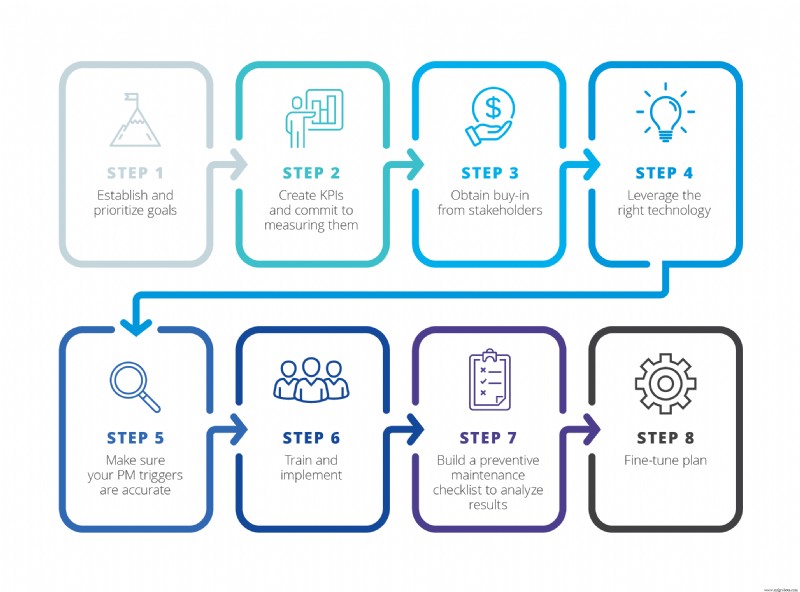
A robust preventive maintenance program lays the foundation for Industry\u00a04.0. Eight proven steps—goal setting, technology selection, KPI definition, training, and continuous improvement—ensure a stable platform for advanced analytics.
2. Prioritize High‑Quality Data
Data quality drives every 4.0 capability. Capture comprehensive asset histories, including failure details, repair actions, part usage, and duration. Standardize naming conventions, digitize records, and automate data feeds to guarantee accuracy and accessibility.
3. Build a Reliability Culture
Technology adoption starts with people. Establish clear asset‑management policies, formal processes, and open communication channels. Recognize and reward teams that champion continuous improvement and data‑driven decision‑making.
4. Start Small with Predictive Maintenance
Implement condition‑based maintenance (CBM) on a few critical assets. Use real‑time sensor data to create early warning systems, refine processes, and build confidence before scaling up to full PdM.
The Bottom Line: Unlocking Industry\u00a04.0’s Potential in Maintenance
Transforming maintenance through Industry\u00a04.0 is incremental. By adopting proven practices—preventive maintenance, data quality, cultural change, and phased predictive programs—you empower teams, reduce costs, and realize the long‑term benefits of connected, intelligent manufacturing.
Equipment Maintenance and Repair
- How to Install Hydraulic Hoses for Maximum Performance & Longevity
- How Lean Tools Unlock Reliability: A Practical Guide
- American Gypsum’s Eagle Plant: 24/7 Uptime Powered by Benchmate Software
- T. Baker Smith Partners with eMaint to Deploy a Comprehensive CMMS Solution
- Expert Crestron TPS Touch Screen Repair Services by ACS
- Army Extends Honeywell TIGER Program Through Option Year 5, Adding $190 M to $1.5 B Contract
- Multifunction vs. Single‑Function Process Calibrators: Choosing the Right Tool for Field Accuracy
- Asset Infinity QR Code Generator – Simplify Asset Tracking
- Extending Coal Pulverizer Gearbox Life with Advanced Filtration and Synthetic Lubrication
- Should You Repair or Replace Old Servo Drives? A Practical Guide