



Aligning Operations & Maintenance: The Proven Formula for Cutting Downtime and Costs
When operations and maintenance operate in silos, the cost is high and the process becomes chaotic. Consider this real‑world example from a food manufacturer.
The plant relies on a sheeter that rolls massive dough balls. To keep it clean, the production team washes the machine daily with water. Unfortunately, water clogs the dough and damages the sheeter, forcing frequent emergency repairs.
If you recognize this scenario, you’re in good company. Misaligned operations and maintenance occur routinely, driven by divergent objectives and processes. The outcome? Confusion, frustration, and blame‑games that harm both the bottom line and workforce wellbeing.
In this article, we’ll show you how to break that cycle and align operations and maintenance, covering:
- Metrics to share
- How to increase collaboration
- Tips for building joint processes
Why Alignment Between Operations and Maintenance Is Essential
Any manufacturer working to reduce waste is either leading the pack or about to fall behind. In fact, manufacturers waste 20% of every dollar spent.
Waste manifests in production as illustrated by these alarming statistics from automation.com:
- Large industrial facilities lose over 323 production hours per year to unplanned downtime
- The average annual cost of downtime is $532,000 per hour or $172 million per plant
- The cost of downtime for Fortune 500 manufacturers equals 8% of annual revenues
| Industry | Unplanned downtime (hours/month) | Cost per hour of downtime |
|---|---|---|
| Automotive | 29 | $1,343,400 |
| FMCG/CPG | 25 | $23,600 |
| Heavy Industry | 23 | $187,500 |
| Oil & Gas | 32 | $220,000 |
Beyond the financial hit, reactive maintenance and emergency purchases impose a mental and physical toll on teams.
Improving the relationship between operations and maintenance is critical to cutting downtime at its source.
When maintenance and operations are aligned, it allows the business to identify issues within the operations, enabling leaders to make informed decisions on how to correct them with the appropriate resources. It turns guessing games and blame games into a unified effort.
- Jason Afara, Senior Solutions Engineer at Fiix
Where to Align Operations and Maintenance Processes
Planning Scheduled Downtime
Effective maintenance keeps equipment running with minimal downtime, yet production quotas often view any interruption as a threat.
“We would fight operations just to get a little bit of maintenance on a machine,” recalls Jason from his time as a maintenance manager.
To create a win‑win plan, teams can:
- Use data to compare the impact of scheduled maintenance against the impact of failure.
- Develop shared processes that reduce scheduled downtime.
Both teams must understand how their actions affect equipment performance. According to Charles Rogers, Senior Implementation Consultant at Fiix with over 33 years of experience, “Maintenance departments often fail because they lack data to back up their requests.”
Determine acceptable risk and failure consequences together. Share information on common failure modes, expected frequency, repair times, and costs. Contrast these with the schedule, duration, and cost of preventive maintenance. Quantifying the difference clarifies that frequent, planned maintenance is the smarter choice.
Use this FMEA template to calculate failure risk and prioritize maintenance.
Shared processes enable operators to spot minor failures and for technicians to respond swiftly. Examples include:
- Regular leadership meetings to discuss production and preventive maintenance schedules, machine specifications, or other updates.
- Quarterly cross‑team reviews covering successes, challenges, solutions, and root‑cause analysis.
- A work‑request workflow that lets operators quickly identify problems and empowers technicians to prioritize and respond with minimal disruption.
Creating Shared Work and Clear Responsibilities
Aligning operations with maintenance is a core principle of Total Productive Maintenance (TPM). For a concise primer on TPM, see this overview.
Involving operators in maintenance processes is one of the most effective ways to launch a TPM program. Consider the workflow below:
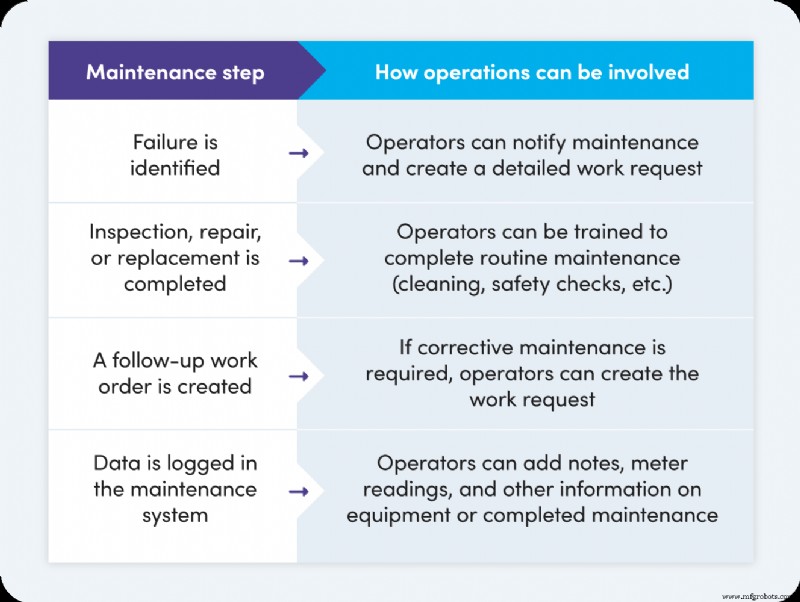
12 ways you can use work orders to start your TPM program.
Success hinges on clear job responsibilities. When roles are explicit, teams can:
- Provide the right training and materials to the right people.
- Create accurate timelines and budgets.
- Test, optimize, and expand new processes.
- Identify erroneous data and uncover its root cause.
Begin by defining a maintenance type for operators. This lets you track the workload assigned to operations and design work‑order templates that guide them through scope changes.
Building Realistic Work Timelines
Accurate timelines empower both teams to set realistic schedules, budgets, and targets, reducing frustration and fostering respect.
Ensure timelines reflect reality by:
- Reviewing equipment maintenance logs to adjust for tasks that frequently overrun.
- Analyzing work‑order data to identify preventive maintenance jobs that often need follow‑up, and factoring that into briefings.
- Accounting for non‑wrench time—parts retrieval, safety procedures, and post‑repair testing.
Realistic timelines may still clash, but they open a constructive dialogue about what can be achieved within available time. When deciding what maintenance to sacrifice for production, ask:
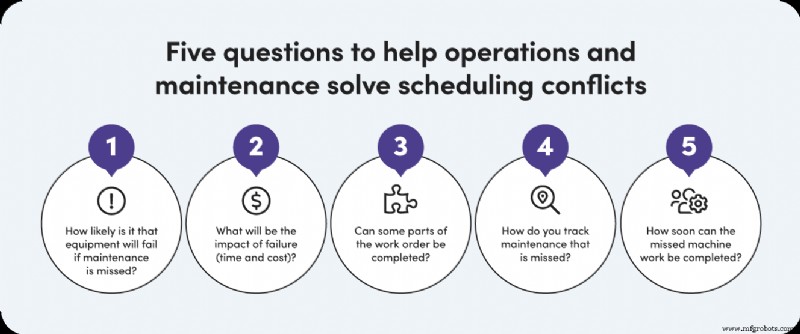
Five Ways to Build a Strong Relationship Between Operations and Maintenance
Create Multiple Communication Channels
Busy schedules often silence communication. Establish formal channels to keep information flowing:
- Team meetings: Regular sessions that give everyone a voice and keep plans visible.
- Update channels: From whiteboards to digital portals that track work‑request status.
- Peer reviews: Anonymous cross‑team feedback to uncover improvement opportunities.
Key discussion topics include:
- Machine updates—spec changes, potential problems, safety risks, or SOP updates.
- Schedules—upcoming work, risks, conflicts, and resource needs.
- Reporting—targets, progress, troubling trends, or successes.
- Roadblocks and solutions—major challenges and collaborative fixes.
- Long‑term planning—budget management, goal attainment, and skill development.
Ground rules for effective communication:
- Focus on solutions, not blame.
- Prioritize collective success over departmental wins.
- Close the feedback loop: Act on input and keep everyone informed.
- Value consistency while staying flexible for emergencies.
- Prepare agendas for every meeting to maximize time.
Set the Same Goals
When operations and maintenance share a common definition of success, friction diminishes. Even if approaches differ, the goal remains the same.
“In the worst scenario, these departments are siblings who are constantly fighting,” says Jason. “In the best case, they celebrate together and collaborate to course‑correct when targets slip.”
Metrics that both teams can own include:
- Clean start‑ups after maintenance and first‑pass yield/good: Measure efficiency and waste.
- Total cost per unit of production: Joint accountability for cost reduction and quality improvement.
- Time spent supporting production/maintenance: Track resource allocation and hiring needs.
- Unplanned downtime (last 90 days): Measure preventive maintenance effectiveness.
- Mean time to detect and repair: Everyone contributes to early failure detection and rapid resolution.
Use this template to create shared goals between operations and maintenance.
Integrate Production and Maintenance Systems
When operations see maintenance only as a source of breakdowns, the relationship suffers. Integrating the systems used for production and maintenance gives both teams visibility into each other’s work, highlighting positive impacts and fostering collaboration.
Ryan Robinson’s maintenance team exemplifies this. As the shop manager for a wholesale tree grower, Ryan connected sensors on several machines to a CMMS. The resulting data allowed him to optimize maintenance intervals and boost production efficiency.
Because we know how equipment is used daily, we can predict tomorrow’s and the day after’s maintenance needs, and identify idle times early. This proactive approach saved us significant downtime and costs.
- Ryan Robinson
Read Ryan’s story to see the results in action.
World‑Class Maintenance Teams Are Aligned With Operations
Operations and maintenance are the heartbeat of any asset‑heavy organization with ambitious production targets. A healthy, formal partnership—sharing metrics, systems, and schedules—provides the visibility and agility needed to overcome challenges. Together, they deliver a win‑win for everyone involved.
Equipment Maintenance and Repair
- Modernizing Facilities Maintenance: The 2025 Digital Transformation Blueprint
- Cut Generator Energy Costs: Proven Strategies for Business Savings
- Maintenance Management: Identifying and Fixing Failure Causes (Part 2)
- Expert Guide to Properly Size Your Commercial Air Conditioner for Optimal Performance
- How Lean Tools Unlock Reliability: A Practical Guide
- Lean Shutdowns: 10 Proven Strategies to Trim Costs and Optimize Operations
- Streamlining Maintenance Purchases: Avoid the P‑Card Pitfalls with CMMS Integration
- Extend Your CMMS Functionality with Our Robust API
- Maximize Efficiency: Maintaining Business Equipment During Slow Sales Periods
- Unlock Operational Excellence: Turning Data into Insight with IoT & CMMS