



Maintenance Technician Guide: Duties, Skills, Salary & Career Path
Becoming a proficient maintenance technician demands teamwork, technical know‑how, and a commitment to safety. This guide breaks down the daily responsibilities, essential skills, earning potential, and career advancement opportunities in the field.
What Does a Maintenance Technician Do?
Maintenance technicians are the backbone of any operation, ensuring facilities and equipment run smoothly. Their tasks range from routine inspections to complex troubleshooting, and they must know when to refer issues to specialists such as electricians, plumbers, or refrigeration technicians.
Typical duties include:
- Managing work orders and preventive maintenance (PM) schedules.
- Performing routine maintenance, inspections, oil changes, and meter readings.
- Responding to and triaging incoming work requests.
- Communicating findings and potential issues to supervisors.
- Logging work in a Computerized Maintenance Management System (CMMS) or paper records.
- Cleaning and maintaining tools and equipment.
- Adhering to safety protocols and company policies.
Below are three common specialties and their unique responsibilities.
1. Industrial Maintenance Technician
- Diagnose and repair mechanical, electrical, and hydraulic problems on production equipment.
- Interpret schematics, blueprints, service manuals, and work orders.
- Disassemble, assemble, and install machinery and monitoring sensors.
2. Building/Property Maintenance Technician
- Maintain plumbing, carpentry, electrical, and HVAC systems.
- Respond to tenant or employee maintenance requests.
- Inspect and service fire, carbon monoxide, and smoke detection systems.
3. Fleet Maintenance Technician
- Service, diagnose, and repair company vehicles.
- Execute preventive maintenance on fleet assets.
- Maintain repair shop facilities and support equipment.
Key Skills for Success
To excel, technicians should master:
Problem‑Solving
Rapid troubleshooting—gather data, synthesize, conclude, and act—is critical. Check maintenance histories, interview operators, and use checklists as guides, but adapt to unique situations.
Broad Technical Knowledge
Versatility matters. A solid grasp of hand tools, power tools, and plant machinery enables independent work and reduces supervision needs.
Attention to Detail
Meticulousness prevents minor issues from escalating and ensures compliance with safety protocols like Lock‑out/Tag‑out (LOTO).
Physical Capability
The job often requires lifting, climbing, and extended standing. Good manual dexterity and fitness support sustained performance.
Basic Computer Literacy
Modern facilities rely on CMMS platforms such as Limble for work order management, tracking, and reporting. Familiarity with mobile devices and simple software enhances productivity.
Patience & Communication
Dealing with recurring breakdowns and coordinating with operators demands calmness and clear verbal and written communication.
Salary Insights
Wages vary by industry, company size, and experience:
- Entry‑level: ~$30k/year (≈$15/hr).
- Experienced technicians at top firms: $70k+/year (≈$22/hr).
US averages from major platforms:
- Payscale: $19.22/hr (~$40k/year).
- Salary.com: $59k/year.
- Indeed: $19.47/hr (~$40k/year + overtime).
- Glassdoor: $45k/year base.
Glassdoor’s chart: 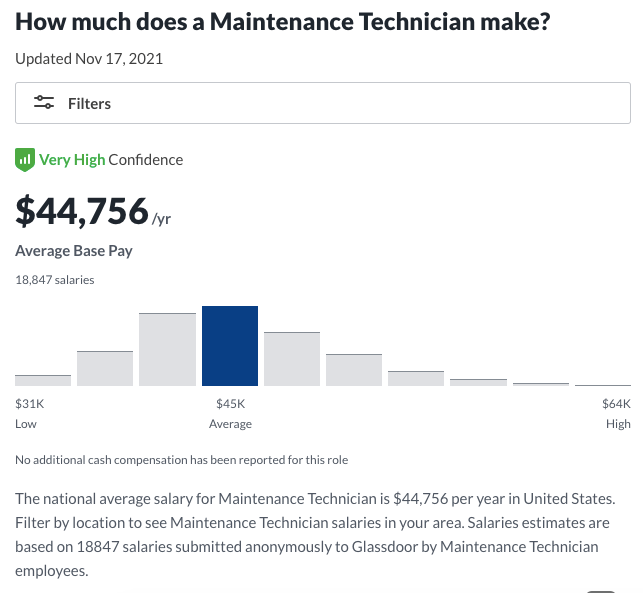
Landing Your First Role
Experience matters, even if it’s informal. Highlight:
- High‑school or community college classes in small engines, welding, or HVAC.
- DIY repairs (e.g., fixing a friend’s appliance).
- Side‑hustles like vehicle maintenance or lawn care.
Leverage networking:
- Industry groups (iATN, BIN, FSETA, PHCC).
- LinkedIn – join job search groups, connect with peers, and ask for recommendations.
Consider apprenticeships or internships listed on job boards such as Indeed, Monster, or Glassdoor. Technical training—certifications, associate degrees, or apprenticeships—can boost credibility.
Prepare a targeted resume and practice interview questions (training, problem‑solving, motivation). Resources: CNET’s resume guide and Glassdoor interview questions.
Advancing to Management
With a high‑school diploma or GED, technicians can move into supervisory roles. Key specialties include:
Plumbing Maintenance
- License required; median $76k/yr.
Electrical Maintenance
- License required; median $75k/yr.
HVAC Maintenance
- Requires EPA refrigerant license; median $23.41/hr.
Groundskeeping
- Often on‑the‑job training; median $14.09/hr.
Machinery & Building Maintenance
- Associate degree beneficial; median $63k/yr.
Continuous learning opens higher wages and leadership roles.
Why Maintenance Technicians Matter
Technicians keep operations running, prevent costly downtime, and ensure safety. Efficient work supported by a user‑friendly CMMS improves training, onboarding, and adherence to industry best practices.
Try Limble CMMS:
- Free 30‑day trial.
- Request a demo.
- Self‑demo available.
Equipment Maintenance and Repair
- Top Aircraft Technicians Crowned Winners in First AMTSociety Maintenance Skills Competition
- Strategic Guide to Outsourcing Maintenance: Turning Contractors into Trusted Partners
- Pepperidge Farm Boosts Maintenance Excellence Through Targeted Training at North Central State College
- Maintenance Coordinator Role: Duties, Skills, Salary, and Career Path
- Maintenance Supervisor Role: Duties, Skills, Salary & Career Path
- Maintenance Worker Job Guide: Duties, Skills, Salary, and Hiring Tips
- Maintenance Mechanic Career: Duties, Skills, Salary & Advancement
- Can AI Replace Your Maintenance Job? Insights from a Predictive Maintenance Expert
- 5 Key Responsibilities Every Crane Operator Must Master
- CNC Setter Role: Duties, Skills, and Responsibilities