



Maintenance Coordinator Role: Duties, Skills, Salary, and Career Path

In every high‑performing maintenance team, there is a single individual who keeps the rhythm: the maintenance coordinator. This person ensures that technicians stay focused on their core tasks while the coordinator manages the flow of work, resources, and communication.
What Does a Maintenance Coordinator Do?
Maintenance coordinators are found across industries—from commercial real estate to manufacturing plants—whenever an organization employs a dedicated maintenance workforce. Their responsibilities vary with company size, but typically include:
- Collaborating with supervisors, facility managers, and maintenance managers to develop and execute the annual maintenance plan.
- Scheduling repairs, preventive maintenance, and vendor services, ensuring timely completion of all projects.
- Recruiting, interviewing, and onboarding cleaners, technicians, and HVAC specialists, and assigning work orders.
- Creating and managing the maintenance budget, processing payments for services and supplies.
- Overseeing inventory and facility assets, ensuring tools and equipment are available and well‑maintained.
- Monitoring PPE usage and recommending replacements to maintain safety compliance.
- Supporting technicians with daily inspections and maintaining detailed maintenance logs.
- Providing administrative support for work order management and tenant or client communication.
- Performing ad‑hoc tasks—such as changing light bulbs or cleaning HVAC filters—when urgent maintenance work is in progress.
Key Qualities of a Successful Maintenance Coordinator
Beyond technical knowledge, the most effective coordinators possess:
Technical Insight
A solid foundation in building systems and repair work enables coordinators to assess job requirements accurately and anticipate potential issues.
Strong Communication
Clear, concise communication—both with staff and external vendors—is essential. Coordinators must translate technical details into actionable instructions, negotiate contracts, and maintain positive tenant relations.
Time‑Management Mastery
The ability to juggle multiple tasks, prioritize effectively, and adapt to unforeseen challenges distinguishes top performers.
Proactive Planning
Forward‑looking coordinators anticipate upcoming needs, secure necessary resources in advance, and streamline administrative support to keep projects on schedule.
Compensation Overview
Because the role bridges operations and strategy, maintenance coordinators earn a salary that falls between technicians and managers. Current data from major job boards shows:
- Indeed: average annual pay of $51,258 plus up to $7,500 in overtime.
- Payscale: salary range of $35k–$98k, with an average of $55k per year.
- Salary.com: average of $41k, ranging from $35k–$48k.
- Reed (UK): average salary of £26k ($36k).
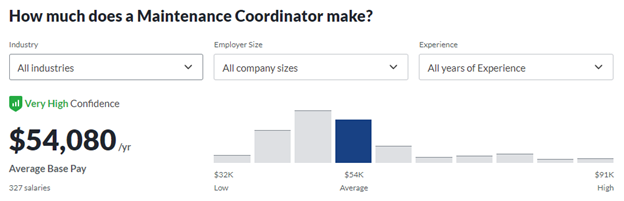
- Glassdoor: base yearly salary around $54k.
These figures confirm that the role is well positioned between maintenance technicians and senior managers, reflecting its blend of technical oversight and strategic coordination.
Career Path and Certifications
Many coordinators start in smaller facilities where they may directly lead a maintenance team, then advance to larger, more complex operations. A high school diploma is the minimum requirement, but higher education in engineering, business, or related fields can accelerate career growth.
Professional development is further supported by certifications such as:
- Certified Maintenance Coordinator (NARPM)
- Certified Manager of Maintenance (NCHM)
- Project Management Professional (PMI) for those managing large-scale projects
These credentials demonstrate expertise and commitment, enhancing employability and career progression.
Leveraging CMMS for Greater Efficiency
Computerized Maintenance Management Systems (CMMS) empower coordinators to:
- Plan and schedule preventive maintenance
- Issue and track work orders
- Communicate in real time via mobile platforms
- Control inventory and procurement
- Manage vendor contracts and budgets
- Track maintenance costs and ROI
By visualizing upcoming tasks and resource availability, a CMMS turns complex scheduling into a streamlined process, enabling coordinators to respond swiftly to emergencies and maintain operational continuity.
Takeaway
While the role demands a blend of technical knowledge, organizational skill, and proactive leadership, the right combination of training, tools, and experience can make a maintenance coordinator indispensable. Whether you’re a hiring manager or an aspiring coordinator, understanding these nuances will help you succeed.
Do you work as a maintenance coordinator or are you looking to hire one? Share your challenges and insights in the comments below!
Equipment Maintenance and Repair
- Top Aircraft Technicians Crowned Winners in First AMTSociety Maintenance Skills Competition
- Strategic Guide to Outsourcing Maintenance: Turning Contractors into Trusted Partners
- Vodcast: Crafting Effective Maintenance Job Plans with Jeff Shiver
- Pepperidge Farm Boosts Maintenance Excellence Through Targeted Training at North Central State College
- Maintenance Supervisor Role: Duties, Skills, Salary & Career Path
- Maintenance Worker Job Guide: Duties, Skills, Salary, and Hiring Tips
- Maintenance Mechanic Career: Duties, Skills, Salary & Advancement
- Maintenance Technician Guide: Duties, Skills, Salary & Career Path
- Can AI Replace Your Maintenance Job? Insights from a Predictive Maintenance Expert
- CNC Setter Role: Duties, Skills, and Responsibilities