



AI Is Revolutionizing Maintenance—Is Your Organization Fully Harnessing Its Power?
Industry forecasts show predictive‑maintenance spend will surge sevenfold by 2033, climbing from about $14 billion to nearly $98 billion—driven by AI, IoT sensors, and advanced analytics. While the buzz often centers on AI’s detection capabilities—identifying abnormal vibration, early bearing wear, or subtle thermal drift—the true payoff is already reflected in financial statements. One manufacturer, for example, eliminated over $8 million in downtime costs in just six months.
Detection is only half the equation. The critical question is: how does an organization act on those insights? Top performers move beyond asking what AI can predict; they focus on integrating the intelligence into enterprise workflows to accelerate decision‑making and execution. In this arena, leadership trumps hardware—yet many operations miss out on substantial value. This leadership gap manifests in three key areas.
1 – Extending the value of predictive insight
Spotting abnormal machine behavior ahead of a failure gives maintenance teams a competitive edge, but translating that signal into action can be time‑consuming—exactly where value evaporates. Technicians must rapidly assemble context from disparate sources—CMMS/EAM records, legacy documentation, and tacit expertise—often turning into a frantic search under pressure.
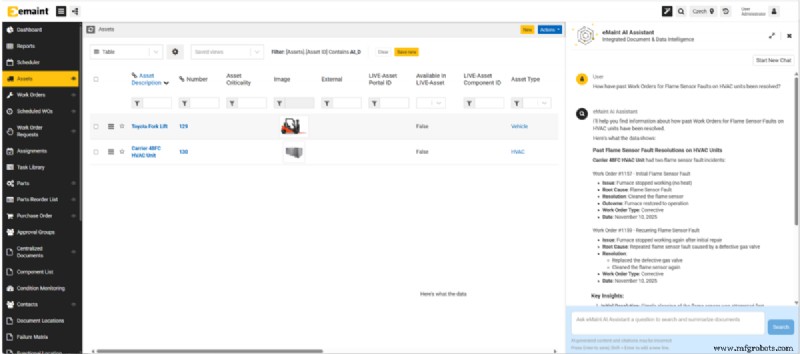
Contemporary AI‑enabled maintenance platforms close that execution gap. By automatically compiling a response package—work‑order history, pertinent SOP excerpts, annotated schematics, and historical technician notes—these systems enable technicians to transition from alert to decisive action within minutes, not hours.
In this way, predictive insight becomes tangible operational value.
2 – Turning expertise into infrastructure
The exodus of seasoned technicians is already shifting maintenance economics. A Fluke survey of manufacturing leaders reports that 97 % see AI as a viable antidote to the skills gap. Yet most organizations treat AI merely as a search engine instead of harnessing it as an expertise engine. The real strategic upside lies in multiplying knowledge—enabling the collective wisdom of the workforce to be accessed, not just retrieved.
Imagine how AI could transform a technician’s routine.
- Instead of having to walk back to a laptop, they simply use voice‑to‑text on a mobile device to log an issue.
- As the work order is created, AI cross‑references the description against technical documentation and years of historical data and notes already in the CMMS or EAM system.
- The AI assistant writes the next steps directly into the work order: “This symptom usually indicates bearing wear. Inspect parts 3, 5, and 8. Follow the SOP used in the previous repair. Relevant technician notes are included below.”
This is institutional knowledge put into action. The technician isn’t relying on personal experience or hunting for a senior colleague. They’re operating with the accumulated wisdom of the organization, codified and delivered at the point of need. This pivot fundamentally upgrades the organization’s operating rhythm:
- Consistency at scale: The “tribal knowledge” that once lived in silos becomes a standardized component of daily execution. When every technician, shift, and site operates from a unified “source of truth,” performance variability narrows.
- Accelerated training: Junior staff acquire effective experience much faster.
- Better use of experts: Senior technicians shift from routine execution to complex problem‑solving and system optimization.
Embedding expertise in processes preserves institutional knowledge through staff changes, whereas reliance on individuals makes it fragile.
3 – Raising the baseline of maintenance decision‑making
Many maintenance teams face a paradox: an abundance of raw data that masquerades as a scarcity of actionable insights. Metrics are plentiful, but intelligence is sparse. Decision delays stem from the need to assemble the right view—often taking planners a half‑day or exhausting analysts. AI can eliminate this bottleneck.
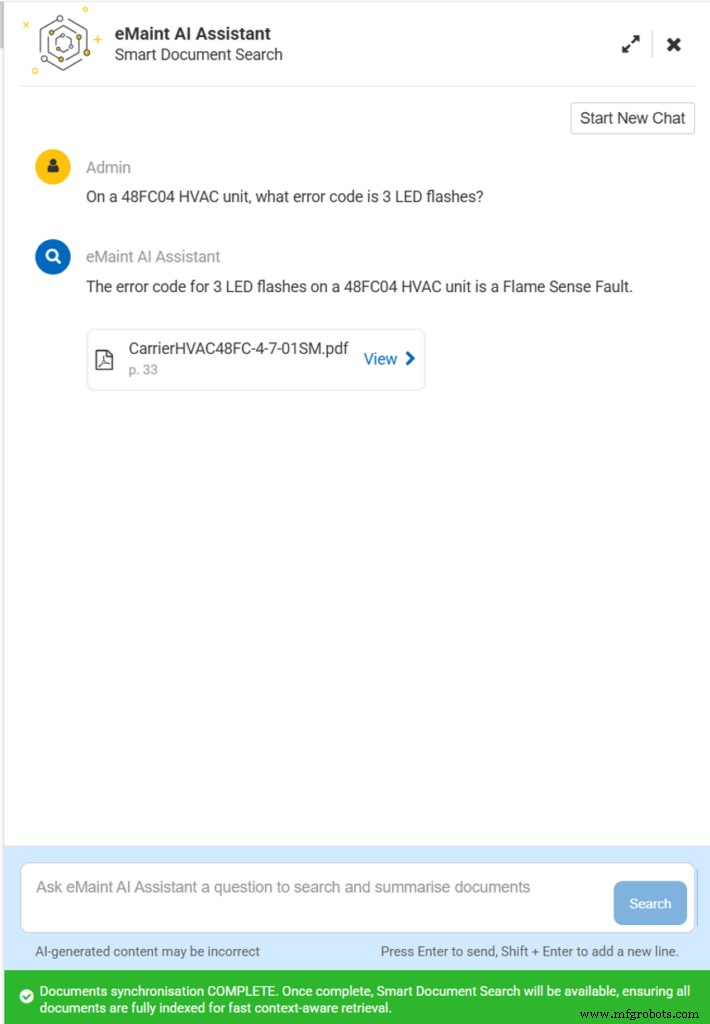
AI transforms the landscape from static reports to dynamic, interactive intelligence.
For instance, a supervisor can simply ask, “Show me related issues on this asset over the past 90 days,” and receive the trend in seconds. By surfacing systemic problems before they become chronic, AI enables evidence‑based course corrections rather than gut‑feeling decisions.
The cumulative impact outweighs any single query. When work orders adhere to consistent patterns, data quality improves, which in turn sharpens AI insights. For leaders, this evolution turns maintenance from a variable cost center into a high‑precision engine marked by measurable, compounding gains.
The real question for leadership teams
Leaders must understand that AI’s true value in maintenance extends beyond technology—it reshapes the organization. Success hinges on deploying AI across three layers:
- Individual: Faster, more informed responses to problems
- Team: Shared knowledge and more consistent execution across sites
- Organization: Faster learning and better decision‑making at scale
Architecting AI across all three layers yields compounding advantages that competitors find hard to match. While some companies focus on cost reduction, others leverage AI to craft maintenance operations that are more responsive, consistent, and resilient.
Equipment Maintenance and Repair
- Expert Guide to Emergency Boiler Management
- Facility Inspection & Production Rounds: Enhancing Safety and Efficiency
- Myllykoski Paper Mill Boosts OEE by 7% and Cuts Maintenance Costs 10% with ABB Full Service
- How Inadequate Training Can Undermine CMMS Success
- Hygienic Design for Food & Processing Industries: From Cleanability to Cost Savings
- Top 5 Construction Equipment Brands Every Contractor Should Know
- 5 Proven Maintenance Practices to Maximize Heavy Machinery Performance
- Defeating Graffiti: Expert Strategies for Industrial Facility Owners
- EPA Proposes Rules to Slash Mercury Emissions by 50% and Save Billions in Health Costs
- How to Persuade Top Management to Invest in Maintenance