



Why Efficient Spare Parts Inventory Management Drives Reliability, Cuts Costs, and Boosts Profitability
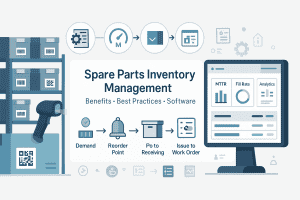 Spare‑parts inventory is the foundation of reliable operations. When a critical component is missing, teams lose hours waiting, incur rush‑shipping fees, and rack up idle labor while equipment sits offline. Conversely, overstock ties up capital and inflates storage costs.
This guide explains how a robust spare‑parts inventory strategy—and the right CMMS/EAM platform—cuts downtime, reduces costs, and delivers measurable ROI.
Ready to cut downtime and rush fees? Book a quick eWorkOrders demo to see it in action.
What Is Spare Parts Inventory Management?
Spare‑parts inventory management is the systematic planning, stocking, and control of MRO components so the right part is available at the right time and at the right cost. It links work orders, purchasing, receiving, and warehouse operations to keep inventory accurate, accessible, and audit‑ready, thereby reducing stockouts, rush fees, and repair delays.
Why It Matters – 9 Key Reasons
- Reduced Downtime – On‑hand spares shorten outages and boost overall productivity.
- Improved Customer Satisfaction – Quick repairs translate to better service levels.
- Lower Lead Times – Effective systems shrink the time needed to obtain parts, speeding up fixes.
- Enhanced Decision‑Making – Real‑time inventory data informs optimal ordering decisions.
- Increased Accuracy – Accurate records cut ordering, billing, and tracking errors.
- Reduced Carrying Costs – Right‑sized stock minimizes storage and management expenses.
- Optimized Warehouse & Supply Chain – Coordinated operations boost efficiency and lower costs.
- Improved Compliance – Proper management helps meet regulatory requirements and avoid penalties.
- Enhanced Competitiveness – Lower inventory costs and higher reliability give a market edge.
The Top 10 Benefits of Spare Parts Inventory Management
Below are the top 10 benefits, each paired with a practical example and the KPIs you should monitor to prove impact quickly.
Cut Downtime & Avoid Rush‑Shipping Fees
When critical parts are planned and available, repairs start immediately instead of waiting for next‑day air. For example, stocking two seal kits for a high‑failure pump can reduce a 6‑hour outage to a 90‑minute changeout, eliminating rush freight and idle crew time. Good spare‑parts management lowers MTTR and keeps lines running.
- KPIs: MTTR, stockout rate, rush‑freight spend, emergency WO %
Higher First‑Time Fix via BOM & Parts Availability
Attaching accurate BOMs to assets and kitting parts to work orders boosts first‑time fix. Technicians arrive with exactly what they need—gaskets, fasteners, lubricants—reducing callbacks and repeat labor. Mobile access to BOMs in your spare‑parts system keeps field execution tight.
- KPIs: First‑time fix rate, repeat WO rate, pick accuracy, technician wrench time
Lower Carrying Costs Without Stockouts (Min/Max, Cycle Counts)
Use min/max levels, ABC/criticality, and cycle counts to balance risk and cost. Many teams trim 10–20% of on‑hand value by right‑sizing slow movers while protecting critical spares with safety stock. Inventory accuracy rises and obsolete items surface early.
- KPIs: Carrying cost %, inventory accuracy %, inventory value, obsolescence rate, inventory turns
Improved Warehouse & Supply Chain Coordination
Tight receiving‑to‑bin workflows, clear locations, and kitting reduce travel time and mispicks. Integrating CMMS with warehouse management software improves dock‑to‑stock, ensures FIFO rotation, and speeds staging for planned jobs.
- KPIs: Dock‑to‑stock time, picking time per WO, location accuracy, FIFO compliance
Compliance & Audit Trails (Who Used What, When)
Issue parts directly to work orders and record who pulled them, for which asset, and why. Lot/serial tracking supports traceability requirements and warranty claims, while permissions limit unauthorized access. This audit‑ready trail satisfies regulators and customers alike.
- KPIs: Traceability rate, audit findings, controlled‑access exceptions, warranty recovery
Increased Asset Reliability (PM Alignment)
Kitting PMs with the right parts prevents skipped tasks and extends MTBF. Standard parts lists for recurring jobs (filters, belts, lubricants) reduce variation and keep maintenance on schedule. The result: fewer breakdowns and smoother production.
- KPIs: MTBF, PM compliance %, emergency vs. planned WO mix, unplanned downtime hours
Accurate Forecasting & Planning (Seasonality, Lead Time)
Lead times, planned shutdowns, and seasonal demand should drive reorder points and safety stock. With spare‑parts software, teams forecast needs months ahead, preventing last‑minute expediting during peak periods.
- KPIs: Forecast bias, service level/fill rate, supplier lead‑time variance, backorder days
Multi‑Site Visibility & Sharing to Cut Rush Orders
Seeing part balances across plants lets you transfer a component today instead of paying to overnight it. Shared catalogs, standardized SKUs, and inter‑site requests turn the network into your safety stock.
- KPIs: Inter‑site transfer time, rush orders per month, duplicate SKU count, network service level
Vendor Performance & Pricing Leverage
Track actual lead times, on‑time delivery, and price changes by vendor. Use that data to consolidate buys, negotiate better terms, and qualify alternates for single‑source risks.
- KPIs: OTIF (on‑time, in‑full), lead‑time reliability, price variance, MOQ compliance, supplier scorecard
Profitability (Roll‑Up of Downtime, Labor, Inventory Turns)
When parts are available, technicians fix faster, production runs longer, and capital works harder. Combine reduced downtime, lower labor hours per WO, and healthier inventory turns to show total ROI from spare‑parts improvements.
- KPIs: Downtime cost avoided, labor hours per WO, inventory turns, maintenance cost as % of RAV, EBITDA impact
Core Practices for World‑Class Storerooms
A disciplined storeroom is the backbone of effective spare‑parts inventory management—it keeps parts findable, counts accurate, and technicians moving.
Part Identification & Data Hygiene (SKUs, Units, Status)
- Create a single SKU per part with a clear naming convention; capture description, unit of measure, manufacturer/MPN, supplier, unit cost, lead time, min/max, criticality/ABC, and status (active, non‑stock, obsolete, consigned).
- Eliminate duplicates and synonyms; standardize units (ea, pack, litre) and attach photos/spec sheets.
- KPIs: Data completeness %, duplicate SKU rate, incorrect‑UoM incidents
BOM Discipline Tied to Assets and PMs
- Attach complete, version‑controlled BOMs to each asset and link them to PM tasks/work orders.
- Include kits (seal kit, fasteners, lubricant), approved alternates, and expected quantities; flag critical spares.
- KPIs: BOM completeness %, kit readiness rate, first‑time fix rate
Location Precision & Clear Labeling
- Assign precise locations (e.g., Aisle‑Bay‑Shelf‑Bin) and map oversize, hazardous, quarantine/returns areas.
- Use large, legible labels and a storeroom map so any tech can pick a part without help.
- KPIs: Location accuracy %, pick time per WO, mispick rate
Barcoding/QR & Mobile Issuing to Work Orders
- Label bins/parts with 1D/2D barcodes or QR; scan to receive, move, issue to WO, and return.
- Enable mobile/offline scanning at the point of use to update balances in real time.
- KPIs: Scan compliance %, real‑time update latency, issue/return accuracy
Cycle Counts & Annual Physicals (Policy & Cadence)
- Set an ABC cadence: A‑items (high value/critical) monthly or weekly, B quarterly, C semi‑annually—plus one full physical per year.
- Use blind counts, recount tolerances, and root‑cause reviews for variances (receiving errors, unissued pulls, wrong locations).
- KPIs: Inventory accuracy %, count variance %, obsolescence/write‑off rate
Security & Access Control to Prevent Shrinkage
- Restrict access with badges/permissions and defined storeroom hours; enable supervised issue windows for high‑value items.
- Segregate duties (request/issue/receive), log who took what and why, and monitor with cameras/spot checks.
- KPIs: Shrinkage %, unauthorized access events, high‑value exception rate
Planning & Control Methods (Lead Time, ROP, Safety Stock)
Smart planning turns spare‑parts inventory management from guesswork into a predictable, low‑risk system that protects uptime and cash.
ABC/Criticality Classification (A/Critical Spares vs Non‑Stock)
- A / Critical: High downtime risk or long lead time; keep on hand with tight controls.
- B: Moderate usage/value; stock with standard reviews.
- C: Low value/usage; consider vendor‑managed or order‑on‑demand.
- Add a criticality tag (Safety/Regulatory/Quality) to override cost‑based decisions when failure risk is high.
KPIs: Service level by class; stockout rate (A‑items).
Lead‑Time‑Aware Reorder Points (Min/Max)
- Reorder Point (ROP): Average daily usage × Lead time (days) + Safety stock.
- Max (Order‑Up‑To): Enough to cover the next review window plus variability.
- Review quarterly (or when usage/lead times shift) and display ROPs in your spare‑parts system so buyers get automatic alerts.
KPIs: Backorder days; rush‑freight spend; ROP compliance.
Safety Stock for Critical Spares (Simple Formula Overview)
- Simple method: (Max daily usage × Max lead time) – (Avg daily usage × Avg lead time).
- Statistical method: Z × σ(demand during lead time) (use higher Z for A/critical items).
- Document assumptions (failure rates, supplier reliability) and revisit after every major outage or vendor change.
KPIs: Fill rate; stockout frequency; inventory value tied up in buffers.
Seasonality & Demand Forecasting (Planned Shutdowns)
- Adjust ROP/safety stock ahead of planned shutdowns, overhauls, and seasonal peaks (e.g., harvest/holiday heating/cooling loads).
- Use rolling 12–18‑month demand, known PM schedules, and supplier calendars.
- Pre‑kit jobs and time receipts so inventory lands just before work begins.
- Let spare‑parts software generate forecast recommendations; buyers validate and schedule POs.
KPIs: Forecast accuracy/bias; on‑time kit readiness; variance between planned vs. actual issues.
KPIs for Spare Parts Inventory (What to Track)
Measuring the right metrics turns spare‑parts inventory management from a cost center into a performance engine—use these KPIs to prove reliability gains and cost control.
Inventory Accuracy %, Inventory Turns, Service Level (Fill Rate)
- Inventory accuracy %: (Counted qty ÷ System qty) × 100. Target 97–99% via cycle counts and disciplined receiving/issuing.
- Inventory turns: Annual issues (cost) ÷ Average on‑hand value. Higher turns = less cash tied up (watch for stockout risk).
- Service level / fill rate: Lines fulfilled from stock ÷ Total requested. Track by ABC/criticality to protect uptime where it matters most.
MTTR/MTBF Linkage to Availability
- MTTR (Mean Time to Repair): Falls when the right parts are on hand and kitted to WOs.
- MTBF (Mean Time Between Failures): Rises when PMs use correct parts/intervals.
- Tie both to parts availability to show how storeroom performance drives asset availability and production output.
Carrying Cost %, Stockout Frequency, Obsolescence Rate
- Carrying cost %: Annual cost to hold inventory (capital, space, insurance, shrink) ÷ Average on‑hand value. Use min/max and FIFO to reduce it without risking outages.
- Stockout frequency: Count of stockout events or backorder days—segment by A/critical items to prioritize fixes.
- Obsolescence rate: (Value written off as obsolete ÷ Average on‑hand value). Root causes: inactive SKUs, spec changes, excess buys—clean via ABC reviews and vendor returns.
Spare Parts Warehouse Management vs CMMS vs ERP
Not all systems do the same job—here’s a quick way to decide what each should own and how they fit together without overlap.
| System | Primary Role | Owns | Best At | Typical Users |
|---|---|---|---|---|
| Spare Parts Warehouse Management (WMS) | Execute storeroom operations | Bin/slot locations, putaway rules, pick/pack, cycle counts, dock‑to‑stock | Fast, accurate moves; location control; physical counts | Storekeepers, inventory controllers |
| CMMS/EAM | Plan & document maintenance work | Assets, PMs, work orders, BOMs, part issues/returns to WOs | Uptime, PM compliance, kitting, usage history per asset | Planners, technicians, reliability engineers |
| ERP | Financials & procurement backbone | Vendors, POs, receiving, invoices, item master (often), costing/GL | Approvals, 3‑way match, budget control, MRP | Procurement, finance, operations leadership |
How eWorkOrders Spare Parts Inventory Management Software Helps

eWorkOrders turns spare‑parts inventory management into a predictable, low‑friction process that protects uptime while reducing carrying costs—built for planners, technicians, and storeroom teams.
Min/Max with Low‑Stock Alerts & Auto‑POs
Set min/max levels by asset criticality and real lead times. When stock hits reorder points, eWorkOrders triggers low‑stock alerts and can automatically create purchase orders to approved vendors, preventing stockouts and rush freight.
BOMs Attached to Assets & Work Orders (Mobile Access)
Maintain bills of materials in the CMMS, link them to assets and pull them into work orders so techs see required parts, quantities, and approved alternates on mobile.
QR/Barcode Issue/Return; FIFO/Cost Tracking
Scan to receive, relocate, issue to WOs, and return parts. Real‑time balances and supported costing methods (fixed, average, FIFO) keep your spare‑parts inventory accurate and audit‑ready.
Multi‑Site Visibility & Centralized Control
View and control inventory across multiple sites from one database—improving availability without duplicating stock everywhere.
Vendor Records, Lead Times, Warranty Linkage
Track vendors, pricing, and shipping/lead‑time details; store contracts and warranties to avoid unnecessary purchases and recover costs.
Analytics & Reports (Turnover, Carrying Costs, Stock Levels)
Generate reports on inventory turnover, carrying costs, reorder points, and usage trends to right‑size buffers without risking downtime.
See real‑world inventory management system examples showing how maintenance teams cut rush orders and stockouts.
Industry Playbooks (What Changes by Sector?)
Different sectors face distinct failure modes, regulations, and logistics—use these quick playbooks to tailor spare‑parts inventory management for manufacturing, facilities/services, and food & beverage.
Manufacturing – Critical Spares, Lead Time Risk, BOM Rigor
Manufacturing lives or dies by critical spares with long or variable lead times (gearboxes, servos, seals, PLC modules). Use ABC/criticality to ring‑fence these items, set higher safety stock, and document approved alternates. Tie BOMs to assets and PMs so kits are complete for planned shutdowns; review BOMs after every engineering change to prevent spec drift. Track rotables (repairable spares) with return‑to‑stock workflows, and align min/max to outage calendars to avoid last‑minute expediting.
Facilities/Services – Van Stock, Multi‑Site Routing
For campuses and field teams, uptime depends on van/truck stock and fast access to the nearest storeroom. Assign par levels per vehicle, enable mobile scan‑to‑issue/return, and auto‑replenish from a central site. Use multi‑site visibility to route technicians to the location that actually has the part, or transfer parts between sites instead of paying rush freight. Measure SLA hit rate, first‑time fix, and inter‑site transfer time to tune your spare‑parts inventory network.
Food & Beverage – Shelf‑Life, Lot/Traceability, Audits
F&B adds perishability and regulatory scrutiny. Manage shelf‑life with FEFO (first‑expire, first‑out), enforce lot/batch traceability on receipts/issues, and segregate allergen‑related components. Store temperature‑sensitive parts correctly, standardize food‑grade lubricants and seals, and kit sanitation/inspection spares ahead of hygiene windows. Maintain audit‑ready usage histories and recall readiness.
Conclusion
Accurate and up‑to‑date information on spare‑parts inventory levels and usage is critical for effective inventory management. This information helps businesses make informed decisions about when to order new parts, how much to order, and how to optimize inventory levels. Maintenance management software can play a vital role in maintaining this accuracy by automating many tasks and providing real‑time visibility into inventory levels and usage. By leveraging maintenance management software, businesses can improve decision‑making, increase efficiency, and drive profitability. The importance of having accurate and up‑to‑date spare‑parts inventory data cannot be overstated, and a CMMS can be a valuable tool in achieving this goal.
FAQ
What is spare parts inventory management?
Spare parts inventory management is the process of planning, stocking, and controlling MRO components so the right part is available at the right time and cost. It connects work orders, purchasing, receiving, and spare‑parts warehouse management to reduce stockouts, rush fees, and downtime.
Are spare parts part of inventory?
Yes—spare parts are typically categorized as MRO (maintenance, repair, and operations) inventory on the balance sheet and managed separately from raw materials or finished goods. They’re tracked for availability, cost, and usage against assets and work orders.
What is KPI for spare parts?
Key KPIs include inventory accuracy %, inventory turns, and service level/fill rate to show availability and cost efficiency. Many teams also track MTTR/MTBF linkage to parts availability, carrying cost %, stockout frequency, and obsolescence rate to prove reliability and ROI.
How to organize parts inventory?
Standardize SKUs and units, assign precise bin/slot locations with clear labels, and enable barcode/QR scanning for receiving, moves, and issues/returns. Classify items by ABC/criticality, set min/max and safety stock based on lead time, run cycle counts, and kit BOM parts to work orders via your CMMS.
What are the key benefits of using CMMS for inventory management?
- Real‑time tracking of inventory levels and locations
- Automated reordering when stock reaches minimum thresholds
- Improved forecasting of inventory needs based on usage data
- Reduced carrying costs by optimizing stock levels
- Enhanced visibility across multiple facilities or warehouses
- Integration with work orders to ensure parts availability
How does CMMS help reduce stockouts and overstock situations?
- Setting minimum and maximum stock levels for each item
- Generating automatic reorder alerts when inventory is low
- Providing usage data to optimize reorder points and quantities
- Enabling just‑in‑time ordering based on scheduled maintenance
How does eWorkOrders CMMS manage spare parts for critical equipment?
eWorkOrders CMMS effectively manages spare parts for critical equipment through the following features:
- Critical Spare Parts Tracking: Designate certain parts as critical for priority management.
- Minimum Stock Levels: Set thresholds to trigger automatic reordering when inventory is low.
- Real‑Time Inventory Monitoring: Access up‑to‑date visibility of stock levels for critical parts.
- Parts Usage Tracking: Automatically record and maintain usage history within work orders.
- Automated Reordering: Generate purchase orders automatically to ensure availability.
- Vendor Management: Maintain vendor information for efficient procurement.
- Barcode Scanning: Enable quick inventory updates for accurate stock levels.
- Reporting and Analytics: Generate reports to optimize inventory management for critical parts.
- Integration with Maintenance Activities: Link parts directly to assets and work orders for easy access.
See What Our Customers Are Saying
Customer Testimonials
Case Studies
© Information Professionals, Inc. All rights reserved.
Equipment Maintenance and Repair
- Why a Maintenance Work Order System Is Essential for Your Business
- Modernizing Facilities Maintenance: The 2025 Digital Transformation Blueprint
- Driving Transformational Leadership in Maintenance & Reliability
- Unlock Exclusive Rewards with Cat Card – Free Tiered Program
- How Effective Hotel Maintenance Boosts Profits and Guest Satisfaction
- Why Every Business Needs a Robust Contingency Plan
- 5 Essential Rules Every Heavy Equipment Owner & Operator Must Follow
- Accurately Calculating Overall Equipment Effectiveness (OEE)
- Navistar Huntsville: A Blueprint for Integrated Maintenance and Operations Excellence
- Introducing the DMG DMF 360 Linear 5‑Axis Machine: Our Most Advanced Tool Yet