



Aligning Operations & Maintenance: A Proven Formula to Slash Downtime and Boost Profits
When operations and maintenance clash, the cost is steep and the work environment becomes chaotic. Consider the case of a food manufacturer whose sheeter—a machine that rolls massive dough balls—must be cleaned daily. The production team uses water for cleaning, but the moisture clumps the dough, damaging the machine and forcing frequent emergency repairs.
If this scenario sounds familiar, you’re not alone. Thousands of such incidents occur daily across industries, fueled by divergent goals, motivations, and processes. The result is confusion, frustration, and finger‑pointing—an unsustainable state for both business and employee well‑being.
In this article we explore how to break that cycle and foster true alignment between operations and maintenance, covering:
- Key metrics to share across teams
- Strategies to boost collaboration
- Best practices for building joint processes
Why Alignment Is a Strategic Imperative
Manufacturers who master waste reduction lead the market, while those who don’t risk falling behind. Data from Automation.com reveals:
- Large industrial facilities lose over 323 production hours a year to unplanned downtime
- The average annual cost of downtime is $532,000 per hour, totaling $172 million per plant
- For Fortune 500 manufacturers, downtime costs equal 8% of annual revenues
| Cost of Downtime | Automotive | FMCG/CPG | Heavy Industry | Oil & Gas |
|---|---|---|---|---|
| Unplanned downtime hours per facility each month | 29 | 25 | 23 | 32 |
| Cost per hour of downtime | $1,343,400 | $23,600 | $187,500 | $220,000 |
Beyond the financial hit, reactive maintenance and emergency purchases take a heavy toll on staff morale and safety. Aligning operations and maintenance is therefore critical to eliminating downtime at its source.
“When maintenance and operations are aligned, businesses can pinpoint issues early and deploy the right resources without blame games,” says Jason Afara, Senior Solutions Engineer at Fiix.
Key Areas for Alignment
Strategic Downtime Planning
Efficient maintenance keeps equipment running with minimal downtime, but production teams often see maintenance as a hurdle to hitting quotas.
To reconcile these perspectives, teams can:
- Use data to compare the impact of maintenance versus failure
- Develop shared processes that reduce scheduled downtime
Both sides must understand how their actions affect equipment performance. Maintenance leaders frequently lack data to justify their requests; a data‑driven approach demonstrates that timely maintenance prevents far more costly failures.
By jointly mapping acceptable risk and failure consequences—documenting common failure modes, frequency, repair times, and costs—teams can objectively compare maintenance schedules with potential downtime. The difference is clear: scheduled maintenance is far less disruptive and more cost‑effective.
Use this FMEA template to calculate risk of failure and prioritize maintenance →
Shared processes also enable operators to flag minor issues quickly, allowing technicians to intervene before problems spiral.
- Regular leadership meetings to review production and preventive maintenance schedules
- Quarterly cross‑functional reviews of successes, challenges, and root‑cause analyses
- A streamlined work‑request system that empowers operators to report problems confidently and lets technicians prioritize responses with minimal disruption
Shared Workflows and Clear Responsibilities
Integrating Total Productive Maintenance (TPM) principles ensures that everyone—from technicians to accountants—has a stake in upkeep. A practical first step is to embed operations into the maintenance workflow.
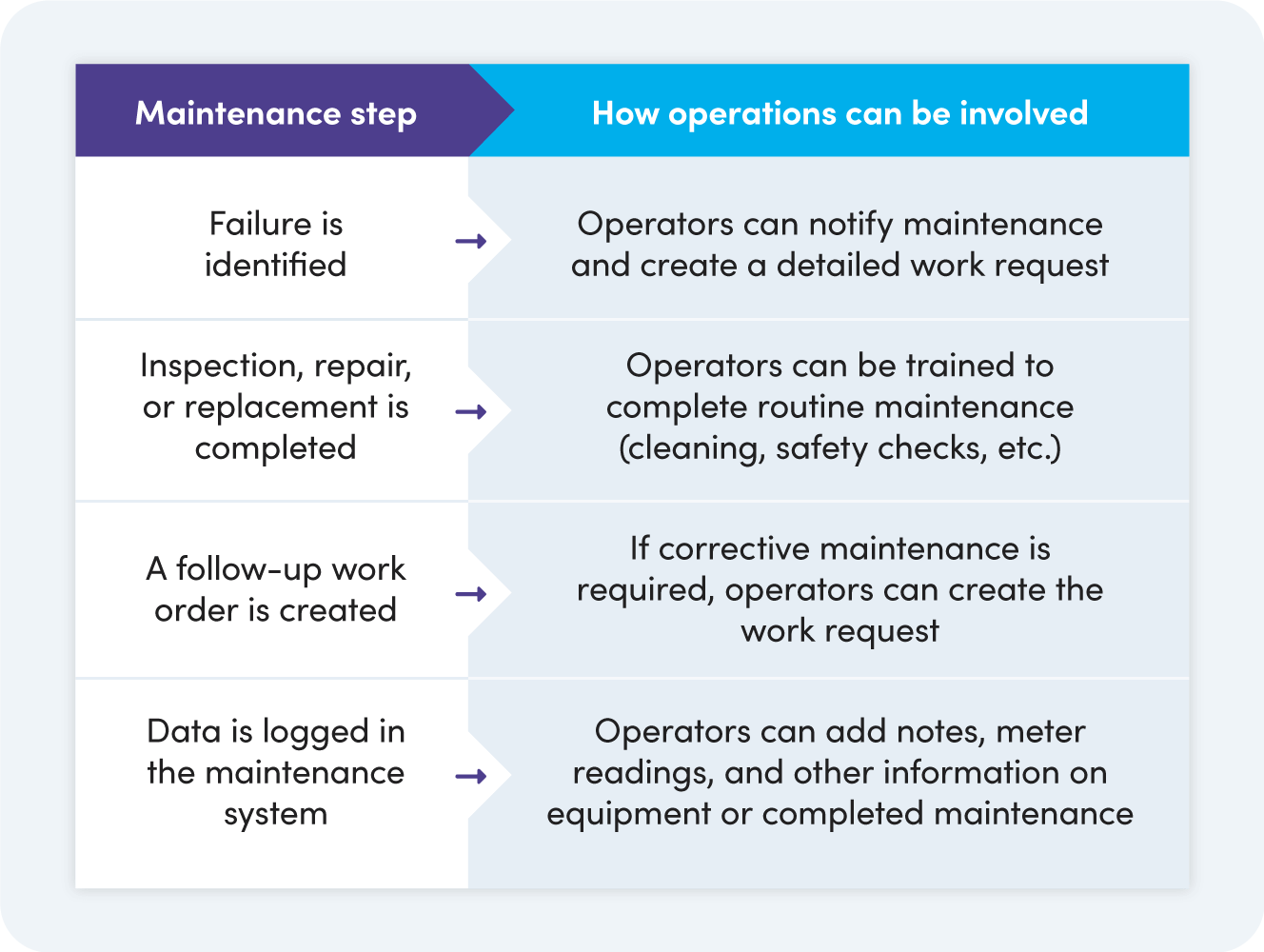
12 ways to use work orders to kick‑start your TPM program →
Success hinges on defining explicit job roles. When responsibilities are crystal clear:
- Training and resources are matched to the right people
- Timelines and budgets become accurate
- New processes can be tested, optimized, and scaled
- Erroneous data is identified and corrected early
Start by creating an “operator” maintenance type, enabling you to track the volume of work delegated to operations and design tailored work‑order templates.
Realistic Work Timelines
Accurate estimates for maintenance tasks prevent hidden delays and build mutual respect. To refine your timelines:
- Review maintenance logs to adjust expectations for tasks that frequently overrun
- Analyze work‑order data to identify preventive maintenance that often requires follow‑up work
- Account for non‑wrench time—parts retrieval, safety checks, and post‑repair testing
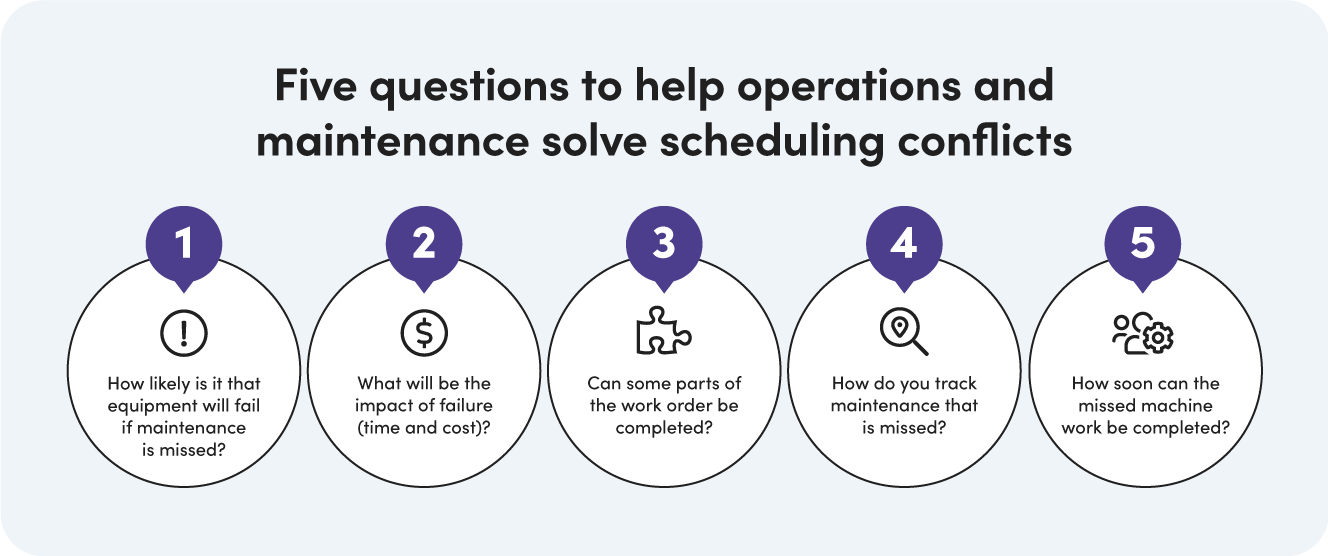
Realistic scheduling may not always sync perfectly, but it opens a dialogue about what can realistically be achieved. When deciding what maintenance can be deferred for production, consider these questions:
Five Proven Ways to Strengthen Operations‑Maintenance Collaboration
Establish Multiple Communication Channels
Busy workflows can silence communication, so formal channels are essential. Possible channels include:
- Regular team meetings for shared visibility on challenges and plans
- Digital dashboards or messaging groups for real‑time updates
- Peer‑review sessions where team members anonymously assess each other’s collaboration
Key discussion topics:
- Machine updates: specs, potential issues, safety changes, SOP adjustments
- Schedules: upcoming work, conflicts, resource needs, changes
- Reporting: targets, progress, trends, successes
- Roadblocks & solutions: major challenges and collaborative fixes
- Long‑term planning: budget management, goal alignment, skill development
Ground rules for effective communication:
- Solution‑focused, not blame‑oriented
- Collective success over individual victories
- Actionable feedback loops that build trust
- Consistency with flexibility for emergencies
- Pre‑set agendas to maximize meeting efficiency
Align Goals and Metrics
Unified objectives reduce friction. Shared metrics might include:
- Clean start‑ups and first‑pass yield: measures efficiency and waste
- Total cost per unit: cost control and quality improvement
- Support time: tracks cross‑team assistance for resource planning
- Unplanned downtime (last 90 days): evaluates preventive maintenance impact
- Mean time to detect and repair: shared responsibility for rapid issue resolution
Use this template to create shared goals between operations and maintenance →
Integrate Production and Maintenance Systems
Visibility breeds respect. By linking maintenance software with production equipment, teams gain real‑time insights into each other’s work. Ryan Robinson, shop manager at a wholesale tree grower, demonstrates this:
He connected sensors on multiple machines to a CMMS, enabling data‑driven maintenance intervals and higher production efficiency. “Knowing how equipment is used daily lets us anticipate tomorrow’s maintenance needs,” he says. He also identified idle vehicles, shared the insight with the farm manager, and together they resolved the underlying issue.
Read Ryan’s story →
Conclusion: Alignment as the Pulse of High‑Performance Operations
Operations and maintenance are the heartbeat of any asset‑heavy, high‑volume organization. By cultivating a healthy, formal relationship—sharing metrics, systems, and schedules—companies unlock visibility into challenges and the collective power to overcome them. The result? Reduced downtime, lower costs, and a stronger, healthier workplace for all.
Equipment Maintenance and Repair
- Elevate Manufacturing Performance: Integrating People, Processes, and Technology
- Transforming MRO with Collaboration Technology: Boost Uptime, Reduce Downtime, and Empower Your Workforce
- Transforming Operations & Maintenance: A Practical Guide to Effective Planning
- 5 Proven Rules to Strengthen Operations & Maintenance Partnerships
- Can Maintenance and Operations Coexist? Lessons from a Postal Service Plant Reorganization
- Enhancing Operations‑Maintenance Collaboration for Superior Manufacturing Outcomes
- Mastering Maintenance Contracts: Expert Tips for Facility Managers
- Optimize Maintenance: Usage‑Based Timing for Maximum Uptime
- How IoT Transforms Fleet Maintenance: Boosting Efficiency & Reliability
- Punch & Die Maintenance: Boost Efficiency & Precision in Fabrication