



Launching a TPM Program: Step‑by‑Step Foundations for Success
You’ve undoubtedly heard the term “TPM” – short for Total Productive Maintenance – you’ve probably encountered the term in various contexts. As Greg Folts explained on the Rooted in Reliability podcast, the acronym can mean different things, but most people focus on autonomous maintenance. In truth, autonomous maintenance is just the first of eight pillars that make up a complete TPM program.
TPM is not a single activity; it’s a culture in which operators, maintenance crews, engineers, and even leadership share responsibility for keeping equipment reliable. The question is: how do you launch a TPM program that delivers measurable gains? Below we outline each foundational step.
Laying the 5S Foundation
Before the eight pillars can be introduced, a 5S foundation must be established. 5S – Sort, Systemize, Shine, Standardize, Sustain – embeds standardization and cleanliness into daily work, creating the conditions necessary for TPM to thrive.
Sort
Identify items that are frequently used versus those that are rarely needed. Keep the essential items close; store the rest in a dedicated location.
Systemize
Assign a single, designated spot for every item to eliminate confusion and save time.
Shine
A clean workplace makes problems visible and maintenance easier. Regular cleaning is a prerequisite for effective inspection.
Standardize
Develop clear labeling and procedures so that everyone follows the same steps, turning informal habits into documented best practices.
Sustain
Embed the 5S practices into daily routines so they become second nature rather than a checklist.
Once 5S is fully ingrained, the facility is ready to embrace the eight TPM pillars.
Building the Eight TPM Pillars
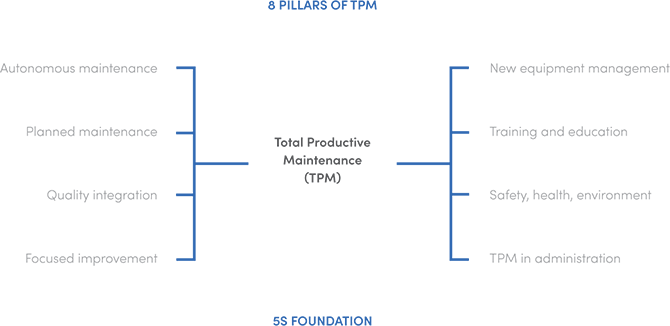
Pillar 1: Autonomous Maintenance
Autonomous maintenance, also called Jishu Hozen, empowers operators to clean, inspect, and lubricate equipment during their normal work cycle. By addressing wear and tear at the source, operators reduce the burden on the maintenance team and keep equipment running smoothly.
Pillar 2: Planned Maintenance
Preventive maintenance schedules are built on data—failure rates, manufacturer recommendations, and time‑based triggers—ensuring that interventions occur when they matter most, without disrupting production.
Pillar 3: Quality Integration
Embedding design‑error detection into the production line eliminates root causes of defects, improving product quality and reducing rework.
Pillar 4: Focused Improvement
Cross‑functional improvement teams tackle specific equipment issues, drawing on the expertise of operators, maintenance, engineering, and quality to craft sustainable solutions.
Pillar 5: New Equipment Management
Insights gathered from day‑to‑day interactions inform the design of new machines, leading to fewer problems and faster adoption.
Pillar 6: Training & Education
Comprehensive training ensures that every employee—from shop‑floor workers to managers—understands TPM principles and can apply them. Leadership must champion TPM to cascade its value throughout the organization.
Pillar 7: Safety, Health & Environment
Creating an accident‑free workplace is a core TPM goal. Eliminating hazardous conditions protects people and safeguards production.
Pillar 8: TPM in Administration
Support functions such as purchasing and logistics adopt TPM concepts, ensuring that process improvements extend beyond the shop floor.
Building the foundation and pillars is only the beginning. Sustained commitment from every level—shop‑floor staff to senior executives—is essential for a thriving TPM program.
Want to learn more about TPM? Read more here.
Equipment Maintenance and Repair
- Kickstart Your IoT/OT Security Project: A Step‑by‑Step Blueprint
- A Practical Guide to Building a Robust Predictive Maintenance Program
- Eight‑Step Blueprint for a Robust Preventive Maintenance Program
- Leveraging Weight‑Loss Discipline to Build Sustainable Maintenance Excellence
- Key Metrics for Demonstrating Predictive Maintenance Success
- Launching Predictive Maintenance: Key Questions and Practical Steps
- Developing a Robust Electrical Maintenance Program: A Practical Guide
- Launching a Reliability Program: A Proven Roadmap
- 50 Proven Strategies to Build a High‑Performance Maintenance Program
- 9 Proven Steps to Build a Robust Preventive Maintenance Program