



Do Machines Truly Wear Out? The Truth About Machine Longevity and Maintenance
The age‑old adage that death and taxes are inevitable is often extended to machines. While a machine that generates profit is subject to taxation, is its demise equally certain?
MIT professor emeritus Ernest Rabinowicz identifies three primary forces that erode machine usefulness: obsolescence, accidents, and surface degradation.
Obsolescence is the cornerstone of technological progress. While some devices—such as the grease fitting introduced by Oscar Zerk in the 1920s—have remained virtually unchanged, most modern equipment, especially automobiles, face functional obsolescence long before they become physically inoperable.
Accidents and human agency can dramatically shorten a machine’s life. Two identical machines operating in identical conditions can exhibit vastly different reliability simply because of operator skill or design flaws introduced during manufacturing.
The third factor—surface degradation—falls under the realm of tribology, the study of wear, friction, and lubrication. Rabinowicz splits this into chemical and mechanical damage.
- Inadequate or degraded corrosion inhibitors in lubricants
- Lubricants that oxidize rapidly and generate acids
- Crankcase oils lacking sufficient alkalinity reserve
- Excessive oil change intervals
- Oil contamination with water or acids
- Biological growth in the oil system
- Moisture in tanks, sumps, and lubrication compartments
- Operating temperatures that exceed lubricant limits
- Use of chemically aggressive anti‑scuff additives
- Improper storage of equipment and inadequate protection from moisture
- Lubricants incompatible with seals, chemicals, or surface treatments
Mechanical surface degradation is divided into abrasion, fatigue, and adhesion, accounting for roughly 50 % of machine retirements. Below is a closer look at each mode and how they can be mitigated.
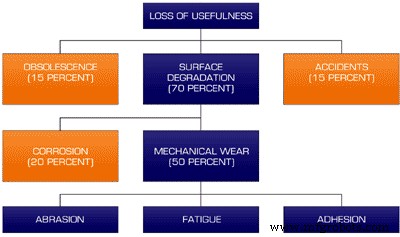
MIT’s Ernest Rabinowicz outlines the causes that reduce machine usefulness.
Two‑Body Abrasion
Two‑body wear, which constitutes about 20‑30 % of abrasive losses, occurs when two surfaces slide against one another—such as a shaft within a stationary journal bearing. The harder surface plows or gouges the softer one. While not always avoidable, it can often be controlled by ensuring a sufficient oil film, proper bearing design, temperature management, and preventing misalignment, over‑loading, or dry starts.
Three‑Body Abrasion
When a solid foreign particle infiltrates the contact between two surfaces, three‑body abrasion can occur. These microscopic particles—often invisible—can act like miniature cutting tools, damaging both sides of the contact. Studies suggest that up to 80 % of total wear in machinery may stem from this mechanism. The culprit is typically airborne dust that becomes entrained in lubricants. Strict hygiene, filtration, and routine oil analysis can eliminate most of these particles, effectively preventing this form of wear.
Fatigue
Fatigue manifests as micro‑pitting that escalates into macro‑pitting and, ultimately, spalling. It is most pronounced in rolling contacts such as gear tooth pitch lines and bearing raceways. Surface roughness, hardness, lubricant viscosity, load concentration, and contaminant size all influence fatigue initiation. Most of these variables can be controlled through design choices and disciplined maintenance. One leading bearing manufacturer claims that with particle removal, its bearings can achieve “infinite life.”
Adhesive Wear (Scuffing/Galling)
Adhesive wear occurs under boundary‑sliding conditions when two metal surfaces bond and then separate, often producing immediate damage. Heavy loads and slow motion exacerbate this phenomenon. While the onset is rapid, the rate of wear can be reduced by operating within rated loads, using surface‑active additives, or employing solid lubricants. Proper design, manufacturing, and commissioning typically keep adhesive wear to a minimum.
Machines Don’t Just Die… They’re Often Murdered
For many pieces of equipment, preventing wear is a formidable challenge, yet not impossible. A well‑maintained, properly lubricated machine can, in many cases, enjoy an effectively infinite service life. The key lies in controlling the environmental and operational factors that accelerate surface degradation.
In reliability engineering, risk is defined as the probability of failure multiplied by the consequence. While the consequences may be outside our direct control, the probability can be dramatically reduced through informed maintenance practices. Human agency failures—stemming from insufficient training, unclear performance metrics, or a weak reliability culture—are inversely proportional to the probability of failure.
Many maintenance teams face a paradox: a machine is broken because it was never serviced, or because it was serviced incorrectly. Reframing the problem clarifies that ignorance—whether of prevention or of ongoing failure—causes the issue. Knowledge, not just action, is the antidote.
Thus, while machines do experience wear, proper maintenance, operator training, and robust design can mitigate this “mortality.” The real culprits are often well‑intentioned individuals who simply lack the knowledge to protect the equipment.
Jim Fitch, President and Senior Technical Consultant at Noria Corporation, brings decades of hands‑on experience in lubrication, oil analysis, tribology, and machinery failure investigations. His clients include Michelin, Timken, John Deere, Caterpillar, Duke Energy, International Paper, Cummins, and U.S. Steel.
Equipment Maintenance and Repair
- Comprehensive Guide to Corrosion Inhibitor Treatments for Industrial Equipment
- Combatting Corrosion in Mounted Bearings: Innovations & Best Practices
- Sealing Out Bearing Contamination: Expert Guide to Timken Bearing Seal Installation & Inspection
- 5 Essential CNC Machining Trends to Watch in 2021
- Prolong Your Undercarriage Life: Expert Maintenance Strategies
- Mastering GD&T Perpendicularity: A Practical Guide for Mechanical Design
- Discover How In-House Surface & Cylindrical Grinding Boosts Efficiency & Quality
- Maximize Efficiency and Precision with Your Benchtop Surface Grinder
- Hydraulic Pump Lifespan: How Long Do They Last and How to Extend Their Life
- Advanced 3D Scanners for Precise Reverse Engineering