



Raytheon Missile Systems Pursues Reliability Excellence
Do you aim to be merely good or to achieve greatness?
Being good is like a second‑string quarterback, an opening act at a concert, or a supporting role in a blockbuster movie. It earns a lukewarm reception and often results in mid‑course cancellations.
Greatness is the hallmark of legends such as Joe Montana, the Rolling Stones, and Mel Gibson. It lands you in the Hall of Fame, a legion of fans, and a star on your dressing‑room door.
While good is acceptable, greatness delivers far more value.
The Facility Services organization at Raytheon Missile Systems’ sprawling 5.1‑million‑square‑foot Tucson, Ariz., site recognizes that being good is only the baseline. What sets this team apart is its relentless pursuit of greatness.
“This is more than just a job; it’s a profession,” says mechanic John Mendoza, one of 400 Facility Services employees who oversee maintenance and reliability for the Tucson missile plants and more than 15,000 mechanical assets.
In the U.S. defense sector, good simply isn’t sufficient.
“We’re not making teapots; this is serious work,” notes Facility Services deputy director Mike Burmood.
These RMS plants design, engineer, and produce 44 distinct offensive and defensive weapons—including cruise missiles and laser‑guided bombs—for the U.S. military and customers in over 40 countries.
Accepting good as a target introduces the risk of failure, jeopardizing American lives. Mission success requires performance at the highest level—greatness.
Facility Services drives itself to this standard by mastering fundamentals while fostering innovation, creativity, education, and customer‑centric solutions.
“We have the vision, the metrics, the practices, and the skills,” says vice president of operations Rick Nelson, who sits at the apex of the Facility Services hierarchy. “We’re set up for greatness.”
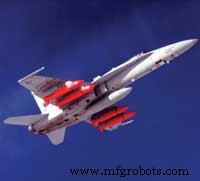 A fighter jet carries a full load of four Joint Standoff Weapon (JSOW) missiles.
The Path to Excellence
Facility Services, comprising five units—maintenance operations, facilities engineering, strategic planning, custodial & landscaping, and infrastructure—spent the 1990s building the foundation for good. To reach that benchmark, the organization eliminated its reactive culture.
“It wasn’t easy,” says Mendoza. “I previously worked at U.S. Borax. The manager claimed we had a proactive maintenance program, but we never had the time to start it.”
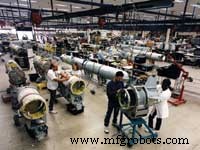 Technicians assemble the final components of a Tomahawk cruise missile at one of Raytheon’s Tucson plants.
The Raytheon Missile Systems crew advanced steadily by implementing:
Meaningful preventive maintenance: The U.S. Air Force audits the site annually, scrutinizing the health of the PM program. This made it a top priority.
Predictive maintenance: An improvement project identified high‑impact tools and technologies—infrared thermography, vibration analysis, ultrasound, and oil analysis equipment—providing the best return on investment.
Improved planning and scheduling: “A well‑designed plan, executed on schedule, positions us where we want to be,” says mechanical planner John Lowe. “Leveraging a computerized maintenance management system and better communication with production makes this possible.”
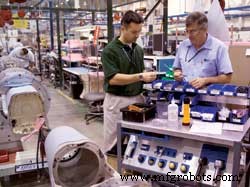 Mechanic Mark Greenbaum (right) and industrial engineer Ricardo Guzman inspect mobile work‑cart components in the Paveway missile plant.
Root cause analysis: By monitoring performance and targeting breakdown locations through RCA, the team reduced failures, says Burmood.
Lean manufacturing principles: Raytheon’s Six Sigma and agile frameworks guide continuous improvement.
Planned work orders—once a small fraction of total work—rose from 25 % in the mid‑1990s to 54 % today (35,000 planned vs. 30,000 unplanned). Strategies aim for 70 % planned. Completed on schedule, 95.3 % of planned work meets its deadline. Breakdowns have fallen to 2 % of unplanned orders.
“By anticipating problems and fixing them before they occur, we dramatically cut breakdowns,” says Facility Services director Brent Bean. “Fewer breakdowns free up time for proactive PM and corrective actions.”
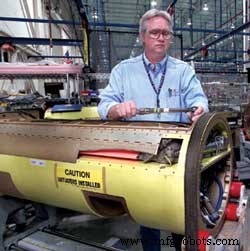 Facility Services developed a fixture that allows a Tomahawk mid‑body to rotate 360 ° on red wheels, reducing material handling and assembly time.
Value‑Added Proposition
Facility Services developed a fixture that allows a Tomahawk mid‑body to rotate 360 ° on red wheels, reducing material handling and assembly time.
Value‑Added Proposition
Facility Services invested significant effort into understanding customer expectations. According to Mike Burmood, the solution centers on six value‑added pillars:
- Service
- Waste elimination
- Reliability
- Speed
- Visual standards
- Accountability
Culture and Leadership
The shift from reactive to proactive opened doors for employees to contribute creativity, technical expertise, and insight. RMS leadership turned this opportunity into reality.
“People embrace empowerment only when it’s genuine,” says Six Sigma master expert Jim Serazio. He shares a classic experiment: when playground fences were removed, children stayed close to the building. “Empowerment is about removing fences and explaining why it’s safe to explore.”
“Leadership is the key,” Serazio adds.
Support also reaches the executive floor.
“Unleashing talent is the biggest challenge in a large company,” says Nelson. “We limit talent by roles, boundaries, and risk. Encouraging calculated risk is vital.”
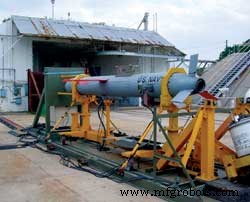 A Tomahawk cruise missile secured in a test‑flight fixture.
Innovative Thinking
Greatness now means enhancing production through ideas that streamline assembly, cut costs, eliminate waste, and address safety and quality.
After 9/11 and the subsequent conflicts in Afghanistan and Iraq, workers on the Paveway line quadrupled monthly production.
“We faced new challenges,” says operations manager Pat McKinney. “Lifting 35‑pound components 200 times a day caused fatigue, mistakes, and injuries.”
Engineers John Tsukamoto, Mark Greenbaum, and machinist Ralph Hammer quickly designed a trolley‑type holder with casters and a multi‑station base, eliminating heavy lifting. “It was a quick solution; we even sourced parts from Home Depot,” notes McKinney.
Greenbaum later added mechanisms to twist, turn, and tip the holder, plus an error‑proofing device for a complex installation step, eliminating rework.
Solutions—big or small—are pervasive across the Tucson plants.
When inventory racks scratched product, Mendoza created an upright rack system that prevented scratches and saved floor space.
Workstation drawers were cluttered; mechanics installed custom drawer inserts with tool‑specific cut‑outs, cutting search time and indicating missing tools.
Production managers seek to reduce material handling while increasing flexibility. Facility Services interviews operators and managers, captures sketches, then designs and builds prototypes—parts presentation carts, mini‑assembly lines, multi‑axis holders—tailored to operator needs.
“Designs must serve the operator, not just an abstract wish list,” says Mendoza.
These tools often use recycled or repurposed materials, keeping cost and time low.
“We frequently source parts from scrap,” says Hammer.
Greenbaum explains: “When a program is retired, we salvage parts. We maintain a warehouse of these supplies.”
Projects can take from minutes to days, but they rarely involve elaborate engineering. “The best solutions are simple,” says Hammer. “We don’t rely on AutoCAD or Pro/E; we use our minds.”
When an idea fails, the mantra is: “Who cares?”
“We try anything,” says McKinney. “The worst that happens is we revert to the old method. A rapid, inexpensive trial allows us to learn quickly.”
More often than not, the idea succeeds, positioning Facility Services as a bottom‑line contributor.
A notable example is the coolant reuse system.
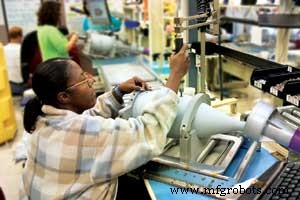 Fixtures and roller system at a Paveway 2 guidance electronics workstation, designed by machinist Ralph Hammer, mechanic Mark Greenbaum, and engineer John Tsukamoto.
Facility Services identified the high cost of draining, disposing, and refilling machine coolant. Utility helper Lou Cahoon proposed a purification system that filters coolant and returns it to production machinery. The system now processes 100 % of plant coolant, saving more than $100,000 annually in labor and material costs.
Another cost‑saver rationalizes compressor oil changes. Mendoza notes that oil was previously drained and replaced on a fixed schedule, even when it was still new. By conducting oil analysis, the team only changes oil when needed, reducing waste and protecting the environment.
Cahoon and colleagues also reduce costs through predictive maintenance. Burmood calls Cahoon “Mr. Oil Analysis” for his ownership of the technology. Facilities engineer Cosme Martinez reports that oil analysis, infrared, vibration analysis, and ultrasound saved the company hundreds of thousands of dollars last year.
What does this mean for individual crew members?
“Recognition matters,” says Hammer. “A simple thank you goes a long way.”
Strong performance and low non‑conformance provide corporate stability and job security.
“Getting people out of their boxes also means moving beyond their job descriptions,” says McKinney. “Mechanics now share responsibility with assemblers and testers for schedules, costs, and reliability.”
“Previously, boundaries were tight—’I’m the mechanic,’ ‘I’m the electrician.’ We now see the entire value stream and how our work impacts everyone.”
“In a competitive environment, the real waste is not labor but capital—$20 million of idle inventory. Reducing that to $10 million, or cutting cycle time from months to days, yields tremendous savings.”
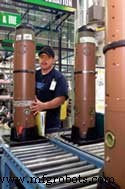 Facility Services continually seeks to reduce heavy lifting for assembly technicians.
Integrated Family
Other plant departments have been pivotal in Facility Services’ evolution from good to great.
Production not only includes Facility Services in strategy meetings but also treats the group as a core family member.
“Historically, we overlooked them. To truly harness their contribution, they must be part of the extended family,” says McKinney.
Engineering now brings Facility Services into design reviews. Maintenance technicians and planners collaborate with design engineers to assess drawings, equipment purchases, and installation plans.
“We’re involved from the start,” says Burmood. “We provide input on maintainability and reliability.”
Design and construction engineers also seek Facility Services for equipment standardization. “We use compressors from dozens of manufacturers. With Facility Services’ guidance, we narrow the list to the best performers and simplify procurement.”
The Joint Apprenticeship Committee, in partnership with the Career Enrichment Program (CEP), offers electrician apprenticeships and is developing programs for machinists, HVAC technicians, and plumbers. These four‑to‑five‑year paths supply highly skilled talent, often drawn from existing employees.
Donna Bower, an electrical apprentice, previously spent 20 years as an assembler. She earned her apprenticeship after an extensive interview and review process.
“I wanted a challenging, brain‑heavy, hands‑on role,” says Bower, who has completed 8,000 hours of on‑the‑job training and 500 hours of classroom instruction.
Plans are underway to expand the apprenticeship program beyond Facility Services, extending skills education to the public. Burmood notes feasibility studies support establishing a technical high school in Tucson that will supply job candidates for maintenance and related roles.
Unwavering Focus
In 2004, Raytheon Missile Systems in Tucson earned the Shingo Prize—often dubbed the Nobel of manufacturing—one of eight recipients that year. Facility Services played a pivotal role in this achievement.
Despite this accolade, the department refuses to settle into complacency. “We’re not finished,” says Bean. “Every day, we try new approaches and improve.”
Burmood adds, “The Shingo award was a milestone, but we still view ourselves as about 20 % of our potential.”
For example, 2 % of unplanned work orders are breakdowns. While the percentage is low, 600 breakdowns per year (2 % of 30,000) remain unacceptable. “Until we hit zero, that number is too high.”
Future plans include deeper lean manufacturing adoption and a formal Reliability‑Centered Maintenance program, with individual workers playing a central role.
“I’m 58, but I look forward to tomorrow,” says Mendoza. “Each day offers a new opportunity. The changes over the past 25 years are remarkable, and I’m eager to see what the next 20 years hold.”
Taking It PersonallyActive participation in the journey to greatness is crucial. Equally important is personal growth, which Raytheon Missile Systems in Tucson supports through the Career Enrichment Program.
With a motto of “helping employees be what they want to be,” the 18‑year‑old program partners with Pima Community College to offer technical and general education courses both on campus and online.
CEP also expands online opportunities through accredited institutions such as Central Georgia Technical College and Rio Salado College in Phoenix.
The program operates on multiple levels:
- Individual courses to deepen current job knowledge.
- Associate degrees in applied science or business and industry from Pima.
- Sequential one‑semester courses that unlock any of the 44 bargaining‑unit job classifications.
Gaining additional classifications provides career flexibility—an electrician can become a machinist, a custodian can become a plumber—protecting employees against downsizing or program shifts.
Mark Hughes, a plumber/HVAC technician and CEP board representative, says, “Many workers want a broad skill set. CEP lets them grow and thrive on their own terms.”
CEP engagement is widespread: 77 % of hourly workers have utilized the program in some form. Over the past five years, workers have taken nearly 3,000 CEP‑approved classes. As a result, 83 % hold rights to two or more job classifications, and 59 % hold rights to three or more.
The site has invested millions in CEP over the last five years.
“We invest in education,” says VP of operations Rick Nelson. “Initiatives like CEP elevate our workforce’s caliber.”
Just the FactsSite: Raytheon Missile Systems, multiple plants in Tucson, Ariz.
Employment: 11,000 total, 400 in Facility Services.
Site size: 5.1 million square feet.
Products: 44 offensive and defensive weapons for U.S. and 40+ allied nations, including Tomahawk, JSOW, Paveway, HARM, Stinger, AMRAAM, and EKV.
2004 RMS sales: $4.1 billion.
FYI: 75 % of weapons dropped in Operation Iraqi Freedom were built at RMS Tucson.
Equipment Maintenance and Repair
- Reliability: The Comprehensive Guide to Asset Management
- From Maintenance to Reliability: Building a Culture of Predictive Excellence
- Building a Reliability Culture: Ownership, Collaboration, and KPI Success
- Cutting Waste to Boost Equipment Reliability
- Whirlpool’s Reliability Revolution: Elevating Uptime, Productivity, and Profitability
- Alcoa’s 50‑Year‑Old Smelter Drives Reliability Excellence to Cut Costs and Boost OEE
- The Key to Reliability Success: Culture Change Over Technology
- Reliability‑Centric Sales: Driving Profitability and Reducing Risk
- Enhancing Plant Reliability Through Collaborative Operations and Maintenance
- Reliability: The Core of Sustainable Manufacturing