



Why Reliability and Maintenance Initiatives Often Fail – A Hedgehog vs. Fox Analysis
Many reliability and maintenance improvement initiatives fail to achieve their promised outcomes. What drives this shortfall?
Through years of consulting, I’ve identified several common pitfalls:
- Top‑management lacks deep understanding, clear direction, and long‑term commitment.
- Projects are driven by short‑term cost savings rather than sustained reliability gains.
- Internal politics and misaligned organizational goals create friction.
- Frequent leadership turnover disrupts momentum.
- Rebranding familiar concepts confuses stakeholders.
- Improvement is a never‑ending process, not a finite program.
- Success depends on disciplined thinking and consistent action.
- Technology is an enabler that thrives only when people are ready.
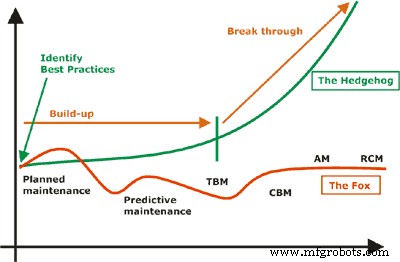
In his bestseller Good to Great, Jim Collins draws on Isaiah Berlin’s “hedgehog and fox” essay to explain why some companies become great while others remain merely good. His research spanned 30 years and showed that the truly great firms—what Collins called “hedgehogs”—focused relentlessly on a single, world‑class capability and sustained that focus for decades. In contrast, the “foxes” chased new ideas, shifting strategies in pursuit of short‑term wins.
The same pattern emerges in reliability and maintenance work. A “fox” organization cycles through initiatives—planned maintenance, predictive maintenance, TPM, AM, RCM—each under a new manager, delivering only fleeting gains. A “hedgehog” organization, by contrast, identifies the practices that truly drive reliability, invests time to master them, and executes them with discipline. Over 3–7 years, this focused effort yields a breakthrough that endures, and new leaders are expected to keep the momentum going.
When a team sees continuous, high‑quality results, trust and enthusiasm grow, creating the environment needed for sustained improvement.
Torbjörn (Tor) Idhammar is a partner and vice‑president at IDCON Inc., a global authority on reliability and maintenance management. With a BS in industrial engineering from North Carolina State University and an MS in mechanical engineering from Lund University, Tor has authored the Condition Monitoring Standards series (volumes 1–3). He leads training and implementation support for preventive maintenance, condition monitoring, spare‑parts planning, and root‑cause analysis.
Contact Tor at 800‑849‑2041 or info@idcon.com. Visit www.idcon.com.
Equipment Maintenance and Repair
- Achieving Sustainable Maintenance Success: Short‑Term Wins vs. Long‑Term Processes
- Autonomous Maintenance: Empowering Operators to Maximize Equipment Performance
- Harnessing Reactive Maintenance: When It Drives Cost Savings
- Begin With Preventive Maintenance, Then Move to Root‑Cause Elimination
- Why TPM Projects Often Falter — Proven Reasons & How to Fix Them
- Why Maintenance Departments Decline Over Time and How to Counteract It
- Why a Maintenance Work Order System Is Essential for Your Business
- The Critical Role of a Structured Equipment Maintenance Workflow
- Why Pneumatic Cylinders Fail and How to Repair Them Effectively
- The Critical Role of Remote Maintenance & Monitoring for Modern Businesses