



Invest in Modern Lubrication: How a $500 Upgrade Yields $10,000 in Five Years
Have you ever realized that buying equipment without modern lubrication options often ends up costing more in the long run? Rather than just focusing on the sticker price, consider the entire life‑cycle cost of your machinery.
When OEMs default to the bare minimum—standard filters, breathers, and sampling hardware omitted from the bill of materials—purchasing agents can cut a few hundred dollars. But that savings can turn into costly maintenance, frequent failures, and lost production time. A better strategy is to add a modest premium for factory‑installed lubrication hardware and let the savings compound over the equipment’s life.
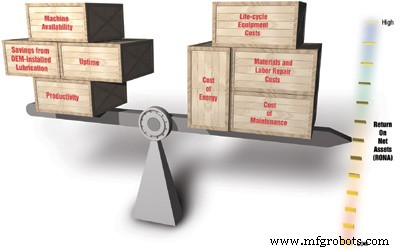
Consider a typical centrifugal pump. Over five years, a pump with standard lubrication can incur:
| Typical | Modern Lubrication | |
|---|---|---|
| Initial Purchase Cost | $6,000 (15%) | $6,500 (22%) |
| Maintenance | $12,000 (30%) | $2,500 (8%) |
| Energy | $16,000 (40%) | $15,000 (50%) |
| Other | $6,000 (15%) | $6,000 (20%) |
| Total Life‑Cycle Cost | $40,000 (100%) | $30,000 (100%) |
Adding just $500 to the initial purchase price translates into $10,000 in savings over five years—a 111% compounded return. Using a 5% discount rate, the net present value of that $500 is approximately $7,727. In other words, the $500 saved by cutting out modern lubrication is actually $7,727 forfeited.
Retrofitting these components on an existing machine is far more expensive. The same $500 worth of hardware can cost $3,000 or more when purchased separately and assembled onsite, not to mention the labor and risk of incompatibility. For instance, a centrifugal pump bought piece‑by‑piece can cost 3.5 times more than a pre‑assembled unit; a car bought in parts can cost 17 times the showroom price.
Beyond cost, modern lubrication improves Return on Net Assets (RONA) by boosting revenue, lowering expenses, and reducing net asset depreciation.
RONA = (Revenue – Expenses) / Net Assets
- Revenue: More uptime means more output and higher earnings.
- Expenses: Efficient lubrication cuts energy use, maintenance, and spare parts.
- Net Assets: Factory‑installed systems reduce the cost of modifications and spare parts, lowering depreciation.
Here is a practical checklist of factory‑installed lubrication equipment that can deliver these benefits:
Inspection
- Level gauges near fill ports for quick oil level checks.
- Expanded‑metal guards on chains, couplings, and belts to protect inspection points.
- Bottom‑sediment and water sight glasses for contamination monitoring.
- Magnetic drain plugs and inspection devices to capture wear metals.
- Inspection hatches on large reservoirs with sealed lips and clamps.
Oil Sampling & Analysis
- Primary sampling ports properly located and installed at the factory.
- Secondary sampling ports on key circulating systems.
Contamination Control
- High‑quality beta‑rated oil filters and breathers.
- Rod boots on hydraulic cylinders to prevent ingress.
- Proper baffling and sizing of reservoirs for sedimentation.
- Dust covers for grease fittings.
- Offline filters (kidney loops) for bath/splash‑lubricated machines.
- Headspace purge systems for large reservoirs.
Instrumentation
- Fluid pressure, flow, and temperature gauges.
- Free water, low oil‑level, and pressure differential alarms.
- Air‑intake vacuum gauges for diesel engines.
- Online sensors for viscosity, ferrous density, particle count, and moisture.
- Headspace dewpoint meters.
Lubrication Systems
- Appropriate lubricant delivery devices: drip, circulating, oil‑mist, splash, constant‑level, single‑point, grease fittings, centralized systems, spray systems.
- High‑quality seals for long life and contaminant control.
- Temperature management with heaters or coolers as needed.
- Grease purge ports and rolling‑element bearing seals.
- Lubricant return‑line diffusers to limit tank aeration.
- Pre‑lube systems for cold starts and power‑flush quick‑connects.
Documentation
- Illustrated lubrication procedures: oil changes, grease changes, top‑ups.
- Flushing procedures and recommended fluids.
- Oil change intervals and lube point lists.
- Recommended lubricants with performance specs for all operating conditions.
- Cross‑reference of lubricant brands/types.
- Equipment storage protection practices.
- Run‑in procedures for gears.
- Seal compatibility information.
In short, world‑class lubrication requires world‑class technicians, lubricants, and procedures—plus factory‑installed equipment that supports them. Don’t wait until maintenance costs blow out; talk to your equipment supplier today.
Jim Fitch, President and Co‑Founder of Noria Corporation, can help you evaluate your lubrication strategy.
Email: jfitch@noria.com | Phone: 918‑749‑1400
Learn more about best practices at machinerylubrication.com and noria.com.
Reference: Mackay, Ross. “Current Best Reliability and Maintenance Practices of Pumps and Pump Systems.” Results‑Oriented Reliability Maintenance Conference, Raleigh, N.C., November 2002.
Equipment Maintenance and Repair
- Balancing Equipment Ownership and Cross‑Training for Maintenance Technicians
- Reliability Excellence: The Key to Safer, More Profitable Operations
- New Year’s Maintenance Reset: Cost‑Effective Strategies for 2024
- 6 Essential Welding Practices for Plant Maintenance
- 5 Proven Maintenance Practices to Maximize Heavy Machinery Performance
- Omron Unveils Advanced Control Panel Solutions for Factory Automation
- Navigating Emerging Challenges in Industrial Equipment Manufacturing
- Volvo Electric Equipment: Unlocking New Opportunities in Heavy-Duty Jobs
- Hydraulic Equipment Reliability: Proactive Maintenance Best Practices
- 6 Proven Strategies to Cut Equipment Maintenance Costs