



Why Crisis, Not Aspiration, Drives Reliability Investments in Manufacturing
In the reliability community, a recurring observation is that senior leaders often fail to recognize the strategic value of plant reliability management. As a consultant, I am repeatedly called upon to help plant engineers and managers articulate the business case to executives who appear unconvinced. While there is no magic phrase that instantly changes minds, understanding why the “why” is often ignored can provide a roadmap to influence decision‑makers.
Two forces typically motivate an organization to pursue excellence in asset reliability: a proactive aspiration or a reactive crisis. In practice, most companies react to a crisis. I attribute this to two main factors:
- Short‑term objectives dominate the agenda.
- Decision‑makers are wired to view reliability investments as a risk rather than an opportunity.
Let’s start with the short‑term focus. Executives of large manufacturers routinely overlook plant reliability as a strategic function. Yet, when a firm depends on equipment to convert raw materials into finished goods, those assets are the true profit engine—especially for businesses operating in a “commodity sandwich” where neither raw material nor finished‑product prices can be controlled. Figure 1 illustrates this dynamic.
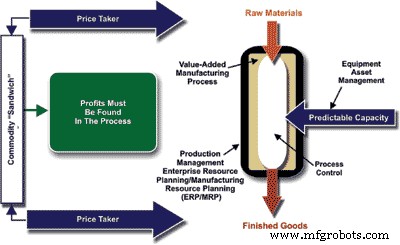
Figure 1. Most manufacturing organizations have no control over the price of raw materials or finished goods. Their profits must be found in the process.
Why, then, do we often design equipment to deliver only baseline performance at the lowest purchase price, rather than applying a life‑cycle pricing approach that maximizes long‑term value? Why is there a lack of rigor in operational processes, a lag in adopting condition‑based maintenance, or a failure to manage workforce skills and behaviors effectively? Why are we rewarded for fixing failures overnight instead of investigating root causes? Why do reactive fixes feel more comfortable than proactive initiatives that reduce the likelihood of failure?
The overarching question is: why do companies wait until a failure escalates before seriously addressing reliability? While there are many explanations, the short‑term focus and the psychological response to risk are key.
From a shareholder’s perspective, a public company’s priority is short‑term share‑price performance. Implementing a robust reliability program demands a front‑end investment—business process reengineering, technology upgrades, training—and the benefits materialize only after months or years. The market’s demand for immediate returns pushes executives toward decisions that appear attractive now but harm long‑term performance—such as buying equipment cheaply, slashing maintenance budgets, or operating machinery beyond its design limits.
In contrast, privately held firms, like Cargill—America’s largest privately held company—can adopt a longer‑term view. Ron Christenson, Cargill’s chief technical officer, exemplified how a strategic focus on reliability can reinforce competitive advantage and customer satisfaction. The private‑company structure removes the pressure of quarterly earnings, enabling a broader perspective on asset reliability.
When a company is in crisis—when the stakes are high and the alternative is failure—leaders become more receptive to initiatives perceived as risky. This phenomenon aligns with Prospect Theory, introduced by Kahneman and Tversky (1979). The theory shows that people are risk‑averse when presented with gains but become risk‑seeking when framed as potential losses. In reliability terms, framing an initiative as “we are losing X dollars annually because of inadequate reliability” rather than “this will add Y dollars in profit” can shift decision‑makers toward investment.
Practical strategies to leverage this insight include:
- Quantify and communicate incremental gains from reliability projects in terms of impact on profit and share price, ensuring the data stands out amid daily operations.
- Reframe projects as loss‑avoidance: highlight the annual loss being avoided, then present the investment as a means to stop that loss.
- Educate stakeholders on reliability concepts, so they can appreciate the likelihood and magnitude of the potential benefits or avoided losses.
Implementing a culture change to embed reliability into business processes is a substantial investment, especially for publicly traded firms. Recognizing the psychological and financial barriers that exist enables leaders to manage the transition more effectively.
References
Troyer, D. (2005). Plant Reliability Management Course Book, Noria Corporation, Tulsa, OK.
Mitchell, J. (2000). Operating Equipment Asset Management Handbook, Clarion Technologies, Houston, TX.
Kahneman, D. & Tversky, A. (1979). Prospect Theory: An Analysis of Decision-Making Under Risk, Econometrica, 47, 263‑291.
Equipment Maintenance and Repair
- Why Preventive Maintenance Doesn’t Always Stop Equipment Failures (And How to Fix It)
- Why TPM Projects Often Falter — Proven Reasons & How to Fix Them
- Why Functional Diversification Drives Plant Reliability Success
- Why Human Engagement Drives Reliability Success
- Reliability Excellence: The Key to Safer, More Profitable Operations
- Why Automation Won’t Replace Human Employees
- Heavy Equipment: More Than a Tool—Why It’s a Valuable Asset
- Why Won’t My 3D Pen Work? Quick Troubleshooting Tips
- Troubleshooting Low Pressure in Your Pump: Common Causes & Fixes
- Diagnosing Common Causes of Hydraulic Pump Failure