



Five Stages of CBM Maturity – Part II: From Basics to World‑Class Performance
In the previous issue of Reliable Plant magazine, I introduced the five stages of a condition‑based maintenance (CBM) program’s evolution. Here we examine how each stage differs across four critical performance dimensions.
CBM and Formal Work Requests
- Stage 1: Very few or no CBM‑generated work orders enter the CMMS.
- Stage 2: CBM yields abundant data, yet only a limited number of work requests are created.
- Stage 3: Half of all CBM findings are converted into formal work orders.
- Stage 4: Approximately 80 % of CBM findings become work requests.
- Stage 5: Every CBM insight results in a formal work request.
Ask yourself: at which stage does your plant reside?
The Resource Factor
- Stage 1: No dedicated CBM staff.
- Stage 2: Part‑time technicians are frequently reassigned, sometimes inspecting already failed equipment—a costly misallocation.
- Stage 3: Full‑time CBM technicians, analysts, and managers are in place, rarely pulled from their primary duties.
- Stage 4: Teams begin cross‑training across multiple PdM technologies.
- Stage 5: Multi‑disciplined teams hold certifications and possess deep expertise across several PdM tools.
Where do you stand?
CBM and Acceptance Testing
- Stage 1: CBM is not used for new or reconditioned equipment verification.
- Stage 2: Spot checks are performed on request.
- Stage 3: CBM is applied to the most critical machines during acceptance.
- Stage 4: Acceptance testing covers at least 75 % of equipment in the CBM program.
- Stage 5: All new and reconditioned equipment is commissioned or re‑qualified with CBM.
Which stage describes your operations?
Involving Operations
- Stage 1: Operations involvement is minimal.
- Stage 2: Limited buy‑in, with a focus on missed opportunities.
- Stage 3: Operations support is significant, though not all metrics are fully leveraged.
- Stage 4: Operations and CBM are fully integrated, with a shared understanding of asset health.
- Stage 5: Operations owns accountability for running a truly reliable plant.
Where does your plant fit?
Remember, the biggest threat to CBM is complacency—not risk. Focusing on these key areas keeps the program moving forward. Once the benefits are realized, no lesser approach will suffice.
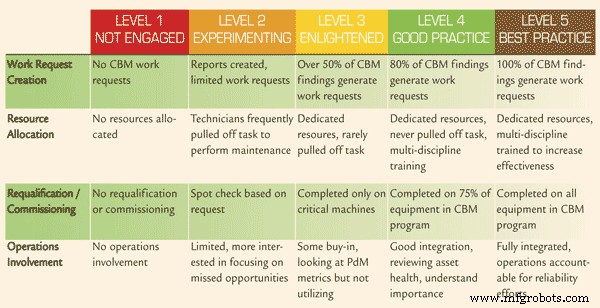
(Click image to enlarge)
Where would you place your CBM program?
The Power of Consistent Learning for Maintenance & Reliability Professionals
Who Should Own Lubrication: Choosing the Right Team for Peak Plant Reliability
Equipment Maintenance and Repair
- Understanding Level Sensors: Types, Functions, and Industry Applications
- Five Levels of Condition‑Based Maintenance Programs – A Practical Guide (Part I)
- Five Types of CBM Programs, Part III: Aligning CBM with Reliability Engineering
- 5 Proven Strategies to Drive Growth Amid the Pandemic
- Sustainability in Manufacturing: Final Episode – Insights from Senseye's Leadership
- How Smart Level Monitoring Drives Industrial Efficiency & Growth
- Enhancing Aluminum Die-Casting Quality: 5 Proven Strategies
- CMMS Expert Series Part 3: Mastering the Three Setup Models for Seamless Integration
- Effective Deburring Techniques: Applications & Process Types
- Choosing the Right Drill Bit for Precision Part Manufacturing