



Five Types of CBM Programs, Part III: Aligning CBM with Reliability Engineering
In earlier columns we mapped the five evolutionary stages of condition‑based maintenance (CBM) programs, from Level 1 plants that perform minimal CBM to Level 5 best‑practice operations. In this installment we examine how CBM dovetails with reliability engineering.
The criticality analysis: A robust criticality ranking is the cornerstone of any effective maintenance strategy, yet few plants execute it with rigor. It informs which assets join the CBM program and how work orders are prioritized.
Many organizations default to the simple ABC system—labeling equipment as A, B, or C. A compressor may earn an “A” while a lunchroom refrigerator receives a “C.” The challenge lies in the bulk of assets that fall into the “B” bucket. When hundreds of B‑rated pieces compete for attention, how do you decide which one to service first?
What you need is a single, composite score that ranks every asset. That granularity removes guesswork and instills confidence that you’re acting on the right equipment at the right time.
Ideally, the composite score incorporates safety, environmental impact, maintenance costs, and throughput/quality effects. Achieving consensus requires collaboration across maintenance, production, purchasing, safety, finance, and marketing teams.
Are you reporting asset health? Accurate asset‑health metrics are the clearest indicator of reliability. For leadership to take them seriously, the data must be standardized, meaningful, and repeatable.
Where once asset health was merely a philosophy, today we can run a suite of CBM diagnostics, backed by software that scores and reports on condition. Top performers now publish asset‑health status for all equipment using consistent benchmarks.
Failure isn’t final: While you can’t change a failure after it happens, you can shape the response. This ability to learn from failure distinguishes successful CBM programs from the rest.
A CBM manager at a large chemical firm noted, "We don’t invest enough in eliminating defects. When the same piece of equipment is cited 19 times in a year with no proactive root‑cause action, the program is misaligned."
Failure is a learning opportunity: what happened, why it happened, and what adjustments will prevent recurrence.
In Level 1 and 2 programs, formal failure investigations are rare. Level 3 programs conduct limited root‑cause analyses on the most costly failures, and only a few staff are trained in RCA.
Top‑tier CBM initiatives feature clear triggers for failure investigations—cost thresholds, failure frequency, operational impact—and often bring in supplier or OEM experts. The process is fully documented, published upon completion, and metrics track outcomes. Many employees are trained in RCA, and results feed back into continuous improvement.
Where does your organization stand?
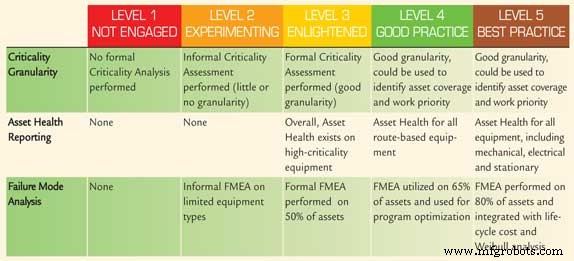
Considering each level’s characteristics, where would you place your CBM program?
Equipment Maintenance and Repair
- Understanding Level Sensors: Types, Functions, and Industry Applications
- Five Stages of CBM Maturity – Part II: From Basics to World‑Class Performance
- Five Levels of Condition‑Based Maintenance Programs – A Practical Guide (Part I)
- C++ Operators Explained: Types, Examples, and Sample Programs
- Sustainability in Manufacturing: Final Episode – Insights from Senseye's Leadership
- Enhancing Aluminum Die-Casting Quality: 5 Proven Strategies
- UID Overview Series – Part III: Shaping the Future of Unique Identification in Defense
- CMMS Expert Series Part 3: Mastering the Three Setup Models for Seamless Integration
- Effective Deburring Techniques: Applications & Process Types
- Choosing the Right Drill Bit for Precision Part Manufacturing