



Diagnostic Framework for Resolving Plant‑Level Issues
Every manufacturing operation encounters challenges, yet effective leadership cultivates a culture where frontline teams tackle day‑to‑day problems while managers focus on systemic solutions.
In practice, too often leaders step in to address issues that belong to lower tiers, creating a “fix‑your‑own‑problem” mindset. Empowering employees to raise concerns and then providing the tools and authority to resolve them is the cornerstone of proven lean systems like Toyota’s Production System.
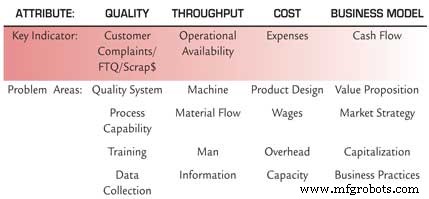
This chart serves as a practical guide to identify and solve plant problems.
Key to success is encouraging analytical thinking rather than passive execution. Ask targeted questions, listen to the answers, and then hand over responsibility and resources for implementation.
Most facilities face limited time and capital for problem‑solving, so prioritizing issues becomes critical. The question is not only “what’s wrong?” but also “where is the most valuable improvement opportunity?”
Start by creating a visual work environment that makes deviations visible. Establish clear standards, monitor them regularly, and audit compliance. Tracking what is normal versus abnormal allows you to focus on genuine problems.
In manufacturing, four metric families are essential: quality, throughput, cost, and the overarching business model.
The attached chart directs you from diagnosis to potential root causes and solutions. For each major attribute, a key indicator is highlighted—if monitored correctly, it reveals the health of that business dimension.
Diagnose from left to right. Once a problem is flagged, define its boundaries and root cause. As management guru Walter Kettering noted, “a problem well‑defined is a problem half‑solved.”
Quality is the highest leverage point. Improving it yields customer satisfaction, productivity, cost reduction, and often safety gains. Track first‑time quality, scrap dollars, and customer complaints or returns. Poor performance prompts checks on quality systems, process capability (CpK), training, and data collection. These diagnostics often point to tools such as control plans, error‑proofing, or structured problem‑solving methods.
If quality is stable yet throughput remains low, shift focus to operational availability. Evaluate uptime: mechanical breakdowns, material shortages, scheduling mismatches, operator work‑method efficiency, and change‑over duration. Tools like Total Productive Maintenance, standard work, pull systems, and SMED become relevant.
When throughput is optimized but costs stay high, investigate overhead, workforce competitiveness, or capacity planning misalignments. Examine product design for manufacturability and model proliferation.
Finally, negative cash flow signals issues beyond the factory floor—value proposition, market timing, overcapitalization, billing practices, or make‑vs‑buy decisions. A comprehensive review of the business model is required.
Metrics that reflect the state of health at each level are vital. Operate from the shop floor left to right; address strategic concerns right to left. Senior leaders should avoid cherry‑picking operational problems and instead foster a widespread problem‑solving culture.
Curtiss Quirin, Director of Operations, The Stanley Works production plant in Indianapolis, can be reached at curtiss.quirin@sbcglobal.net.
The Reliability in Action department publishes case studies and articles submitted by readers.
Equipment Maintenance and Repair
- Launching Reliable Plant: Your Trusted Guide to Maintenance Excellence
- Celebrating Excellence: Reliable Plant’s First‑Year Awards and Milestones
- Resolving Electrical Issues After Energy‑Efficiency Upgrades
- Plant Maintenance Demystified: Best Practices for Modern Industries
- Quick & Reliable Fixes for Common Warehouse Door Issues
- 9 Welding Issues You’ll Encounter – Expert Fixes & Prevention Tips
- Top Rotary Valve Issues and Proven Fixes for Reliable Performance
- Top 5 Warehouse Challenges & Proven Solutions for Faster Fulfillment
- 5 Red Flags That Indicate Information-Sharing Issues in Your Plant
- Common Lithium‑Ion Battery Issues & Practical Fixes