



White Roofs: A Proven Strategy to Reduce Urban Heat and Mitigate Climate Change
Painting building roofs white has the potential to significantly cool cities and help counter global warming, a new study shows.
This computer‑modeling research is the first to simulate the worldwide impacts of white roofs on urban areas, offering promising evidence for the concept.
Led by scientists at the National Center for Atmospheric Research (NCAR) in Boulder, Colorado, the study cautions that several practical challenges remain before white roofs can become a widespread climate‑mitigation tool.
“Our research demonstrates that white roofs, at least in theory, can be an effective method for reducing urban heat,” says NCAR scientist Keith Oleson, lead author. “Whether it’s truly feasible for cities to adopt this approach is still under investigation, but the idea warrants further study.”
The findings will appear later this winter in the American Geophysical Union (AGU) journal Geophysical Research Letters.
The work was funded by the National Science Foundation (NSF), NCAR’s sponsor. “Climate change mitigation research is an extremely important topic,” says NSF program director Steve Nelson. “Whether on white roofs or other mitigation subjects, it’s essential to consider the many feedbacks and complexities that make this research challenging.”
Cities are especially vulnerable to climate change because they are warmer than surrounding rural areas.
Asphalt roads, tar roofs and other artificial surfaces absorb solar heat, creating an urban heat island that can raise temperatures by 2–5 °F (1–3 °C) or more relative to rural zones.
White roofs reflect a portion of that heat back into space, analogous to wearing a white shirt on a sunny day.
The research team developed a new computer model to quantify how much solar radiation urban surfaces absorb or reflect.
Simulations—representing idealized versions of cities worldwide—show that painting every roof white could reduce the urban heat island effect by up to 33 %, cooling cities by an average of about 0.7 °F, especially during daytime and in summer.
Authors emphasize that this is a hypothetical scenario; actual roofs in a given city may not be fully painted or may darken over time due to dust and weathering.
White roofs also lower indoor temperatures, potentially reducing the energy needed for heating or air conditioning. Depending on local climate, this could amplify or partially offset the cooling benefit.
“It’s not as simple as painting roofs white and instantly cooling a city,” Oleson says.
The study indicates that benefits vary by city characteristics, including roof density, building construction, and climate. For example, densely packed roofs yield greater cooling; roofs with minimal insulation transmit more heat indoors, diminishing external cooling; and white roofs have a larger effect in warm, sunny regions.
The model predicts that the New York metropolitan area could see almost a 2 °F drop in summer afternoons.
The urban canyon model simulates temperature changes in city landscapes, capturing the influence of roofs, walls, streets, and green spaces on local microclimates.
Oleson linked the urban canyon model to the NCAR-based Community Climate System Model, enabling studies of global climate change impacts on urban areas.
While the model cannot replicate every city’s exact architecture, it uses abstractions based on population density, urban design, and building construction.
Oleson and colleagues plan to refine the model further to provide policymakers with actionable data on protecting urban populations from heat waves and other climate risks.
“Understanding how climate change will affect vulnerable urban areas, which house most of the world’s population, is critical,” says NCAR scientist Gordon Bonan, co-author of the paper.
The National Science Foundation (NSF) is an independent federal agency that supports fundamental research and education across all fields of science and engineering. In fiscal year (FY) 2010, its budget is about $6.9 billion. NSF funds reach all 50 states through grants to nearly 2,000 universities and institutions. Each year, NSF receives over 45,000 competitive requests for funding, and makes over 11,500 new funding awards. NSF also awards over $400 million in professional and service contracts yearly.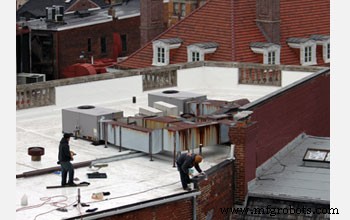
A construction crew paints a white roof in downtown Washington, D.C.
Credit and Larger Version
Equipment Maintenance and Repair
- Smart Cities: Delivering Tangible Benefits Through Proven Connectivity Solutions
- Mastering Condition‑Based Maintenance: Language, Strategies, and ROI
- May 2019 Maintenance Insights: Fiix News & Global Trends
- Reliable 24/7 Cooling with Baldor Ammonia Compressor Motors
- Why Your Monitor May Need Repair: Common Issues and Solutions
- When to Retrofit Your CRT Monitor for Superior Performance
- Binary Switch Game – Arduino UNO Project
- Mastering Job Shop Bidding: Avoid Common Quoting Pitfalls
- White Paper: Rittal's Industry 4.0 Philosophy – Shaping Future Manufacturing
- 12 Signs Your Diesel Engine Requires an Overhaul