



Mastering Condition‑Based Maintenance: Language, Strategies, and ROI
The most effective maintenance strategy is tailored to each asset, not a blanket approach. By analyzing each piece of equipment, organizations can chart a path that delivers the greatest reliability and ROI. Today, maintenance professionals increasingly rely on predictive maintenance (PdM) and condition monitoring (CdM) to navigate this journey.
To navigate the maintenance landscape, we must first use the right terminology. PdM and CdM are techniques and tools that operate within a condition‑based maintenance (CBM) strategy. These tools detect symptoms of impending failures; they are not strategies themselves.
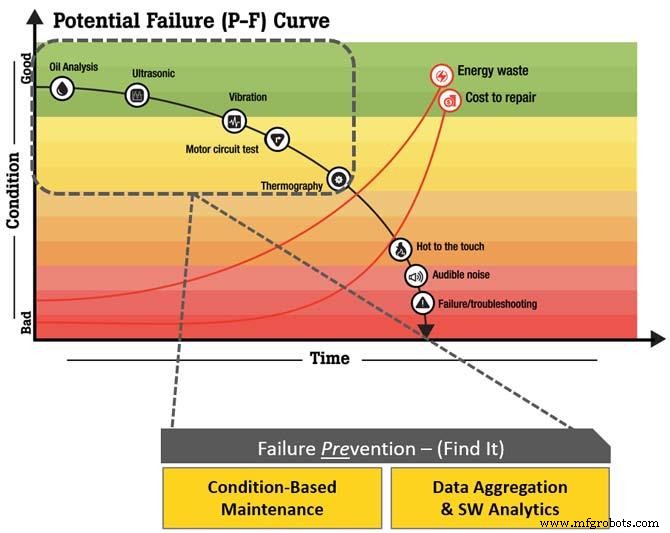
CBM aggregates data from PdM and CdM to identify the optimal moment for maintenance, mitigating conditions that lead to failure.
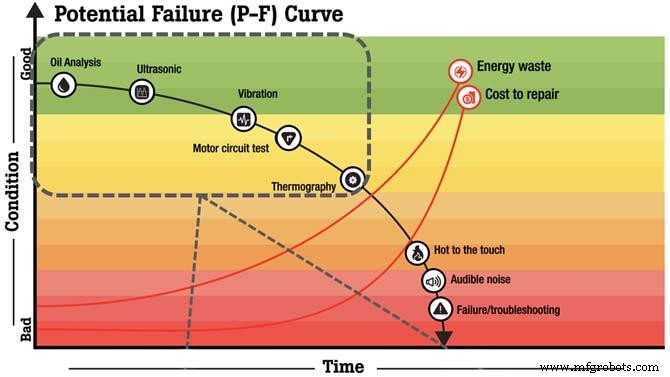
The objective of CBM is to keep each asset available when needed while avoiding maintenance that is too early or too late on the P‑F curve. The goal is to shift left on the P‑F curve by detecting potential failures sooner.
Finding that ideal maintenance window has long challenged practitioners.
Adopting an Industry 4.0 (IIoT) Mindset
Until recently, maintenance decisions were a blend of time‑directed schedules and run‑to‑failure approaches. Human observation and post‑failing data were the primary sources of insight.
Facilities often waited for a motor, pump, or conveyor to fail before intervening— the only viable option when tools and data were scarce.
The rise of automation and digital data during Industry 3.0 introduced computerized maintenance management system (CMMS) software, enabling a digitized, time‑based preventive maintenance (PM) schedule for each asset.
Maintenance teams measured key indicators to anticipate failures, then scheduled downtime to repair or replace components on a set schedule (often OEM‑specified), regardless of actual condition. This reduced failure rates but added labor, downtime, and unnecessary replacements.
Today, with Industry 4.0 and IIoT, many facilities leverage real‑time (or near real‑time) asset condition data to optimize maintenance activities.
CBM captures data from sensors, handheld diagnostics, SCADA, and other acquisition systems. The data is aggregated, analyzed, and translated into actionable intelligence via a CMMS, which directs resources where they are most needed. Maintenance teams shift from firefighting to digital process optimization.
Predictive Maintenance vs. Condition Monitoring: What’s the Difference?
Both PdM and CdM use technology to capture asset condition data, and both operate fully within the maintenance environment. The differences are subtle; they are complementary. Most robust programs combine both to deliver a comprehensive reliability picture.
Together, PdM and CdM provide the empirical data needed to allocate maintenance resources efficiently and profitably.
Predictive Maintenance
PdM tools—thermography, vibration analysis, oil analysis, ultrasonic measurement—capture a snapshot of asset health. Because the data is time‑specific, it must be contextualized with operational data such as runtime and load conditions.
PdM does not predict exact failure times or lifespan. Instead, it supplies observation data that informs more accurate, cost‑effective maintenance scheduling, improving availability and capacity assurance.
Condition Monitoring
CdM tools collect continuous health data via sensors and acquisition systems, ideal for hard‑to‑reach or hazardous assets. Sensors detect bearing vibration, overheating, or power quality issues without exposing personnel to risk or requiring downtime.
Data can be collected from seconds to days. The IIoT, sensor advances, and falling costs are creating exponential data growth. Applying AI and machine learning to this trend data helps pinpoint the optimal point on the P‑F curve for preventive action.
Mitigating Random Failures
Random failures arise from unknown causes. PdM and CdM excel at uncovering the root causes of these events.
Maintenance teams must examine vibration, thermography, power quality, and other signals to identify failure precursors. Relying on repetitive time‑directed inspections can drain resources.
With PdM and CdM, organizations can classify failures accurately, resolve root causes, and implement the correct mitigation strategy, transforming “unknowns” into predictable maintenance windows and extending MTBF.
Developing an Effective Preventive Action Strategy
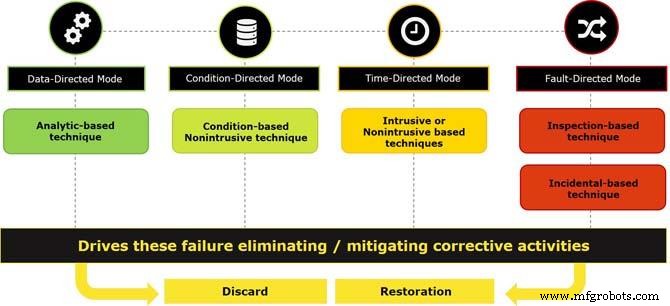
Maintenance evolution moves from time‑directed to condition‑directed to data‑directed approaches. Not every asset follows the same path; strategy choice depends on criticality and cost.
Most facilities adopt a hybrid preventive plan that blends time‑directed, condition‑directed, and data‑directed methods. The key is selecting the right mix.
While time‑directed PM has waned, it remains effective for tasks such as scheduled replacement of high‑risk components in mission‑critical environments—oil & gas, nuclear power, etc. In these contexts, combining CBM with data‑directed maintenance is preferred.
Decisions should consider asset criticality, budget, and the availability of human and technical resources. Deploying PdM and CdM only when they outperform simple time‑directed or run‑to‑failure methods ensures cost‑effective maintenance.
Data collection frequency must match the failure mode. A bearing with a six‑month P‑F curve may only need weekly monitoring, whereas the same bearing in a nuclear plant demands constant surveillance.
Key Considerations in Designing an Effective Maintenance Strategy
Choosing the optimal strategy is both a financial and logistical decision. Keep these factors in mind:
- Assess whether replacing an asset periodically is cheaper and faster than scheduled inspections.
- Identify assets whose criticality justifies the cost of condition monitoring.
- Remember the distinction between strategies and techniques & tools:
- CBM, RCM, RBM, DOM, and RTF are strategies.
- PdM and CdM are techniques & tools used within the CBM strategy.
- Time‑directed, condition‑directed, and data‑directed classify procedural tasks in a preventive action plan.
- Reliability tools like FMEA and FMECA guide strategy selection and procedural steps to mitigate or eliminate failure causes.
Ultimately, you must balance two returns on investment: traditional efficiency gains and the ROI of integrity—maintaining asset availability and capacity assurance. The tools, techniques, and strategies you choose must support that mission.
About the author
Gregory Perry, CMRP, CRL, is a Senior Capacity Assurance Consultant at Fluke Reliability. A Certified Reliability Leader with nearly two decades of experience in maintenance and operational best practices, he specializes in MRO, storerooms, world‑class maintenance principles, and CMMS leadership. Perry delivers implementation and consultative services, presents best‑practice sessions at leading industry conferences, and authors webinars on maintenance excellence.
Equipment Maintenance and Repair
- Modernizing Facilities Management: Key Trends for a 40% Construction Growth
- Maximizing the Impact of Condition‑Based Maintenance: A Practical Guide
- Condition‑Based Maintenance: The Definitive Guide to Predictive Asset Care
- GE and Boeing Introduce Industry‑Standard OSA‑CBM for Condition‑Based Aircraft Maintenance
- Mastering Multi-Technology Condition Monitoring for Large Mining Operations
- Avoiding Common Pitfalls in Condition Monitoring for Factory Maintenance Success
- IoT for Predictive Maintenance: Proactive Strategies to Cut Downtime and Costs
- Condition‑Based Maintenance Explained: A Practical Guide for Reliable Asset Management
- Condition‑Based Monitoring: Key Benefits & Practical Tips for Proactive Maintenance
- Why Implement Condition‑Based Maintenance? Boost Asset Performance & Reduce Downtime