



Asset Tracking Best Practices: Unlocking the Value of Your Asset Data
Today’s asset‑tracking technology gives us unprecedented insight into equipment performance, cost, and safety. The volume of data can feel overwhelming—almost like a tsunami that threatens to drown your organization if not handled correctly.
Yet, when harnessed effectively, this data transforms routine maintenance into strategic decision‑making. Unfortunately, many teams spend up to 80% of their time simply collecting, cleaning, and organizing information rather than acting on it.
In this guide we present proven best practices for asset tracking and offer actionable tips for turning raw data into measurable business value.
Table of contents
- What is asset tracking?
- Asset tracking metrics: What you should measure
- Asset tracking tools
- The PDCA model: Bring the data to life
- Using the data to design with reliability in mind
- Learn to love the numbers: Why asset tracking matters
What is asset tracking?
Asset tracking is the systematic monitoring of a fixed asset’s usage, performance, and cost—think of a bottling machine or a heavy‑machinery asset.
Today’s asset‑tracking technology gives us unprecedented insight into equipment, but the sheer volume of data can feel like a tsunami when you get too close.
Fiix solutions engineer Jason Afara, who spent years as a maintenance manager, frames asset tracking as a way to quantify the financial impact of maintenance:
“I looked at asset tracking as a method to measure the performance of my fixed, production‑intensive assets,” says Jason.
“My goal was to see how maintenance—downtime, labor, parts—translated into financial outcomes, ultimately keeping assets healthy and budgets accurate.”
This focus marks a pivotal shift toward a data‑driven asset management program. The metrics you track influence parts inventory, process design, and strategic planning.
Asset tracking metrics: What you should measure
The first step is clarity: identify the information that drives value for your organization.
Below are broad KPI categories to guide your selection—tailor them to your specific facility.

Safety
Safety remains a core discussion point in nearly every maintenance meeting.
Traditional safety metrics focus on incident counts and lost hours, but additional indicators reveal proactive risk management:
- Percentage of safety audits completed on time
- Percentage of sub‑standard conditions identified and corrected
- Percentage of employees with adequate safety training
Tracking these metrics per asset improves uptime, onboarding, and audit compliance, fostering a safer, more efficient environment.
Costs
“Money is the universal language,” says Juan Ruiz, operations manager at a manufacturing plant.
Aligning asset data with financial outcomes helps justify investments. Start with downtime analysis, then drill into root causes.
Key metrics include:
- Mean Time Between Failure (MTBF)
- Mean Time to Repair (MTTR)
These figures illuminate where to focus maintenance efforts and cost‑saving opportunities.
What’s the ROI of maintenance software? We calculated it.
See the results
Throughput and Quality
Balancing production quantity, quality, and cost is critical. OEE—Overall Equipment Effectiveness—provides a comprehensive view of availability, performance, and quality.
OEE helps identify underperforming assets and informs purchasing decisions. A replacement machine should exceed the OEE of its predecessor.

Asset tracking tools
Integrating diverse systems—sensors, CMMS, ERP—transforms raw data into actionable insights.
“The biggest challenge is data overload; you need to sort, verify, and act on it,” says Joe Kuhn, owner of Lean Reliability.
Equipment maintenance logs
Maintenance logs are an often‑underutilized data source. Best practices include:
- Use a standard log template for every asset to establish consistency.
- Store logs in a centralized, cloud‑based CMMS to prevent loss and ensure accessibility.
- Exchange logs during shift changes to maintain continuity and safety.
Six ways you can use equipment maintenance logs to make data‑driven decisions


Maintenance software and technology
While a full taxonomy is beyond this article’s scope, here’s a concise snapshot of the main categories:

CMMS software centralizes asset and work records, enabling planning, tracking, and optimization.

EAM software provides a holistic lifecycle view—from procurement to disposal.
APM solutions integrate IoT and AI to boost reliability and availability.

ERP software unifies transactional data across business units.
MES technology manages production floor activities for quality and cost efficiency.
Data collectors (SCADA, PLCs, sensors) monitor real‑time asset data and log events.
When selecting and deploying asset management software, keep these principles in mind:
- Tools are only as good as the people and processes behind them. Without a culture that turns data into action, technology yields little ROI.
- Integration is critical. Disconnected systems generate incomplete data and dilute insights.
The PDCA model: Bring the data to life
Applying the Plan‑Do‑Check‑Act cycle to asset tracking ensures continuous improvement.
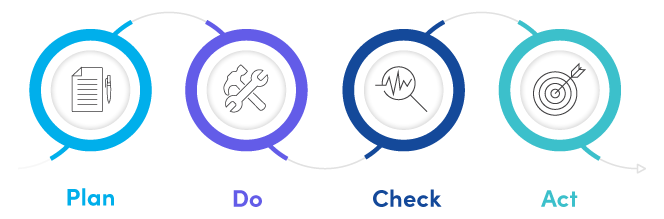
Plan
Develop a roadmap that aligns maintenance and asset performance goals with business objectives.
Key planning elements:
- Preventive maintenance schedules and work orders
- Audit and compliance tasks
- Inventory purchasing plans
- Scheduled equipment upgrades
- Hiring and training plans
Achieve liftoff on a preventive maintenance strategy
Get your 8‑step guide
Do
Execute the plan. Reliable tools and processes provide a baseline for evaluation.
Check
Periodically verify that:
- Planned actions are being performed.
- Recorded data matches reality.
- Outcomes meet expectations.
Automated daily reports keep stakeholders informed. In‑person audits further validate data integrity.
Identify red flags in safety, cost, throughput, and quality KPIs, then trace them back to maintenance metrics. Determine whether the frequency of PMs or condition‑monitoring baselines need adjustment.
Act
Respond with one of four strategies for each plan element:

Eliminate ineffective tasks.
Modify tasks to improve outcomes.

Optimize tasks for further gains.

Celebrate victories and plan the next cycle.
Example of PDCA method on a conveyor
Monthly inspection of the conveyor is planned and scheduled.
Work orders are assigned to a technician, who completes the inspection on time.
The maintenance manager and technician assess effectiveness: Are the correct parts used? Are safety protocols followed? Is the PM preventing early failure?
The inspection routine is refined—adjusting instructions, frequency, or tools—to improve efficiency.
Using the data to design with reliability in mind
Data‑driven insights can reshape equipment design. When Juan’s team analyzed faults on a replacement machine, they discovered that 20% of failures caused 80% of downtime. The analysis pinpointed defective parts that limited product compatibility.
Redesigning with those parts in mind extended the asset’s lifecycle, reduced maintenance effort, and improved availability and quality.
For deeper guidance, read Plant Services’ article by Certified Reliability Engineer Michael Blanchard on leveraging asset data for design and lifecycle management.
Learn to love the numbers: Why asset tracking matters
Acquiring clean, actionable data is an investment in time and effort. By establishing the right metrics, tools, and processes, you free up resources to focus on decision‑making that drives maintenance success and organizational performance.
Equipment Maintenance and Repair
- Unlocking IoT Data: How Business Rules Management Drives Enterprise Value
- Audit Your Preventive Maintenance Schedule to Maximize Team Efficiency and Cut Costs
- Industrial Internet: Revolutionizing Asset Management Through Connectivity, Analytics, and User Experience
- Maximize Your Manufacturing Day Experience: Expert Tips & Strategies
- Maximize Efficiency: Proven Carton Coding Best Practices
- Optimize Your Supply Chain for Resilience and Efficiency Today
- Maximize Efficiency: Expert Tips for Your Warehouse Scanning System
- Turn Data into Gold: Proven Strategies for Leveraging Your Organization’s Most Valuable Asset
- Top 4 Fixed Asset Tracking Best Practices for Business Efficiency
- Maximize Warehouse Efficiency: Proven Strategies to Optimize Space & Boost Profits