



Idle Time: What It Is, How to Measure It, and Proven Strategies to Reduce It

In manufacturing and workforce management, “idle time” is a key indicator of productivity.
Reducing idle time can directly improve a company’s profitability, but first you must understand what it is and why it matters.
In this article, we’ll define idle time, explain how to calculate it, identify the most common causes, and share actionable steps to minimise it.
What Is Idle Time?
Idle time refers to periods when an asset—whether a machine or a person—is ready and available but not performing productive work. Because the asset is simply waiting, idle time is often called waiting time.
Examples include:
- A machine waiting for raw material.
- An office employee waiting for an internet connection.
- A construction truck stalled while an excavator moves it to the next site.
- A maintenance technician waiting for a spare part before finishing a repair.
Tracking idle time reveals the gap between actual output and the theoretical maximum. Every minute of idle time is a minute of lost productivity.
While 100 % efficiency is unattainable, the goal is to minimise idle time rather than eliminate it entirely. Complete elimination is realistic only in fully automated, closed systems.
Idle Time vs. Downtime
Idle time does not equal downtime. The difference lies in the cause of the stoppage.
Idle time occurs when an asset is capable of working but is not doing so because of external factors:
- No raw material available.
- Waiting for a downstream machine to finish.
- Process or workflow inefficiencies.
- Production throttled to prevent over‑inventory.
- External technical issues such as power outages.
Downtime, on the other hand, happens when the asset cannot operate because of:
- Scheduled maintenance – planned work to keep the equipment in good condition (sometimes called normal idle time).
- Unexpected failure – a breakdown that requires repair before the asset can resume work (often termed abnormal idle time).
Thus, idle time means the asset can run but isn’t, whereas downtime means the asset cannot run because it can’t. Maintenance teams should record planned and unplanned downtime separately from idle time.

How to Calculate Idle Time
Idle time is the difference between scheduled operating time and actual productive time.
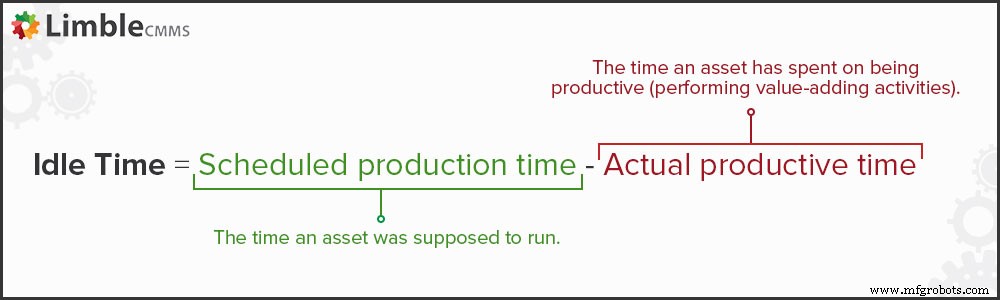
For example, an 8‑hour shift with 7 h 20 min of productive work equates to 40 min of idle time.
For machinery, you must also account for startup, shutdown, cleaning, and shift‑change pauses. Suppose a machine is scheduled to run 16 h. After deducting 10 min to power up, 5 min to shut down, a 30‑min cleaning break, and a 15‑min shift change, the machine’s net productive window is 15 h (900 min).
If the machine idles 5 min each hour waiting for material (75 min), loses 10 min to an extended shift change (15 min), and stops 40 min because a preceding machine breaks down, the total idle time is 125 min.
Zero idle time is rarely desirable; some idle periods are necessary for safety checks, operator breaks, or machine cooling. The focus should be on eliminating unplanned idle time caused by inefficiencies or breakdowns.
Common Causes of Idle Time
- Worker inefficiencies – Humans differ in skill and stamina. New hires need onboarding, and all employees benefit from a culture that encourages shared responsibility.
- Process & workflow inefficiencies – Bottlenecks, approval delays, or missing tools hinder production. Streamlining processes reduces idle time.
- Faulty equipment – Unexpected breakdowns erode productivity. Proactive maintenance and CMMS systems help catch issues early.
- External disruptions – Accidents or natural disasters are hard to avoid; preparedness and contingency planning mitigate their impact.
How to Reduce Idle Time
Before diving into tactics, ask: “Do we really want zero idle time?” For employees, a 50‑90 minute work block with 5‑20 minute breaks balances focus and rest, preventing burnout and sustaining productivity. Machines, while not tired, can suffer wear if operated continuously. Allowing brief idle periods for cooling can extend equipment life.
High idle rates harm long‑term profitability by wasting labor, fuel, and capital. Below are proven strategies to lower idle time and boost output.
#1) Optimize Your Workflow
Workflow inefficiencies are a leading cause of idle time. Start by implementing a system that records productive vs. non‑productive time.
For staff:
- Design balanced schedules that align tasks across teams.
- Eliminate redundant administrative steps (pre‑approvals, duplicate data entry).
- Document clear SOPs for routine tasks.
- Ensure immediate access to tools and resources.
- Adopt lean principles to remove waste.
For machines:
- Arrange equipment so that outputs flow naturally to the next stage.
- Maintain an adequately staffed operating team.
- Maximise asset utilisation by scheduling maintenance during low‑impact windows.
#2) Keep Your Assets in Peak Condition
Damaged equipment never reaches full productivity. Maintain assets proactively:
- Schedule preventive maintenance on critical machines.
- Use condition‑monitoring and autonomous alerts to detect degradation early.
- Source high‑quality raw materials.
- Minimise the use of improvised parts; prefer OEM replacements.
- Deploy a mobile CMMS to track and enforce timely maintenance.
#3) Improve Information Flow
Organisations that struggle to adapt often suffer from rigid, slow decision paths. Reduce administrative delays by:
- Removing unnecessary middlemen and defining clear responsibilities.
- Creating direct communication channels between interdependent teams.
- Leveraging digital tools—CMMS, project management, and workflow software—to automate approvals and generate real‑time reports.
Identify, Drill Down, Correct
Pinpointing the root cause of idle time is the first step to solving it. Ask whether idling stems from process gaps, equipment limitations, input quality, or a mix of factors. Once the cause is clear, targeted interventions can deliver measurable ROI.
Equipment Maintenance and Repair
- Retrieve Current Date and Time in Python: A Practical Guide
- Wrench Time: Definition, Importance, and Measurement
- Deferred Maintenance: Definition, Costs, and Strategies to Control Backlogs
- Understanding Welding Fumes: Hazards & Effective Reduction Strategies
- Understanding Welding Spatter: Causes and Effective Reduction Techniques
- Cut Setup Time to 15 Minutes: Proven Strategies for CNC Shops
- Cut Idle Time, Boost Profits: Proven Strategies
- Cut Downtime, Boost Productivity: Proven Strategies
- Accelerate Development and Boost Revenue with Effective Application Lifecycle Management
- Understanding Welding Fume: Hazards and How to Safely Reduce Exposure