



Step-by-Step Guide to Crafting Durable Silicone Molds at Home
Molds — negative impressions of parts that can be filled with material — are an integral part of manufacturing. In fact, the majority of the world’s plastic parts are made via injection molding.
But while metal injection molds are expensive and can only be made by professionals, flexible silicone molds are highly affordable and can be made at home or in the office. And they have myriad uses, from professional-quality vacuum casting of prototypes to low-volume wax casting for jewelry making, to at-home applications like baking and confectionery making.
This article looks at the relatively simple process of making a silicone mold, discussing its applications and advantages for both professional and personal use, as well as offering tips on silicone mold making at home.
What is a silicone mold?
Mold is a kind of container with a hollow cavity. In most cases, a liquid material can be poured or forced into the container and then hardened (by cooling or another method), making a solid object in the shape of the mold cavity.
Molds can be made of different materials like tool steel or aluminum. They can also be made from silicones, a group of polymers made up of siloxane that is sometimes used to make products like flexible protective casings, gaskets and contact lenses.
Silicone molds are not as durable as metal ones, but they are affordable, easy to make and highly flexible. This flexibility, coupled with the fact that few materials adhere to silicone, makes it easy to remove molded parts from within the silicone mold.
How to make a silicone mold
Making a silicone mold is surprisingly simple and requires only a handful of components. And while professional equipment gives you more options, there are also plenty of at-home uses for silicone molds.
The components needed to make a silicone mold are:
Liquid silicone: Silicone for mold making is widely available and usually comes in two parts that must be mixed together immediately before use.
A container: The liquid silicone is poured into a container, which should be larger (but not much larger) than the master pattern. In many cases, a new and suitably sized box can be made on demand using e.g. wood or cardboard.
A master pattern: The master pattern is the original object that you will duplicate using the silicone mold. A master pattern can be an existing object like a plastic toy, or a newly made item fabricated using e.g. a 3D printer.
Mold release: Mold release is a spray-on liquid used to prevent the mold from sticking to the watertight container and also to prevent casting materials from sticking to the inside of the mold. (It should not be used for applications like making food products.)
Casting material: The material poured into a silicone mold can be anything from polyurethane to melted chocolate.
Clay (optional): Clay is only required when making a two-part mold.
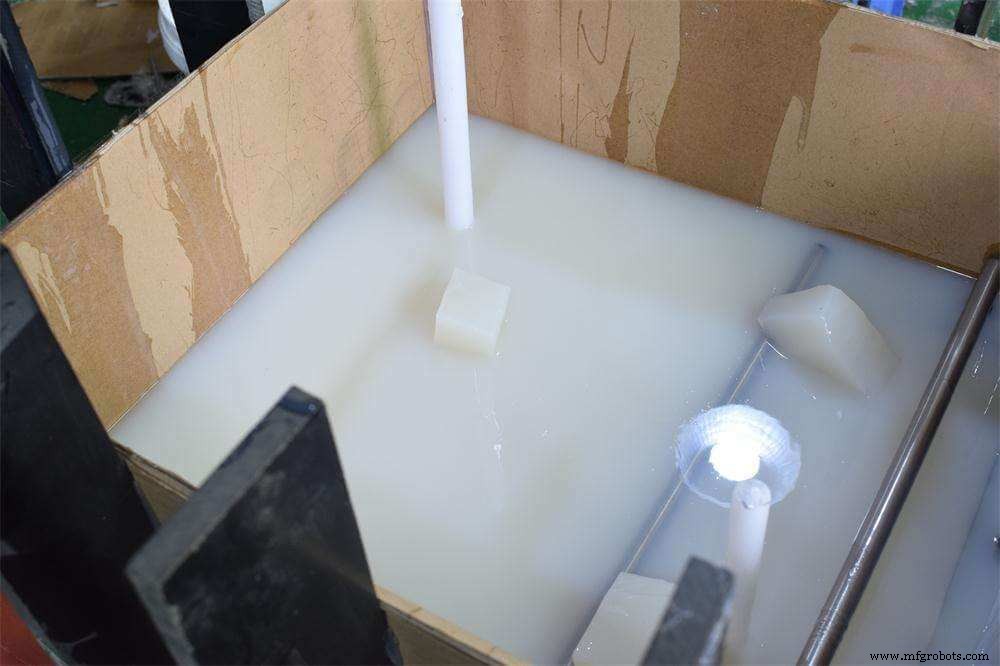
The silicone mold making process is as follows:
- Obtain or make the master pattern: The master is a positive original of the parts you will make with the silicone mold. This can be an existing solid object or a new item made with manufacturing equipment. (See next section.) For best results, the master should not contain complex cavities or overhangs.
- Lay the pattern(s) in the container: In many cases, a container is made specifically for the pattern. The box container can be made from e.g. wood or cardboard. After applying mold release to the inside of the container, place the patterns flat side down in the container or suspend them within the newly made container. If you have multiple patterns (for making a popsicle tray, for example), spread them out evenly. Spray them with mold release. If you are making a two-part mold, half of the container should be filled with clay and the patterns inserted half-way into the clay.
- Mix and pour the silicone: Mix the two silicone components according to the instructions on the bottle, then pour it slowly into the container. The surface level should rise half an in inch above the top of the master pattern to prevent the mold from tearing. Curing can take several hours (specific times may be specified on the silicone bottle). For professional applications at 3ERP, we remove air bubbles, then cure the silicone mold in an oven at a medium temperature.
- Remove the cured mold: Once it has fully cured, the silicone mold can be gently removed from the container. If you are making a two-part mold, you should remove the clay, leaving just the mold with the pattern still half sticking out. Return the mold to the container the other way up, so the pattern is protruding upwards. Apply mold release to the mold and pattern, then fill the other half of the container with silicone like in Step 3, wait for curing, then remove.
- Remove the master pattern from the mold: Gently remove the master pattern(s) from the silicone mold. If you are making a two-part mold, you will first have to separate the two halves of the mold.
- Cast the parts: Depending on your casting material, casting your parts may be as simple as applying for mold release then pouring liquid into the mold. Professional processes like vacuum casting involve inserting the silicone mold into a machine that removes air bubbles from the casting material.
3 ways to make a master pattern
Master patterns define the outcome of silicone molding, so it is important to obtain or manufacture a high-quality, detailed pattern that can be easily molded. It is also important to make a pattern with a long lifespan if multiple silicone molds are required — for small-batch production using vacuum casting, for example.
If making a pattern from scratch, there are three different methods that can be used.
Master pattern method I: Manual
Non-digital technologies have been used to make patterns for millennia. For this method, we can use a soft material like clay to sculpt a pattern by hand and with manual cutting tools. Specialists may also carve patterns from wood or other materials.
Advantages:
- No expensive machinery required
- Ideal for duplicating artwork and artisanal items
Disadvantages:
- Can be inaccurate
- Specialist manual skills required
Master pattern method II: 3D printing
Digital technologies and CAD software have made pattern making much much more efficient and accessible to non-specialists. 3D printers, especially high-resolution Stereolithography machines that create smooth surfaces, are now widely used to create masters.
Advantages:
- Uses digital files (can be downloaded from the internet)
- Accurate and repeatable
- Printers can be used in a non-industrial setting
- Minimal post-processing if using SLA
Disadvantages:
- Expensive machinery
- Cannot meet tightest tolerances
- Very short lifespan of pattern due to brittle resins used
Master pattern method III: CNC machining
CNC machining is another digital manufacturing technology used to create master patterns. With CNC machining, highly durable materials can be used, resulting in stronger and longer-lasting patterns. CNC machines can also meet much tighter tolerances, although they are less accessible to non-specialist users and cannot be used in home or office environments.
Advantages:
- Most accurate and precise
- Very long lifespan of patterns
- Compatible with heat-resistant materials
Disadvantages:
- Expensive and inaccessible machinery
- Some post-processing required
Professional uses for silicone molds
Low-volume manufacturers like 3ERP use silicone molds for various purposes. With the silicone molding process, we can do things like create molds of plaster statues and other handmade artworks, allowing them to be easily reproduced.
Making a silicone mold can also help us with other manufacturing processes. One of those is vacuum casting, in which silicone molds are filled with polyurethane within a vacuum environment to create high-quality plastic parts and prototypes. Vacuum casting is good for small-batch part production and is cheaper than injection molding in small quantities. Silicone molds have a lifespan of about 20 castings when used for vacuum casting, and for high-resolution parts we use a CNC machined master pattern.
Another use of silicone molds is for wax casting, an ancient technique used to make metal parts like jewelry and industrial pats. In lost wax casting (or investment casting), silicone molds are filled with melted wax to make wax copies of the master pattern. These wax models can then be coated with ceramic before being burnt away in a kiln. The remaining ceramic structure can then be used as a new mold, into which liquid metal can be poured to make new objects.
Making professional silicone molds in a manufacturing environment generally requires the use of specialist machinery like vacuum casting machines and ovens for silicone curing.
At-home uses for silicone molds
You don’t need a factory or shop to make use of silicone molds. Silicone for mold making is readily available, and by following the instructions to make a silicone mold you can create molds for several at-home uses.
Casting resins are commercially available and are safe to use in everyday settings if instructions are properly followed. Anyone can therefore use a silicone mold to create things like artisanal figurines, plastic jewelry, soaps, candles and other decorative items.
Another common use of silicone molds is in food and drink. Silicone is safe to put in the fridge, freezer, microwave and oven, which makes it a highly valuable material for many kitchen applications. (Many kitchen utensils are made from silicone.) Silicone molds can be used as a popsicle and ice cube trays, cookie/cake molds and for making decorative chocolates and candies.
Making a silicone mold is also great for children’s activities. You can use them to make, for example, colorful crayons, chalks and erasers.
Advantages of silicone molds
Silicone molds are highly effective for many reasons. They are:
Durable: Silicone molds can be used several times before they degrade, especially if they are thick and used in non-demanding applications.
Flexible: Because silicone molds are rubber-like, it is easy to remove cast parts without damaging the part or the mold itself.
Heat-safe: Silicone molds can be used in hot or cold temperatures without degrading or warping, making them suitable for applications like cooking.
3ERP is a prototyping and low-volume manufacturing specialist with years of experience in silicone mold making, vacuum casting, investment casting and much more. Get a free quote on your next project.
CNC Machine
- Building an Arduino‑Powered Robot with Raspberry Pi: A Step‑by‑Step Guide
- The Complete Guide to Fiberglass Production
- How to Make Fiberglass Reinforced Plastic Molds: A Step‑by‑Step Guide
- Expert Guide to Designing and Manufacturing Injection Molds
- Build a Stunning NeoPixel LED Matrix with Arduino Nano: Step-by-Step Guide
- Achieving Precision in Parts and Mold Cavities: A Practical Guide
- Build a Winning Prototype: Step‑by‑Step Guide for Rapid Product Development
- DIY Guide: Build Your Own DC Motor Controller
- Professional Silicone Mold Creation Using Vacuum Casting Techniques
- Master CNC Programming: A Beginner’s Guide to Fanuc Controls