



Expert Guide to Designing and Manufacturing Injection Molds
What Is an Injection Mold?
An injection mold is a precision‑engineered tool that, once fully assembled, fits into an injection molding machine to produce identical plastic parts. The process starts with a detailed engineering drawing of the part. An experienced moldmaker then translates that drawing into a mold layout, considering factors such as cavity geometry, cooling channels, and material flow.
How Injection Molds Are Fabricated
Creating an injection mold demands skilled craftsmanship and advanced machinery. Most molds are forged from high‑strength tool steel and machined to tolerance by CNC routers or lathes. The mold functions as the negative of the finished part and includes a runner system that directs molten plastic into each cavity, as well as heating and cooling channels that regulate temperature throughout the cycle.
During a typical injection cycle, roughly 10 % of the time is spent actually injecting the molten plastic. The remainder of the cycle is devoted to cooling, solidification, packing, and holding the part until it can be ejected.
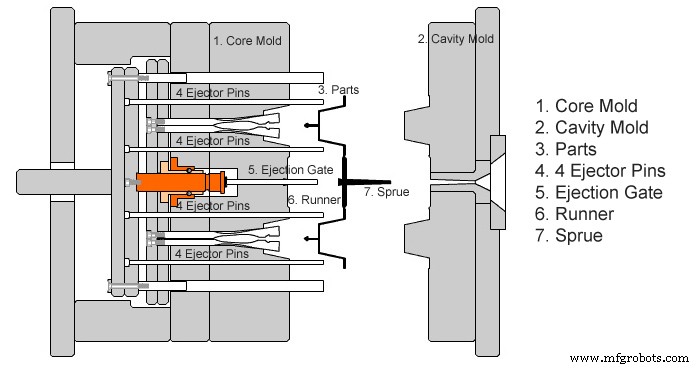
The simplest configuration is a straight‑pull mold with two halves: the “A” side, which forms the cavity, and the “B” side, which forms the core. More complex geometries often require additional components such as inserts or multi‑shot tooling.
Key Components of an Injection Mold
The mold designer will decide whether the part needs an insert tool or a free‑standing mold. For free‑standing molds, manufacturers commonly source pre‑made bases from global suppliers like Misumi, DME, or Hasco.
A complete mold typically contains:
- Cooling lines to manage heat distribution
- A runner system (sprue, runner, gate) to guide material flow
- Sprue and gate channels for precise injection
- Threaded eye bolts and guide pins that secure the mold to the machine and maintain alignment
Ejection Techniques
Once the plastic has solidified, the part is removed using ejection pins, sleeves, or, for more complex shapes, ejector plates or air‑pressure systems.
EDM (Electronic Discharge Machine) in Mold Making
When a cavity geometry cannot be achieved through conventional milling, a graphite or copper‑tungsten electrode is shaped on a CNC machine and then submerged in an EDM bath. The EDM erodes the tool steel to match the electrode’s profile. Two EDM variants exist:
- Sinker EDM – creates a cavity by blasting material.
- Wire EDM – cuts intricate shapes with a thin brass wire.
The Runner System Explained
The runner system directs molten plastic from the machine nozzle into the mold cavities. It consists of three primary components:
- Sprue – connects the nozzle to the runner.
- Runner – channels material toward the gates.
- Gate – opens into each cavity, allowing plastic to fill.
Vent channels may also be incorporated to release trapped gases during filling.
Injection Molding Machine Overview
An injection molding machine comprises a loader, a reciprocating screw, a barrel, a nozzle, and a platen. The cycle begins by drying polymer granules to eliminate moisture. The granules are then heated in the barrel to their melting point. A large screw transports the molten plastic to the nozzle, which injects it into the mold mounted on the platen. After cooling, the mold opens and ejector pins eject the finished part. Typical cycles run every 60–90 seconds.
Resin
- The Complete Guide to Fiberglass Production
- How to Make Fiberglass Reinforced Plastic Molds: A Step‑by‑Step Guide
- Injection Molding Explained: Expert Video & Practical Guide
- Precision Plastic Injection Molding: Efficient Production of Durable Components
- Achieving Precision in Parts and Mold Cavities: A Practical Guide
- Step-by-Step Guide to Crafting Durable Silicone Molds at Home
- Build a Winning Prototype: Step‑by‑Step Guide for Rapid Product Development
- DIY Guide: Build Your Own DC Motor Controller
- Professional Silicone Mold Creation Using Vacuum Casting Techniques
- Master CNC Programming: A Beginner’s Guide to Fanuc Controls