



Managing Delayed Deformation in CNC‑Milled Plastic Parts: Causes, Diagnosis, and Prevention
It Looks Fine After Machining, Then Changes Later
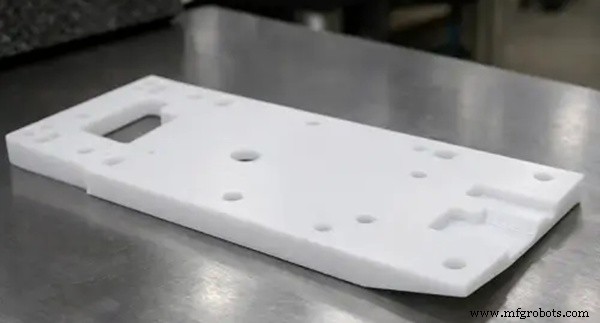
Unlike metals, plastics are not inherently rigid or dimensionally stable. They exhibit a clear time‑dependent response that can manifest long after machining.
During CNC cutting a part may sit in a temporary equilibrium state:
- While cutting, the fixture holds the material in place.
- Once machining ends, the external constraint is released.
- Over time, internal stresses begin to redistribute.
As a result, the part can gradually deform on its own, even in the absence of external forces.
This dimensional change typically appears in three forms:
- Warpage
- Dimensional shrinkage or expansion
- Local twisting deformation
Why Does the Deformation Appear Later?
Plastic parts often maintain their initial shape after machining, only to shift over the following hours or days.
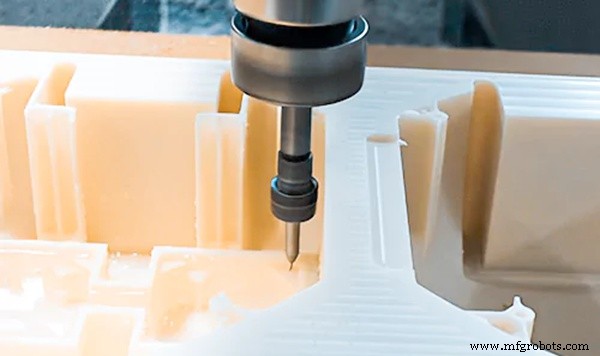
1. Residual Stress Release
Residual stress originates from two primary sources: the material’s own manufacturing history (e.g., injection molding or extrusion) and the machining process itself, which introduces tool pressure and friction‑induced surface stress.
During CNC cutting:
- Material is locally removed.
- The original stress balance is disrupted.
- Internal structures lose their constraints.
However, the remaining stress does not collapse immediately. Instead, the material undergoes a stress‑relaxation process where molecular chains slowly move and rearrange toward a new equilibrium over several hours or days. Typical outcomes include warpage, twisting, or local dimensional drift.
2. Molecular Chain “Memory Effect”
Polymers are long‑chain molecules. High‑speed CNC cutting can stretch, orient, or partially break chains near the machined surface—much like stretching a spring. Immediately after machining these chains haven’t fully responded, so the part temporarily holds its shape. Over time and with temperature fluctuations, the chains gradually return to their original curled state, causing shrinkage or deformation.
3. Thermal Expansion Aftereffects
Even with proper cooling, the cutting zone can reach temperatures approaching the melting point of POM or the glass transition of PMMA. The part’s temperature distribution is often uneven right after machining. When it fully cools to room temperature—sometimes taking several hours—dimensional changes may occur, especially in thick‑wall parts where heat dissipates more slowly.
4. Moisture Absorption Causing Volume Changes
Hygroscopic plastics such as PA absorb moisture from the air. After machining, moisture gradually penetrates the material, altering molecular spacing and slightly expanding the part. Uneven absorption—fast on the surface, slower inside—creates differential strain that can eventually lead to deformation.
5. Release of Machining and Clamping Stress
During machining, parts are clamped with significant force. The fixture’s constraint can mask actual deformation, and cutting may introduce additional residual stress. Once the part is removed, stress redistributes, the structure rebounds, and dimensions change. Thin‑wall parts and large flat structures are particularly vulnerable.
Solutions: How to Control Delayed Deformation?
The goal is not to eliminate deformation entirely but to manage the path and rate of stress release.
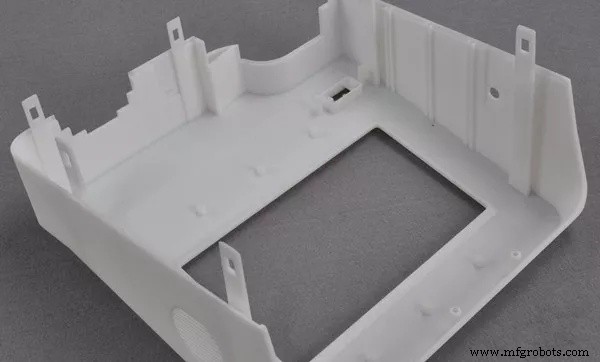
1. Choose Low‑Stress Materials or Stabilized Grades
Prioritize materials with minimal internal stress or those that have undergone stabilization treatments, such as:
- Annealed POM
- Stabilized PA
- Low‑stress PC grades
The inherent stability of the material largely determines the upper limit of potential deformation.
2. Employ Symmetrical, Step‑by‑Step Machining
Avoid removing a large amount of material from only one side. Instead, use balanced machining on both sides, layer‑by‑layer material removal, and avoid sudden loss of overall rigidity. These approaches reduce abrupt stress release.
3. Allow Time for Stress Stabilization After Rough Machining
After rough cutting, let the part rest at room temperature for 12–24 hours before performing finishing operations. This step can significantly reduce dimensional drift after delivery.
4. Control Cutting Heat and Machining Stress
Optimize parameters by:
- Using high spindle speeds with shallow cutting depths.
- Avoiding dull tools.
- Monitoring and limiting cutting temperature rise.
These measures minimize secondary stress introduced during machining.
5. Manage Humidity for Hygroscopic Materials
For PA and similar plastics:
- Store parts at controlled humidity.
- Condition moisture if necessary.
- Avoid exposing freshly machined parts to high‑humidity environments.
Proper moisture control can greatly improve dimensional stability.
Case Study: Delayed Deformation in a POM Structural Component
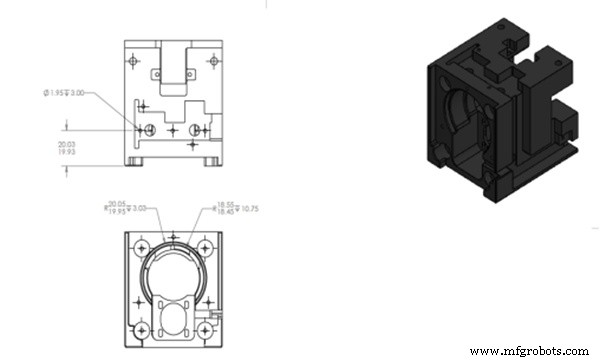
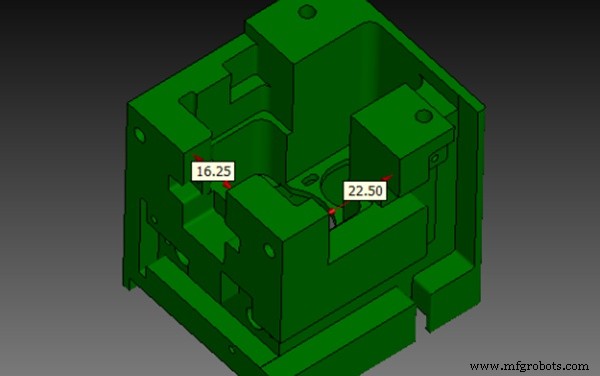
A structural part for automated equipment required tight tolerances:
- Material: Black POM
- Size: 66 × 66 × 72 mm
- Tolerance: ISO 2768‑MK
- Features: Flat surfaces with deep cavities and multi‑hole positioning.
- Application: Precision assembly positioning.
Initial Situation
Immediate post‑machining inspection revealed:
- Flatness met requirements.
- Hole position accuracy within tolerance.
- No abnormalities at delivery.
However, after 24 hours:
- The opening structure shrank inward by 0.2 mm.
- Hole alignment deviated during assembly.
- Batch consistency became unstable.
Initial Attempts (Ineffective)
The engineering team first suspected tooling issues and tried:
- Replacing cutting tools.
- Reducing feed rate.
- Increasing finishing passes.
Despite these adjustments, deformation persisted after 24 hours.
Root Cause Analysis
Further review uncovered:
- Residual internal stress in the raw material.
- Large material removal from one side only.
- Deformation hidden by fixture clamping during machining.
In effect, machining only temporarily restrained the deformation rather than eliminating the stress.
Final Optimization Strategy
Process changes included:
- Switching to double‑sided, step‑by‑step machining.
- Allowing a 24‑hour rest after rough machining.
- Using shallow cutting depths during finishing.
- Adding a final stabilization period before inspection.
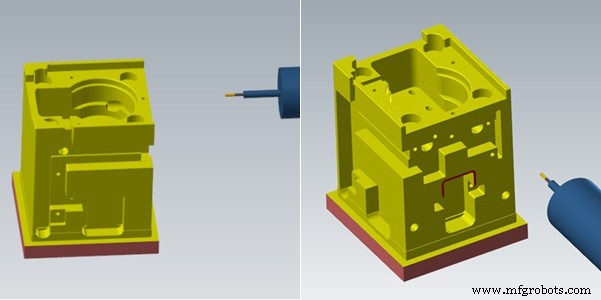
Final inspection was performed only after the part had stabilized in a temperature‑ and humidity‑controlled environment.
Final Results
Post‑optimization outcomes:
- Delayed deformation almost eliminated.
- Flatness remained within 0.1 mm.
- Batch consistency improved significantly.
Conclusion
Delayed deformation in CNC‑machined plastic parts is fundamentally a time‑dependent stress‑relaxation process rather than a machining accuracy problem. The most effective mitigation combines:
- Careful material selection.
- Optimized machining strategy.
- Controlled stress‑release timing.
The aim is to allow stresses to release before final finishing or inspection, preventing dimensional changes after delivery.
WayKen offers professional plastic CNC machining services for precision components with complex geometries and tight tolerances. Through optimized processes, stress‑control strategies, and stringent quality inspection, we help improve dimensional stability and reduce the risk of delayed deformation.
CNC Machine
- Season's Greetings from BDE Inc.: Wishing You a Merry Christmas & a Prosperous 2020
- Mantech UK: Comprehensive Support, Installation & Maintenance for Your Machines
- Expert Contract Manufacturing Services for Defense, Aerospace & Telecom
- How CNC Machines Can Drive Business Growth and Boost Efficiency
- Master Tool Setup on Sinumerik 808D CNC Lathe – Video Tutorial (Part 5)
- Maximize 2020 Tax Incentives: Claim Up to $1M Deduction on New & Used Capital Equipment
- Premium 1330mm Linear ATC CNC Router – Delivered to Australia
- Mastering the Wood Lathe: A Beginner’s Step-by-Step Guide
- 2020 ATC 4-Axis CNC Woodworking Machine Delivered to Houston
- Where to Purchase a CNC Wood Carving Machine – Trusted Sources & Expert Advice